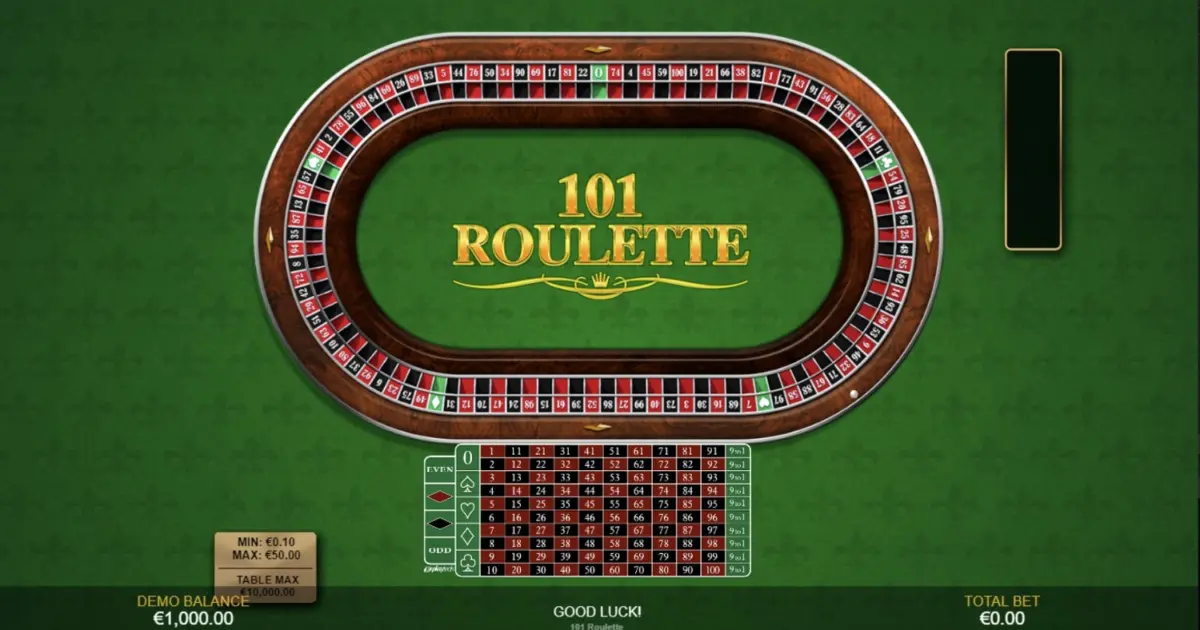
101 Roulette is an Origins (Playtech) table with a published RTP of 96.19% and a free demo you can load without depositing. That figure is 0.78 points below the 96.97% average across the roulette games in our index, and lower than the 96.64% average across Origins’ own eleven titles. The number does not tell you which wheel you are spinning, so the rules screen is your first stop.
Is 101 Roulette worth your spins?
It depends on what the return figure is attached to. A classic single-zero wheel returns 97.30% on every standard bet, and a double-zero wheel returns 94.74%. The 96.19% listed here falls between those two anchors, which usually signals one of two things: a paytable that has been reshaped to fund a feature, or a return averaged across bet types that do not all pay the same house edge.
FACTS does not tell us which. There is no pocket count here, no confirmation of La Partage or En Prison, no table limits, no racetrack or call-bet information, and no multiplier or side-bet detail. That absence matters, because on roulette the rules screen is the entire product. Two tables with identical names and identical graphics can differ by nearly three percentage points of expected loss purely on whether a second zero exists.
What you can rely on: the demo is free, so every unknown above is answerable in about ninety seconds of looking at the game’s own paytable and rules panel before any money is at risk. Do that first.
Origins (Playtech) and this wheel
Origins is Playtech’s in-house studio line, and this is one of eleven games from that provider in our index. Their catalogue average RTP is 96.64%, so 101 Roulette sits at the lower end of what the studio publishes rather than the middle.
If the return figure is your deciding factor, the same studio’s other tables are worth comparing directly. Classic Roulette (Origins) is listed at 97.30% — the textbook single-zero figure — and is the cleanest point of reference for what a standard European wheel from this studio looks like. Quantum Roulette and Spin Till You Win Roulette both list 97.31%, above the corpus average.
Ranked 182nd in our index and sitting in the 18.8th popularity percentile, 101 Roulette is not one of the heavily played tables. That is a traffic statistic, not a quality judgement, but it does mean fewer players have publicly documented the paytable, which is another reason to read the in-game rules rather than a forum post.
House edge: 2.70%, 5.26% or 1.35%?
Three numbers cover almost every roulette table in existence, and knowing which one applies is worth more than any strategy article you will ever read.
- 2.70% — a single-zero (European) wheel, 37 pockets. A straight-up number pays 35:1 when the true odds are 36:1. That one-pocket gap is the whole edge, and it applies identically to every standard bet on the layout.
- 5.26% — a double-zero (American) wheel, 38 pockets. The second zero nearly doubles your expected loss per spin. The five-number basket bet on this layout is worse again at 7.89%.
- 1.35% — French rules, meaning La Partage or En Prison. When zero lands, even-money bets return half the stake or are held for the next spin. This is the best standard bet available anywhere in the game, and it applies only to even-money bets, not to inside numbers.
The name “101 Roulette” points to no wheel family in particular. It carries no European, American or French signal, so you cannot infer the pocket count from the title. Combined with a 96.19% figure that matches none of the three standard returns, this is a table where guessing is genuinely useless. Open the rules screen, count the zeros, and check whether even-money bets are refunded on zero.
Bet types, payouts and true odds
Because the wheel type is unconfirmed, here are the figures we do know alongside the standard reference points you can measure the game against once you have seen its rules.
| Figure | Value | What it means |
|---|---|---|
| 101 Roulette RTP | 96.19% | Provider-published; 3.81% expected loss per unit staked |
| Origins catalogue average | 96.64% | Across 11 games; this table is 0.45 below |
| All roulette tables in index | 96.97% | This table is 0.78 below |
| European wheel reference | 97.30% | 2.70% edge, 37 pockets, all standard bets |
| American wheel reference | 94.74% | 5.26% edge, 38 pockets |
| French rules, even-money only | 98.65% | 1.35% edge with La Partage or En Prison |
| Free demo | Available | Rules and paytable checkable at zero stake |
| Table limits | Not published here | Check in-game before planning stake sizes |
Inside and outside bets change the shape of your session, not its expected value. A straight-up number produces long dry runs and occasional 35:1 hits; red-black produces near-coinflip swings. On a standard wheel both carry the same edge.
What experienced players actually do
They stake flat. Progressions — Martingale, Fibonacci, D’Alembert, waiting for five reds before backing black — do not change expected value by a single fraction of a percent. Spins are independent and the wheel has no memory; a number that has not landed in 200 spins is exactly as likely as any other on the next one. What progressions do is concentrate your risk: doubling after losses walks you toward the table maximum fast, and the ceiling is where the strategy stops working.
The genuinely useful decisions are small. Pick the lowest-edge bet the table offers, which means even-money bets if French rules are in play and otherwise any standard bet on a single-zero layout. Set a session length and a loss limit before the first spin, in cash, and stop at it rather than at a feeling. Size stakes so the table minimum is a small fraction of your session budget, which is why unpublished limits are worth checking in the demo.
Tracking previous results, on paper or via the on-screen history panel, has no predictive value on an RNG wheel. The display is decoration.
Free play before real money
The 101 Roulette free demo is the practical answer to everything this review cannot confirm. Load it, count the pockets, read the paytable for each bet type, look for a second zero, and check whether zero refunds half your even-money stake. Note the minimum and maximum bet. That is your real research, and it costs nothing.
Demo results predict nothing about real-money sessions — the RNG behaves identically, but a short run of spins tells you about variance, not about return.
Roulette is entertainment, not income. Play only if you are 18 or older, set a budget in cash before you start, and treat that figure as the cost of the session rather than a stake you expect back. If it stops being fun, close the table.
Final take
101 Roulette gives you one hard number and a lot of blanks. The 96.19% RTP is real, published, and below both the Origins average of 96.64% and the 96.97% figure across the tables we cover. Everything else that determines your per-spin cost — pocket count, zero handling, limits — sits behind a rules screen you can open for free.
If you want a known quantity from the same studio, the 97.30% and 97.31% tables listed above are the straightforward comparison. If you want to play this one, spend the ninety seconds in the demo first. On roulette the maths is fixed and public; the only variable is whether you bothered to look it up.
Frequently Asked Questions
Can I play 101 Roulette free with no download?
Yes. A free demo of 101 Roulette is available and runs in the browser, so no download or deposit is needed. Use it to check the details this review cannot confirm: the pocket count, whether zero refunds half your even-money stake, and the table minimum and maximum bet limits.
What is the 101 Roulette RTP?
Origins (Playtech) publishes 101 Roulette at 96.19% RTP, meaning an expected loss of 3.81% of everything staked over a long run. That is 0.78 points below the 96.97% average across the roulette tables in our index and 0.45 below the studio's own 96.64% catalogue average.
Which wheel is this and what is the house edge?
The name gives no clue, and FACTS does not confirm the pocket count. A single-zero wheel carries a 2.70% edge, a double-zero wheel 5.26%, and French rules cut even-money bets to about 1.35%. The 96.19% figure matches none of those, so check the game's own rules screen.
Does any betting system work on 101 Roulette?
No. Martingale, Fibonacci, D'Alembert and waiting for a colour streak all leave expected value untouched. Spins are independent and the wheel has no memory, so past results carry no predictive information. Progressions only reshape variance and push you toward the table maximum faster during a losing run.
Who makes 101 Roulette and how does it compare to Classic Roulette (Origins)?
Origins, Playtech's in-house studio, with eleven games in our index. Classic Roulette (Origins) lists 97.30% RTP against this table's 96.19%, a 1.11-point gap in published return. If the RTP figure is your deciding factor, the Classic table is the stronger listed number from the same provider.




