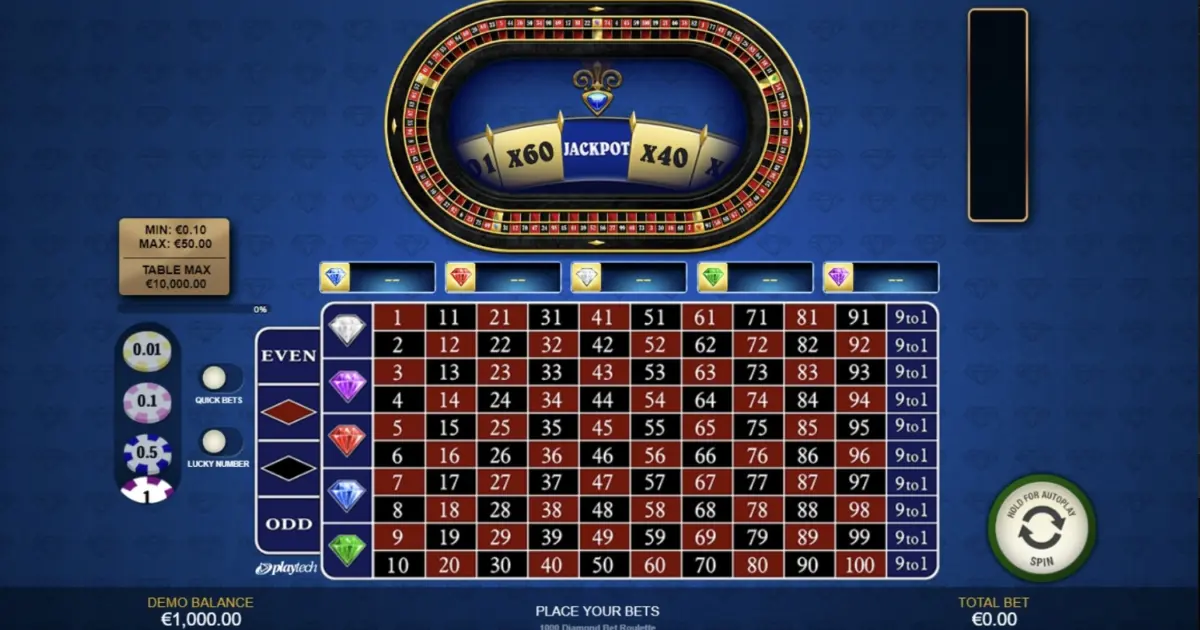
The one number worth leading with: 100 Diamond Bet Roulette is published with an RTP of 96.19%, which is below the 96.64% average across the eleven Origins (Playtech) tables in this corpus and 0.78 points under the site-wide roulette average of 96.97%. That figure alone tells you this is not the cheapest wheel in the provider’s range. Whether it still suits you depends on what the paytable actually does with your stake, and FACTS does not include that paytable — so this review tells you what to look for rather than pretending to know.
What kind of roulette is 100 Diamond Bet Roulette?
The title points to a multi-bet layout — “100” and “Diamond Bet” both suggest a large grid of pre-set bet combinations rather than a plain felt with red, black and the dozens. That is a hint from the name, nothing more. FACTS does not confirm the pocket count, whether a single zero or double zero sits on this wheel, whether La Partage or En Prison apply to even-money bets, or what the diamond-bet positions actually cover.
Those gaps matter, and they matter in a specific order. Pocket count sets the baseline house edge: 37 pockets means 2.70% on standard bets, 38 pockets means 5.26%, and there is no way to infer which from a game’s name. French rules, if present, would cut the even-money edge to roughly 1.35% — the best standard bet available anywhere in roulette. A multi-bet grid also usually redefines what a “bet” is, bundling several inside positions into one click at one stake.
Open the game’s own rules screen and note three things before your first real spin: the number of pockets, whether zero returns half your even-money stake, and exactly which numbers each diamond position covers. Everything else in this article is downstream of those three answers.
Return to player and house edge
The published RTP is 96.19%, meaning the game is modelled to return £96.19 per £100 wagered over a very long run of spins. Read it as a long-run average, not a session forecast. Over a few hundred spins your actual return can sit far above or far below it, and the figure says nothing about any individual outcome.
House edge is the same statement inverted: 3.81% of turnover, on this game’s own published figure. That is worth comparing against the textbook numbers. A single-zero wheel with no French rules runs at 2.70% flat across standard bets, so 3.81% is materially worse than a plain European table. A double-zero wheel runs at 5.26%, so 3.81% is better than that. The gap suggests the paytable does something non-standard — trimming a payout somewhere to fund the multi-bet structure is the usual mechanism in formats like this — but FACTS does not say which bets carry the cost, and neither should this page.
Within the Origins (Playtech) range the comparison is cleaner. Quantum Roulette is listed at 97.31% and Classic Roulette (Origins) at 97.30%, both from the same studio. On pure published RTP, this table costs you about 1.1 points more per unit wagered than either.
Reading the Origins (playtech) paytable before you bet
On a classic European wheel the maths is fully visible: a straight-up number pays 35:1 against true odds of 36:1, and that one-pocket shortfall is the entire 2.70% edge. Every other standard bet arrives at the same 2.70% by the same arithmetic. That predictability is what makes classic roulette easy to evaluate at a glance.
Multi-bet and multiplier formats break that uniformity. They typically reduce the base payout on some positions and hand the difference back through a feature, which means the edge is no longer identical across the layout. Some bets can end up notably worse than others. Since FACTS does not include this game’s paytable, you cannot assume any position on it pays a textbook price.
Practical approach: open the paytable, find each bet you intend to use, and write down what it pays and how many numbers it covers. Divide 36 by the covered count on a 37-pocket wheel to get the fair price, then compare. If a bet pays less than fair minus one pocket’s worth, it is carrying more than its share of the 3.81%. If the game groups bets into diamond positions, check whether the stake shown is per position or per number underneath it, because that changes your real cost per spin.
Bet coverage, variance and session length
Coverage changes how long your balance survives, not what it returns. Wider coverage means more frequent small wins and a slower, flatter decline. Narrow coverage means long dry runs punctuated by larger hits. Expected value is unaffected either way. The reference figures below are for a standard 37-pocket single-zero wheel, since this game’s own layout is unconfirmed.
| Bet | Numbers covered | Pays | True odds (37 pockets) | Win chance |
|---|---|---|---|---|
| Straight up | 1 | 35:1 | 36:1 | 2.7% |
| Split | 2 | 17:1 | 17.5:1 | 5.4% |
| Corner | 4 | 8:1 | 8.25:1 | 10.8% |
| Dozen / column | 12 | 2:1 | 2.08:1 | 32.4% |
| Red / black / odd / even | 18 | 1:1 | 1.06:1 | 48.6% |
Every row carries the same 2.70% edge on that reference wheel. If you want the longest session from a fixed budget, the bottom rows do that. If you want the chance of a large single result, the top row does that, and will usually cost you the balance faster. A multi-bet grid tends to push you toward covering many numbers at once, so watch your total stake per spin rather than the stake shown on any one position.
Patterns, hot numbers and the gambler’s fallacy
No betting system changes the expected return on any roulette wheel. Martingale, Fibonacci, D’Alembert, Labouchere, waiting for five reds before backing black — all of them redistribute variance and none of them touch the house edge. Martingale in particular concentrates a large loss into a rare event and runs into the table maximum exactly when you most need another double.
The reason is simple: spins are independent. An RNG wheel has no memory of the previous result, so a number that has landed four times in a row is neither more nor less likely on the next spin than any other. Calling numbers “due”, “hot” or “cold” describes the past and predicts nothing. Scoreboards and history panels are entertainment features.
What you can control is stake size, spin count and when you stop. Those genuinely determine how much you risk. The RTP determines the rest, and no sequence of bets alters it.
Trying the demo
A free demo is available for 100 Diamond Bet Roulette, and for a multi-bet format that is genuinely useful — not for testing a strategy, but for learning which diamond positions cover which numbers and what your real stake per spin becomes once you start filling the grid. Demo results do not predict real-money results; the maths is the same but your sample is tiny either way.
Roulette is 18+ entertainment, not income. Set a budget before you open the game, treat it as spent the moment you do, and stop when it is gone rather than raising stakes to recover it. If play stops feeling like entertainment, close the tab.
Worth doing alongside the demo: try Spin Till You Win Roulette at 97.31% from the same studio, so you can feel the difference between a feature-heavy grid and a higher-RTP alternative before committing real money to either.
Verdict on 100 Diamond Bet Roulette
The case against is the 96.19% RTP. Two Origins (Playtech) stablemates publish 97.30% and 97.31%, and if published return is your main filter, those are the better buys on paper. The case for is the format: a 100-position multi-bet grid gives you a way of covering the layout that a plain table does not, and some players value that structure enough to pay 1.1 points for it.
What you cannot judge from here is the detail. FACTS confirms no pocket count, no La Partage rule, no table limits and no paytable, so the 3.81% house edge is the only edge figure you can rely on, and you cannot know which bets carry it. Check the rules screen first, use the demo to map the grid, and go in with a number you have already decided you can lose.
Frequently Asked Questions
Can I play 100 Diamond Bet Roulette free with no download?
Yes, a free demo is available for 100 Diamond Bet Roulette and runs in the browser with no download. It uses play money on the same maths as the real-money version, so it is a good way to learn the multi-bet grid. Demo results do not predict real-money outcomes.
What is the 100 Diamond Bet Roulette RTP?
Origins (Playtech) publishes 96.19%. That is 0.78 points below the 96.97% average across roulette tables in this corpus and below the 96.64% average across the studio's eleven tables. Read it as a long-run figure across many thousands of spins, not a guide to any single session.
What is the house edge and is this a European wheel?
The house edge implied by the published RTP is 3.81%. Whether this is a single-zero or double-zero wheel is not confirmed in the available data. For reference, a standard 37-pocket wheel runs 2.70% and a 38-pocket wheel 5.26%, so check the game's rules screen for the pocket count.
Does a betting system work on this table?
No. Martingale, Fibonacci and D'Alembert all leave expected value unchanged, because spins are independent and the wheel has no memory. Progressions only reshape variance and push you toward the table maximum faster. No number, colour or sector is ever due, hot or cold on an RNG wheel.
How does it compare to Quantum Roulette?
Quantum Roulette, also from Origins (Playtech), publishes 97.31% against 96.19% here, a gap of about 1.1 points of turnover. Quantum is the cheaper table on paper. The trade-off is format: this one offers a 100-position multi-bet grid, which is a different playing experience rather than a better price.




