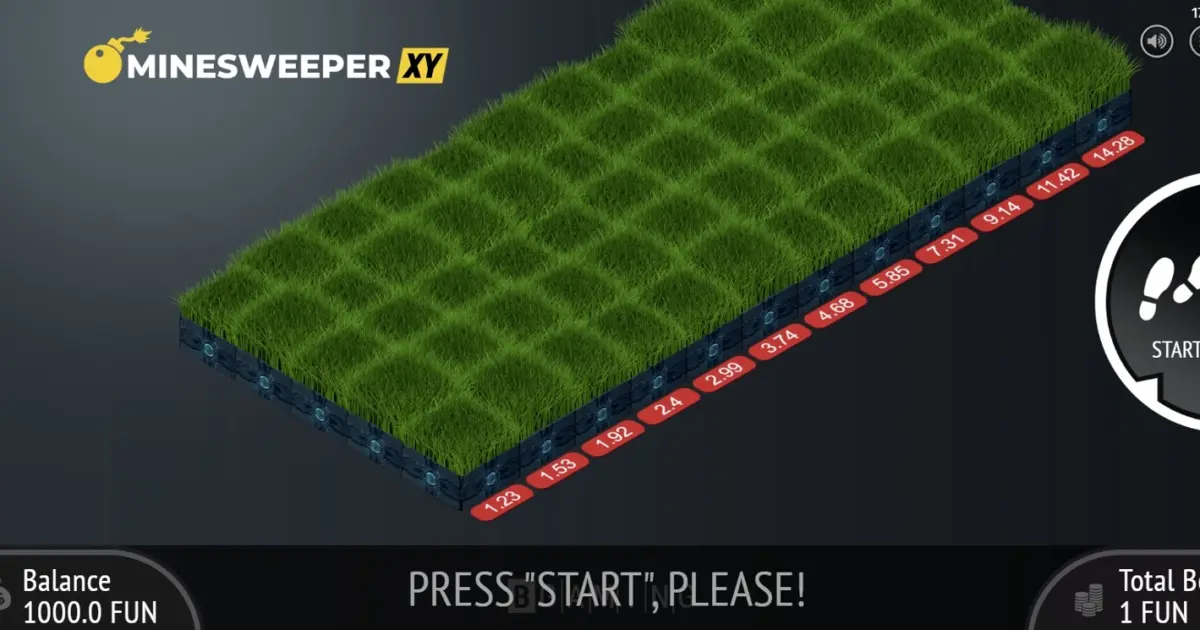
If you want a crash game with a genuinely high published return figure, this is one of the better options on paper: BGaming lists a 98.4% RTP for the minesweeper xy crash game, against a 96.2% average across the games covered on this site. What you get for that number is the standard crash format — a multiplier that climbs from 1.00x until it stops at a randomly chosen point — and one decision, repeated: when to cash out. If you were hoping for a puzzle element you can actually solve, the theme label is doing more work than the mechanics.
Minesweeper XY in one minute
A round opens at 1.00x and the multiplier rises. Somewhere along that curve is a crash point that was already determined when the round began. Cash out before it and your stake is multiplied by whatever figure was on screen at that moment. Stay in when it crashes and the stake is gone. There is no partial refund, no consolation tier, no third outcome.
That is the whole game loop, and it repeats quickly. The skill component is narrow by design: you are choosing a target multiplier and deciding whether to hold past it. Nothing in that choice alters the distribution the crash point is drawn from.
| Detail | Value |
|---|---|
| Provider | BGaming |
| RTP | 98.4% |
| Category | Crash games |
| Free demo | Available |
BGaming has nine games in this category on our site, averaging 97.86% RTP, so this release sits at the upper end of the studio’s own range. Note what the table does not say: BGaming has not published a maximum multiplier cap or bet limits for this title in the information available to us, and there is no confirmation of a provably-fair verification system. Check the game’s own info screen for those before you play for money.
Return to player: 98.4%
An RTP of 98.4% means that across a very large number of rounds, the game is modelled to return 98.4% of everything staked, keeping 1.6% as house edge. That figure is a long-run average across millions of rounds, not a promise about your session, your next hundred rounds, or your next round. A short session can end well above or well below it, and usually does.
Where the edge lives matters for understanding this format. In a crash game the house edge is baked into the statistical distribution of crash points — some proportion of rounds crash so early that no realistic cash-out saves them. It is not applied round by round as a fee, and it is not something a cash-out strategy can sidestep, because the strategy operates on the curve while the edge is built into the shape of the curve itself.
What 1.6% does buy you is a shallower grind than most of the category. At 96.2% average, a corpus-typical game keeps more than twice as much of your stake over the long run. That is a real, if undramatic, advantage: 2.2 percentage points better than the corpus average. It does not make the game profitable and it does not make losing sessions unlikely.
Independent rounds and why streaks mean nothing
Each round’s crash point is generated independently of every round before it. That is not a marketing claim, it is how these systems are built, and it has one blunt consequence: patterns in the history strip carry no predictive information whatsoever.
If the last eight rounds crashed under 1.30x, a high multiplier is not building up. Nothing is stored, nothing is owed, and the generator has no memory of the eight rounds you just watched. The reverse also holds — a run of 20x results does not mean the game is about to punish you. Language like “due”, “hot” or “cold” describes a pattern-matching instinct in your own head, not a property of the game.
This matters practically because streak-reading is the entry point for progression betting. Doubling after losses, raising stakes after a cold run, waiting for a “correction” before committing a bigger bet — all of these assume the next round is informed by the last one. It is not. What progression systems actually do is increase the size of your exposure at the moment your bankroll can least absorb it. The expected value per unit staked is identical whether you flat-bet 100 rounds or ladder your way through them.
Setting an auto-cashout you can live with
Auto-cashout lets you nominate a multiplier in advance and have the game exit for you when the curve reaches it. Auto-bet repeats your stake across rounds without a manual click. Both are risk-management and discipline tools. Neither improves your odds by any amount.
What they do well is remove the moment of hesitation. Manual cash-out invites you to hold “just a bit longer”, and that hesitation is where sessions unravel — not because holding is mathematically wrong, but because it is an unplanned change to a plan you already made.
The trade-off you are actually setting is variance, not edge. A target around 1.30x to 1.50x hits often and pays little; the balance moves in small increments and long losing runs are shorter. A target at 10x or above will miss for dozens of rounds in a row and needs a bankroll that can sit through that without you reaching for the stake slider. Both settings face the same 98.4% long-run return. Pick the one whose losing streaks you can watch without changing your mind, then leave it alone. Cash-out timing is the one lever you fully control and the one lever that provably does not move expected value.
Multiplayer bet feeds and what they don’t change
Crash games typically show a live feed of other players’ stakes and cash-outs alongside the curve. It is the format’s most effective piece of presentation, and it is worth being clear about what it is: a social layer sitting on top of maths that is entirely indifferent to it.
Every player in the round is watching the same crash point resolve. Someone else cashing out at 40x does not remove that outcome from a pool, and it does not mean the round was ever going to reach 40x for you specifically had you held. Conversely, a wall of players exiting early tells you about their risk appetite, nothing about the curve.
The genuine risk in the feed is behavioural. Watching a stranger bank a large multiplier is a strong prompt to abandon a target you set for good reasons, and the feed shows you winners far more prominently than the far larger number of people who held too long. If you find your auto-cashout drifting upward after someone else’s big round, that is the feed working on you rather than information reaching you.
Trying the demo first
A free demo is available for this title, which is the sensible first stop. Use it to learn where the interface puts the cash-out button, how auto-bet behaves when you walk away from it, and how a 25-round losing run at a 5x target actually feels in real time. That last one is the useful lesson, and it costs nothing to learn.
Demo results do not predict real-money results. A good demo session is a sample of the same distribution you would face with cash on the line, not a signal about what comes next. Try Minesweeper XY free without expecting the numbers to carry over.
These games are 18+ and rounds repeat fast enough that an hour disappears without much resistance. Decide what the session is worth to you before you open it, treat that figure as the price of the entertainment rather than a float you expect back, and stop when it is spent. Money staked here is not income and cannot be made into income by any pattern of play.
Who should play Minesweeper XY
This suits you if you like the crash format on its own terms — a fast, single-decision loop — and you want the best published RTP you can find within it. At 98.4%, the case for choosing this over a 96% alternative is straightforward and it is the main reason to pick it.
It suits you less if you wanted the theme to mean something mechanically, or if you are the kind of player who reads history strips for patterns. The fast round cadence and the visible bet feed both reward discipline and punish improvisation.
Worth comparing before you commit: Space XY is BGaming’s better-known entry in the category at 97.0% RTP, so you can see how much the extra 1.4 points is worth to you. Aviamasters and Dragon’s Crash also run at 97.0% and give you a sense of the studio’s baseline, which makes this title’s figure easier to judge in context.
Frequently Asked Questions
Can I play Minesweeper XY for free?
Yes, a free demo is available for this BGaming title, so you can run rounds without staking money. Use it to learn the interface and see how auto-cashout and auto-bet behave. Demo outcomes are drawn from the same distribution as real play but do not predict what a real-money session will do.
What does the 98.4% RTP mean for me?
It means the game is modelled to return 98.4% of all money staked across a very large number of rounds, leaving a 1.6% house edge. That is a long-run average, not a session forecast. It sits 2.2 points above the 96.2% average across the crash games reviewed here, so the long-run cost per stake is lower than most.
Does cashing out at the right moment improve my odds?
No. The house edge is built into the distribution of crash points, so no cash-out timing, one-third rule, or progression system changes expected value. What your timing does change is variance: early exits pay small amounts often, late exits miss frequently for a shot at more. Both face the same 98.4% long-run return.
Who makes Minesweeper XY?
BGaming, which has nine crash games covered on this site averaging 97.86% RTP. This title's 98.4% figure puts it at the top of that range. For comparison, the studio's Space XY, Aviamasters and Dragon's Crash all run at 97.0%, so the provider baseline is a reasonable benchmark when judging this release.
What does provably fair mean in a crash game?
It describes a system where the crash point is generated from a seed you can verify after the round, letting you confirm the result was not altered mid-round. The information available for Minesweeper XY does not confirm whether it uses provably-fair verification, so check the game's own info screen before playing for money.




