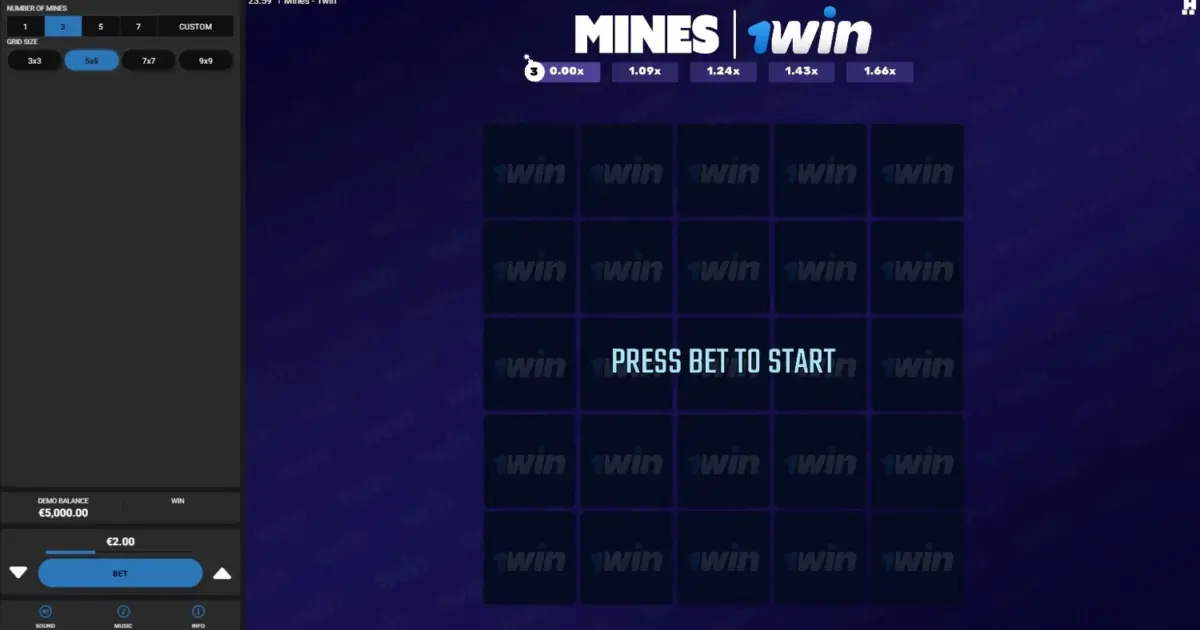
Mines 1Win is a straightforward crash game from Hacksaw Gaming where a multiplier starts at 1.00x and climbs until the round crashes at a random point. If you cash out before that crash, you win your stake multiplied by the displayed number; if you are still in when it hits, you lose the bet. The game sits comfortably within the crash-game format — no extra side bets or complicated bonus rounds to learn — and a free demo lets you see the curve in action without spending anything.
What kind of crash game is Mines 1Win?
Mines 1Win belongs to the crash-game subcategory, a format defined by a single mechanic: a rising multiplier that can end at any instant. The entire decision you make each round is when to cash out, and that decision does not change the underlying odds. Hacksaw Gaming is the provider behind this title, and the game is one of four crash games in their current portfolio. The provider’s average RTP across those titles sits at 97.25%, which gives you a rough benchmark for how this particular 96% figure compares to the rest of their lineup. There is no minefield or tile-picking layer here despite the name — the “mines” label refers to the crash mechanic itself, where each round contains an invisible trap that ends the multiplier at a randomly determined point.
| Provider | Hacksaw Gaming |
|---|---|
| RTP | 96.0% |
| Free demo | Yes |
| Site-wide average RTP | 96.2% |
The maths of a single round
Every round of Mines 1Win works the same way. A multiplier begins at 1.00x and increases continuously. At a randomly determined moment the round “crashes” and the multiplier stops. If you have already cashed out, you receive your stake times the multiplier at the moment you exited. If you have not, you lose the entire stake. The crash point for each round is generated independently — a run of low crash points does not make a high crash “due,” and a run of high crashes does not make a low one more likely. The skill component, such as it is, is purely a variance trade-off: cashing out at 1.50x locks in a smaller but more reliable return, while waiting for 5x or higher gives you a bigger potential payout but a much greater chance of losing. Auto-cashout settings let you set a target multiplier in advance, which is a convenience and discipline tool, not an odds improvement.
Where the 96% comes from
The 96% RTP (return to player) in Mines 1Win is a long-run statistical average. Over a very large number of rounds, the game is designed to return 96 cents for every dollar wagered, with the remaining 4 cents representing the house edge. This figure is built into the distribution of crash points — some rounds crash very early, some climb to high multipliers, and the overall shape of that distribution produces the 96% return over time. In any individual session your actual return can be far above or below 96% because variance is high in crash games. The corpus average RTP across all crash games we track is 96.2%, so Mines 1Win sits almost exactly at the market average, trailing by just 0.2 percentage points. That small gap is not something you would notice in practice.
Reading the rules and max multiplier before you bet real money
Before switching from demo to real money, check the in-game information screen for the maximum multiplier cap. This is the highest value the multiplier can reach in a single round, and it directly affects the upper limit of any potential win. Hacksaw Gaming has not published a specific maximum multiplier figure for Mines 1Win in the data available here, so you should verify this inside the game itself before placing real bets — the information screen or paytable will show it. Knowing the cap matters because it defines the ceiling of the variance range: a game capped at 100x plays very differently from one capped at 1,000x. Also confirm the bet limits, since these determine the practical floor and ceiling of what you can wager per round.
How Mines 1Win compares to other crash games
Mines 1Win carries a 96% RTP, which is slightly below the 96.2% corpus average for crash games. If you are comparing within Hacksaw Gaming’s own catalog, Limbo (Hacksaw Gaming) offers a higher published RTP of 98%, making it a more efficient game from a house-edge perspective. Outside the same provider, Speed Crash comes in at 97% RTP, and Dice Dare2Win reaches 98%. None of these numbers change the core experience — every crash game is a multiplier curve and a cash-out decision — but the RTP differences do compound over hundreds of rounds. A 2-percentage-point gap between 96% and 98% translates to roughly 2 extra cents kept per dollar wagered, which adds up across a long session. The choice between these games ultimately comes down to which interface and pace you prefer, with the RTP as one factor among several.
Free demo and staying in control
A free demo of Mines 1Win is available, and it uses the same maths as the real-money version — the only difference is that no actual funds are at stake. Playing the demo lets you observe how the multiplier behaves round to round and gives you a feel for the pacing without any financial risk. Since crash games run fast and rounds repeat quickly, it is easy to lose track of time and spending. Set a budget before you play, decide on a session length in advance, and treat every bet as a cost of entertainment rather than a path to income. You must be 18 or older to play for real money. If the demo feels more stressful than fun, that is useful information — take it seriously.
Final verdict
Mines 1Win is a clean, no-frills crash game from Hacksaw Gaming with a 96% RTP that sits just below the market average. The mechanics are standard for the genre: a rising multiplier, a random crash point, and a cash-out decision that controls your variance but not your expected value. The free demo is available if you want to see the game in action before committing real money, and the provider has four crash games in total if you want to explore alternatives within the same studio. What this game does not offer, based on available information, is a published maximum multiplier cap — check the in-game rules before betting. For a similar experience with a higher RTP, consider Hacksaw Gaming’s own Limbo at 98%, or browse other crash games in our library to compare house edges and pacing side by side.
Frequently Asked Questions
Can I play Mines 1Win for free without downloading anything?
Yes, a free demo of Mines 1Win is available on this page with no download required. The demo uses the same crash-game maths as the real-money version, so you can observe how the multiplier behaves round to round without risking any funds.
What is the RTP of Mines 1Win and what does it mean?
Mines 1Win has a published RTP of 96%. This means that over a very large number of rounds, the game is designed to return 96 cents per dollar wagered on average. In any single session your results can vary widely above or below that figure due to the high variance inherent in crash games.
Does cashing out early or using a specific system improve my odds in Mines 1Win?
No. Every round in Mines 1Win is independent, and the crash point is determined randomly before the round begins. Cashing out earlier reduces variance by locking in smaller multipliers, but it does not change the expected value. No timing pattern, progression system, or auto-cashout setting improves the underlying odds.
What does "provably fair" mean in crash games like Mines 1Win?
Provably fair is a verification system where the game's crash point is determined by a cryptographic algorithm that the player can audit after the round using a seed and hash. It proves the result was not manipulated mid-round. Whether Mines 1Win specifically uses provably fair technology is not confirmed in the available facts — check the game's info screen for details.
How does Mines 1Win compare to Limbo by Hacksaw Gaming?
Both are crash games from Hacksaw Gaming, but Limbo carries a higher published RTP of 98% compared to Mines 1Win's 96%. Over many rounds, that 2-percentage-point difference means Limbo returns roughly 2 extra cents per dollar wagered. The core mechanic — a rising multiplier and a cash-out decision — is the same in both games.




