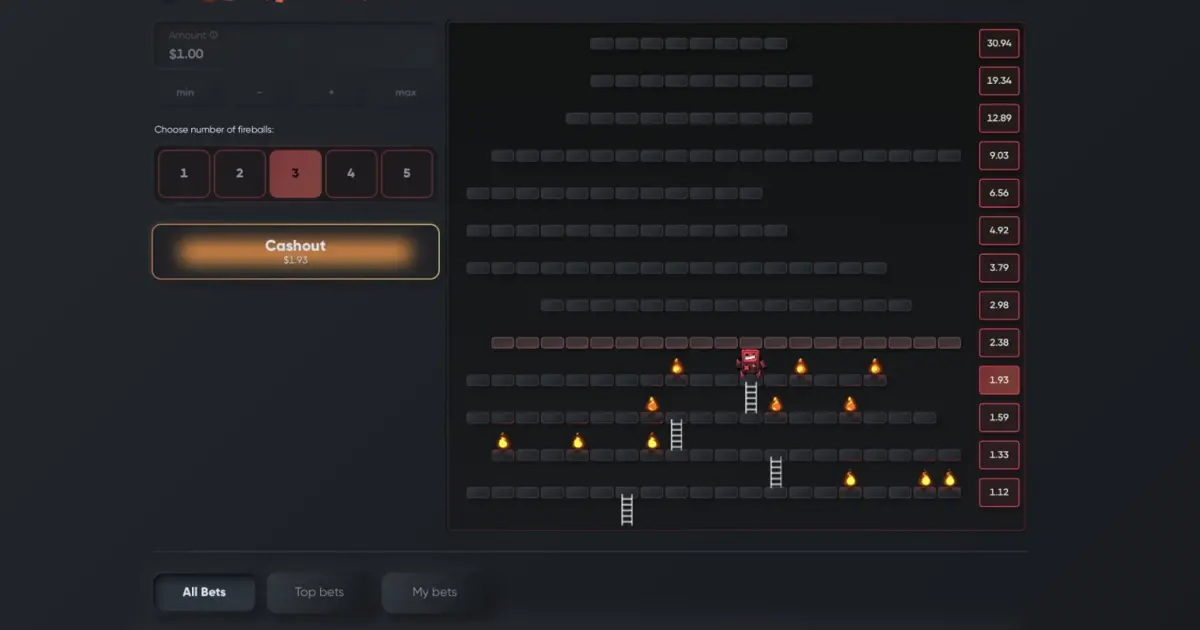
If you want a crash-style game with a published return figure rather than a blank space, this is a reasonable place to spend time. Turbo Games states a return-to-player of 97% for Fury Stairs, which is higher than the 95.58% average across the studio’s 16 titles and higher than the 96.2% average across the crash games covered on this site. A free demo is available, so the cash-out decision costs you nothing to learn.
What kind of crash game is Fury Stairs?
The fury stairs crash game belongs to the crash category, which means the shape of the round is fixed and simple. A round opens at a 1.00x multiplier and climbs. At some point it stops, and the stopping point was decided before you saw a single frame of the climb. Your only input is when you press cash out.
Cash out before the round ends and you keep your stake multiplied by whatever figure was showing at that moment. Stay in past the end and the stake is gone. There is no partial result, no consolation return, no bonus round waiting behind the curve. That is the entire game loop, repeated as fast as you care to bet.
What Turbo Games has not published for this title is a maximum multiplier cap, a bet range, or a statement about provably fair verification. The absence matters in a practical way: those are the numbers that tell you how much a single round can pay and how much it can cost, so read them off the game’s own information screen before you stake real money rather than assuming a figure from another crash title.
| Provider | Turbo Games |
|---|---|
| RTP | 97.0% |
| Free demo | Yes |
| Site-wide average RTP | 96.2% |
The maths of a single round
Each round’s stopping point is generated independently of the last one. That is the single most useful fact about the format, and it is worth stating flatly: a run of early crashes does not build up a high multiplier owed to you, and a run of long climbs does not mean the next round is short. The game does not remember what it did. Neither does it know what you staked.
This is why cash-out timing is a variance decision, not an odds decision. Taking 1.30x repeatedly gives you a high hit rate and small increments. Holding for 20x gives you a low hit rate and rare, larger returns. Over a long enough run both approaches converge on the same expected value, because that value is set by the distribution of stopping points, not by your reaction time.
The same applies to anything that looks like a system. Doubling after a loss, holding back a third of your bankroll, alternating targets, following the live bet feed to see what other players are doing — none of it shifts the maths. Auto-cashout and auto-bet tools are genuinely useful, but what they do is enforce a decision you already made when you were calm. They do not improve your odds by a single decimal.
Where the 97% comes from
The 97% figure is a long-run average, not a promise about your session. Read as arithmetic, it means that across a very large number of rounds the game is modelled to return 97 units for every 100 staked, leaving a 3% house edge. That edge lives in the distribution of stopping points across thousands of rounds, not in any individual round you play.
Over a hundred rounds you can finish well ahead of 97% or well behind it, and neither result tells you anything about whether the number is accurate. The figure only becomes visible at sample sizes no individual player reaches. Treat it as a comparison tool between games rather than a forecast for your afternoon.
As a comparison tool it does the job well here. Against the 96.2% average for crash games on this site, 97% keeps 0.8 percentage points more of every 100 staked in play. Against Turbo Games’ own 95.58% average across 16 titles, the gap is wider still. If Fury Stairs rtp is the reason you clicked, that is the honest context: a good number for the category, not a different kind of game.
Reading the rules and max multiplier before you bet real money
Turbo Games has not published a maximum multiplier for this title, so there is no ceiling figure for us to quote. Find it in the game’s help screen before you commit money, because a cap changes how you think about long holds. If a game stops paying beyond a certain multiplier, holding past that point adds risk without adding upside.
Three other things are worth checking on that same screen. First, the minimum and maximum stake, which set how long a given budget lasts at your chosen bet size. Second, whether the game offers provably fair verification — a seed you can check after the round to confirm the stopping point was not altered mid-climb. Nothing in the published information for this game confirms that either way, so look rather than assume.
Third, confirm the RTP on the information screen matches the 97% quoted here. Operators occasionally deploy different configurations of the same title, and the version in front of you is the version that pays you. Any figure quoted on a third-party page, this one included, is worth verifying against the game itself.
How Fury Stairs compares to other crash games
Within the Turbo Games catalogue, the clearest comparison is Crash X, another crash title from the same studio running a published 95% RTP. That is two full percentage points below Fury Stairs, which is a meaningful gap when the entire house edge here is only three points. If you like the format and are choosing between the two on numbers alone, the higher figure is the better default.
The studio’s other well-known titles work differently. Mines and Turbo Mines both sit at 95% and replace the rising multiplier with a grid you reveal tile by tile, deciding when to bank rather than when to cash out. The underlying trade-off is the same shape — more reveals for more return, one wrong pick for nothing — but the pacing is slower and the decision points are discrete rather than continuous.
Across the wider crash category, 97% is towards the upper end of what studios publish. That does not make the game generous. It makes the edge smaller, and a smaller edge still grinds in one direction over enough rounds.
Free demo and staying in control
A free demo is available for this title, which is the right place to start. Use it to work out what cash-out target you actually find tolerable, to see how the auto-cashout controls behave, and to read the rules screen without money on the table. Fury Stairs free demo play is also the only cost-free way to find out whether the pace suits you at all.
What the demo cannot do is predict real-money results. Demo rounds are generated the same way, which means they are just as independent of each other and just as independent of anything you play later. A strong demo session is not a signal.
Crash rounds finish in seconds, and that speed is the part worth watching. It is easy to place fifty bets in the time a slot would take for ten, and easy to lose track of the total. This is an 18+ activity. Decide a budget before you open the game, treat it as money spent on entertainment rather than money you expect back, and stop at the number you set rather than the number that feels close. If stopping is difficult, that is the signal to walk away for the day.
Final verdict
Fury Stairs is worth a look mainly because of its published numbers. At 97%, the return figure beats both the Turbo Games studio average of 95.58% and the 96.2% crash-game average on this site, and in a format where the house edge is the whole story, that is the fact that matters most.
The caveats are about missing information rather than the game itself. No maximum multiplier, stake range, or provably fair statement has been published for this title, so the information screen is where you confirm all three. Do that, use the demo to settle on a cash-out habit, and set your budget before the first round rather than during the tenth.
Frequently Asked Questions
Can I play Fury Stairs for free?
Yes, a free demo is available for Fury Stairs, so you can run rounds without staking money. Use it to test cash-out targets and read the rules screen. Demo rounds use the same independent generation as real-money rounds, so results from the demo do not predict what happens when you switch to cash play.
What is the RTP of Fury Stairs and what does it mean?
Turbo Games publishes a 97% return-to-player figure, leaving a 3% house edge. That means the game is modelled to return 97 units per 100 staked across a very large number of rounds, not within your session. It sits above the studio's 95.58% average and the 96.2% crash-game average on this site.
Does cashing out at the right moment improve your odds in Fury Stairs?
No. Cash-out timing changes variance, not expected value. Taking small multipliers gives frequent, modest returns; holding longer gives rare, larger ones, and both converge on the same 97% long-run figure. Progression systems, one-third rules and auto-cashout settings enforce discipline but do not alter the underlying maths.
Is Fury Stairs provably fair?
Turbo Games has not published a provably fair statement for this title, so check the game's own information screen. Provably fair generally means the round's stopping point is derived from a seed you can verify afterwards, confirming it was not changed mid-round. Without that, the result comes from a standard RNG instead.
Who makes Fury Stairs and how does it compare to Crash X?
Turbo Games develops Fury Stairs, one of 16 titles in its catalogue. Its closest in-house comparison is Crash X, another crash game running a published 95% RTP. That is two percentage points lower, which is significant when the total house edge on Fury Stairs is only three points.




