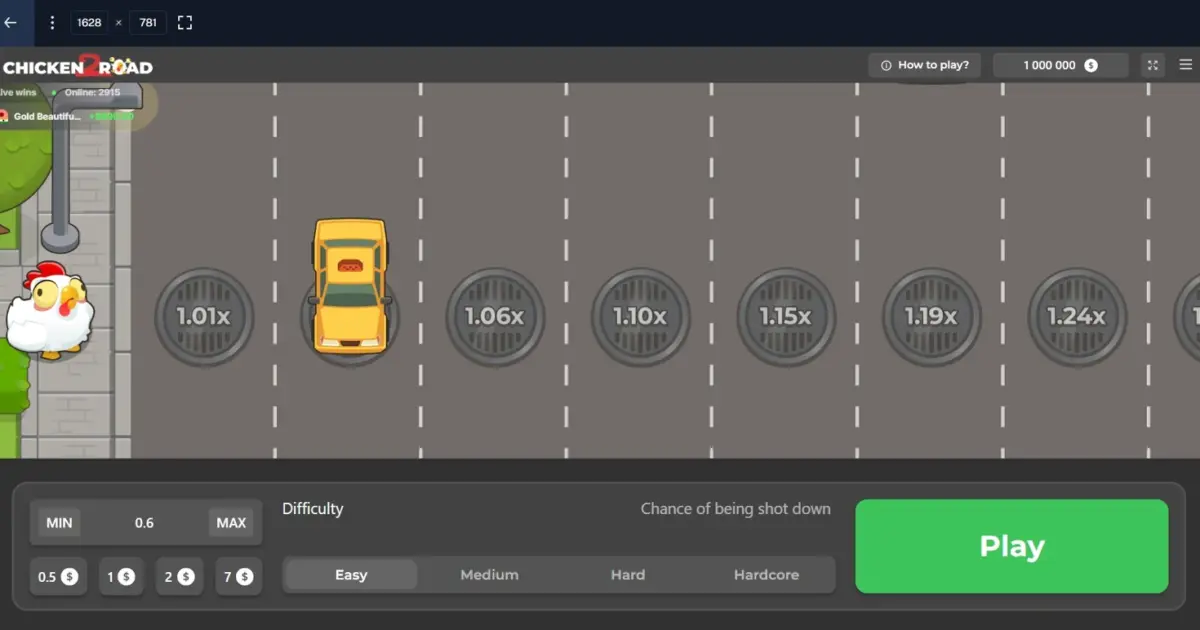
Chicken Road 2.0 is a crash game from InOut where a multiplier rises from 1.00x until it crashes at a randomly determined point, and your only decision is when to cash out. Its 95.5% return-to-player figure sits slightly below the provider’s 96.38% average, which matters more over long sessions than any single round. The free demo is available, so you can get a feel for the pace of rounds without risking a cent before you decide whether it earns a spot in your rotation.
How Chicken Road 2.0 plays
Every round of this chicken road 2.0 crash game opens at a 1.00x multiplier. The curve then climbs — quickly at first, then slower as it stretches higher — until it hits a randomly generated crash point. Cash out before that moment and you win your stake times the multiplier on screen. Stay in when it crashes and the round ends with the stake lost. There is no third outcome.
The skill component, such as it is, is deciding when to take your profit. Cashing out at 1.10x or 1.20x locks in small, frequent wins. Holding for 3x or 5x offers a bigger payout but a higher chance the round ends before you get there. Varying your exit point for a low target, a middle target)Skip or hold targeting — either way the distribution of crash points is unchanged by anything you do during the round.
InOut’s presentation here keeps the core mechanics honest: you place a bet, watch the multiplier, and cash out when the number suits you. The interface covers the essentials — current multiplier, your stakes, and the live bet feed of other players’ cash-outs. If you have played a crash title before, you will pick this up in a single round.
| Provider | InOut |
|---|---|
| RTP | 95.5% |
| Free demo | Yes |
| Site-wide average RTP | 96.2% |
InOut and this game
Chicken Road 2.0 is one of four games InOut lists in this provider’s catalogueasi this provider’s current catalogue of four titles. Across those games the average RTP is 96.38%, so at 95.5% this one runs slightly under the house norm. That 0.88-point gap is modest — it does not make the game a dud, but it is the kind of number a player watches when comparing options side by side.
If you like InOut’s approach to straightforward betting mechanics, it is worth a look at Penalty Unlimited, a penalty-themed title that quotes a 96.0% RTP, a touch above this one. For a more nature-leaning pick with a higher return figure, Forest Fortune lists 97.0%. And if short, punchy rounds are your thing, Hamster Run also sits at 97.0%. Comparing the published RTPs of these InOut neighbours is a useful way to gauge where Chicken Road 2.0 sits in the family.
Reading the 95.5% figure
The 95.5% RTP is the long-run expectation: on average, for every 100 units staked across a large number of rounds, the game pays back 95.5 units and the house keeps 4.5. This is exactly how a slot’s RTP works — it emerges from the statistical distribution of crash points, not from any individual round. One round can pay 10x on a small stake; another can crash at 1.01x. The figure only becomes meaningful over thousands of rounds.
It also bears repeating how this compares. The provider’s average sits at 96.38% and the broader corpus of crash games here averages 96.2%, so 95.5% is about 0.7 points under both. In plain terms: the house edge here is a little fatter than the field. For a casual player this difference is small in any single session, but it compounds at the rapid pace crash rounds repeat, so it is worth knowing before you commit a budget.
InOut publishes this figure, so you can treat it as an honest baseline rather than a guess. As with any RTP number, it describes the machine, not your evening.
Provably fair, explained in general terms
Many crash games use a provably fair algorithm: the crash point for a round is generated from a seed combination whose inputs are published before the round, then verified by the player afterwards. The common alternative is a standard RNG. Either approach produces the same practical result — each round’s crash point is independent, and the house edge already sits inside the distribution of those points, so there is nothing a player can inspect that changes the odds.
The useful part of provable fairness is verification. You can check after the round that the crash point you saw was the one the seed actually produced, rather than trusting the screen. What it does not do is let you predict the next crash or nudge a round in your favour. In this case, the facts I have do not specify whether InOut uses a provably fair algorithm here, so treat any claim you read elsewhere as unconfirmed. The independence of rounds, however, holds under either mechanism.
Why no cash-out system changes the odds
Because every crash point is generated independently, no pattern of exits affects the underlying distribution. A run of low crashes does not make a high crash “due,” and a run of high crashes does not make a low one likely. Cashing out early locks in a smaller, more reliable return; holding longer risks everything for a shot at a bigger one. That is a variance trade-off you control — not an edge you can alter.
So-called “systems” — the one-third rule, martingale progressions, or any manual timing pattern — all fail the same way: they redistribute when you win and lose without changing the expected value. Auto-cashout settings, where you set a fixed multiplier to exit at, are useful for discipline: they stop you chasing a round past a target you set when the stake was on the table. Auto-bet does the same for round frequency. Neither tool improves your odds; they just enforce the plan you made.
The live bet feed showing other players cashing out is pure social layer. It can make a round feel communal, but it carries no information about the next crash point. Enjoy it if you like it — just do not read the room’s exits as a signal.
Free play before real money
A free demo is available for Chicken Road 2.0, which means you can play the full game with the same multiplier behaviour and round pace using practice balance. This is the sensible way to build a feel for the timing — how fast the curve moves at low multipliers, how long a high crash actually takes — and to test cash-out targets without any money on the line. Demo play does not predict real-money outcomes, because the underlying generator is the same either way, but what it does give you is familiarity with the interface before you stake.
If it is your first time with the title, set a clear exit plan before you start. A quick run of demo rounds to decide what multiplier you will hold for is exactly the right preparation.
One thing worth stress given how fast crash rounds repeat: if you move to real money, set a budget in advance and treat it as the cost of entertainment, not as income. This game is 18+, and the speed of rounds means losses can accumulate quickly. It is fine to play for the fun of the gamble — just keep the stake at a level you can afford to lose outright.
Final take on Chicken Road 2.0
Chicken Road 2.0 is a solid, no-frills crash game that delivers the format’s central tension — a rising multiplier versus a random end — without gimmicks. The 95.5% RTP is a touch under the InOut average of 96.38%, so it is not the most generous title in the catalogue on raw return, but the gap is small and the free demo means you can judge the pace for yourself before committing any money.
Play it if you want a straightforward crash experience and you are comfortable with the house edge being about average. Skip it if you are hunting the absolute best return among the titles here. The deciding factor is how the round rhythm suits you, and that is exactly what the demo is for. Decide your cash-out point, stick to it, and treat the rest as entertainment.
Frequently Asked Questions
Is there a Chicken Road 2.0 free demo?
Yes, a free demo is available for Chicken Road 2.0. You can play the full game with the same multiplier behaviour and round pace using practice balance, which lets you test cash-out targets and get familiar with the interface before you stake any real money.
What is the Chicken Road 2.0 RTP?
InOut lists the return-to-player figure for Chicken Road 2.0 at 95.5%. That means over a large number of rounds the game pays back 95.5 units per 100 staked on average, leaving a 4.5 house edge. It sits about 0.7 points under the broader crash-game average.
Can any cash-out timing or system change the odds in Chicken Road 2.0?
No. Every crash point is generated independently, so no exit timing or betting progression changes the expected value. Cashing out early or late only shifts the variance trade-off you control. Auto-cashout tools enforce discipline but never improve the underlying odds.
What does provably fair mean for a game like Chicken Road 2.0?
Provably fair means the crash point comes from a published seed the player can verify after the round, confirming the result was not manipulated. It does not let you predict the next crash. I do not have confirmation that InOut uses provably fair here, so treat claims otherwise as unverified.
Who makes Chicken Road 2.0 and how does it compare to InOut's other games?
Chicken Road 2.0 is made by InOut Dispenser, whose catalogue of four games averages a 96.38% RTP. At 95.5%, this title runs below that averagerosts, while related InOut games like Penalty Unlimited and Forest Fortune quote 96.0% and 97.0% respectively, making them slightly more generous on paper.




