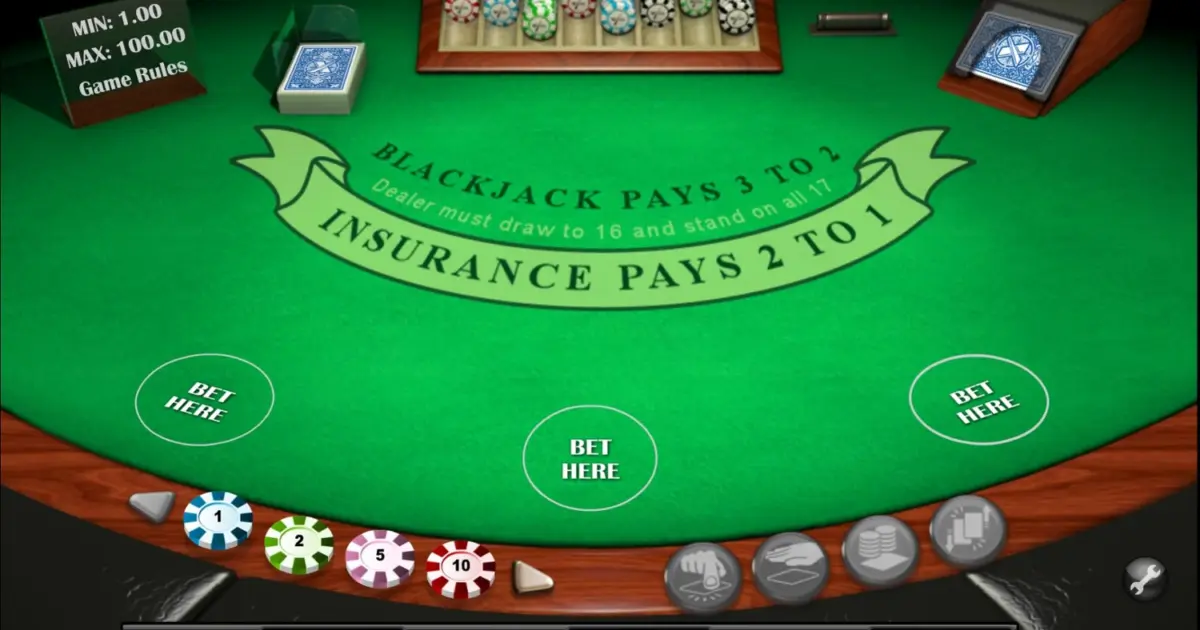
Blackjack Pro MonteCarlo MH is a multi-hand RNG blackjack table from Nextgen Gaming that returns 98.55% at perfect basic strategy. That figure places it 0.86 percentage points below the average for blackjack tables in this category, and noticeably below Nextgen’s own portfolio average of 98.84%. The multi-hand format lets you play several boxes at once, which increases variance and hand throughput but does not change the edge. If you want tighter rules from the same provider, Black Jack Atlantic City SH and Black Jack (MH) Portuguese both return 99.12%, a material improvement worth 0.57% in expected value.
How Blackjack Pro MonteCarlo MH plays
This is a multi-hand table, meaning you can play between one and five hands per round against a single dealer upcard. Each hand is dealt from the same shoe state at the start of the round, and you make decisions on each box in sequence. The format suits players who want to see more hands per hour and are comfortable managing multiple decisions quickly, but it demands a larger session bankroll because you are putting units at risk on every box simultaneously. The game uses an RNG and reshuffles after every round, so the deck composition resets completely between deals.
Nextgen Gaming does not publish the exact deck count, the dealer’s soft-17 rule, or the blackjack payout ratio for this table in the available documentation. Those three variables directly affect the house edge—deck count by a few hundredths of a percent, soft-17 by roughly 0.2%, and the blackjack payout by 1.4% if it pays 6:5 instead of 3:2. Check the in-game paytable before you play for money, because a 6:5 payout alone will push the edge well above 2% and make the game unplayable at any stake.
MonteCarlo rules and what the name tells you
The MonteCarlo label in the title is a branding choice rather than a reference to a standardized rule family like “European” or “Atlantic City.” Nextgen has not published what specific rules the name indicates, so treat it as flavour text. The variant hints in the game’s metadata do not include a rules profile, which means you cannot assume deck count, surrender availability, double-after-split, or re-split rules from the title alone.
What you can infer is that the 98.55% RTP indicates a moderately liberal ruleset—neither the tightest nor the loosest in the market. For context, a single-deck game with 3:2 blackjack, dealer standing on soft 17, and full doubling typically returns around 99.7%, while a six-deck game with 6:5 blackjack and the dealer hitting soft 17 can drop below 97%. This table sits in the middle, but without knowing which rules drive that figure, you cannot reverse-engineer the edge from first principles. Confirm the rules in the game client and adjust your expectations accordingly.
Rules summary
| Rule | Value |
|---|---|
| RTP | 98.55% |
| House edge | 1.45% |
| Provider | Nextgen Gaming |
| Format | Multi-hand (up to 5 boxes) |
| Free demo | Yes |
Reading the 98.55% return figure
The published RTP of 98.55% assumes you play perfect basic strategy on every single hand—no deviations, no hunches, no insurance bets unless the chart explicitly calls for them (which is almost never at standard odds). Basic strategy is a solved decision chart derived from combinatorial analysis of every possible player hand versus every dealer upcard. It tells you whether to hit, stand, double, or split based solely on the cards in front of you, and it minimises the house edge without ever eliminating it. If you play basic strategy correctly, you will lose 1.45% of your total action over the long run on this table.
A casual player who stands on 16 versus a dealer 7, takes insurance at whim, or doubles soft hands incorrectly will realise a materially lower return—often 2% to 3% house edge or worse. The gap between the published RTP and your actual result is entirely a function of how closely you follow the chart. This is not a guess or a guideline; it is a mathematical fact. Every deviation from basic strategy has a quantifiable cost, and those costs accumulate quickly over a session.
The 98.55% RTP on this table is below the 99.41% average for the blackjack category, which means the rules are less favourable than the typical offering. Compare it to Multihand Blackjack at 99.5% or American Blackjack at the same figure, and the difference is 0.95 percentage points. On a £10 average bet over 500 hands, that gap costs you roughly £47.50 in additional expected loss. For a recreational session that may not matter; for a regular player it adds up.
Where the house edge actually comes from
The dealer acts last, which gives the house its structural advantage: if you bust, you lose immediately, even if the dealer busts on the same round. That edge is roughly 8% before any other rules are applied. Blackjack paying 3:2 instead of even money gives back about 2.3%. Doubling on favourable hands returns roughly 1.6%. Splitting pairs recovers another 0.4%. Dealer busting more often on stiff upcards contributes the rest. After all these offsets, a typical liberal ruleset leaves the house with an edge between 0.3% and 0.6%. A tight ruleset pushes it past 1%.
The 1.45% edge on Blackjack Pro MonteCarlo MH tells you the rules are tighter than average but not punitive. The single biggest factor is almost always the blackjack payout: 3:2 versus 6:5 moves the edge by 1.4 percentage points on its own. If this table pays 6:5, that accounts for nearly all the gap between this game and a 99.5% RTP table. The next most impactful rule is whether the dealer hits or stands on soft 17, worth roughly 0.2%. Deck count matters less than most players think—going from one deck to eight decks costs about 0.5% total—but it still moves the needle. Without confirmed figures for these rules, you cannot decompose the edge further, but you know it is being driven by at least one unfavourable condition.
Does card counting work here?
No. This is an RNG table that reshuffles the entire shoe after every hand, which means the deck composition resets to neutral before the next deal. Card counting relies on tracking the ratio of high cards to low cards remaining in the shoe, and using that information to raise your bet when the remaining deck favours the player. If the shoe is reshuffled after every round, there is no remaining deck to track, and the count provides no advantage. The true count is always zero at the start of every hand.
Some players believe counting still offers a psychological or discipline benefit even when it does not affect the edge. That is fine as a mental routine, but it does not change the mathematics: you cannot overcome a 1.45% house edge by counting cards against an RNG that resets every round. The only way to minimise the edge on this table is to play basic strategy correctly and avoid side bets.
Bankroll and unit sizing
A multi-hand table increases variance because you are playing multiple boxes per round. If you play three hands at £5 each, you are risking £15 per round before any doubles or splits, and a bad run can drain a session bankroll quickly. A general guideline for a low-risk-of-ruin session is to bring at least 50 times your total round stake: if you play three £5 hands, that means a £750 session bankroll. For five hands the requirement scales accordingly. This is not a guarantee—you can still lose it all in an hour—but it gives you enough cushion to absorb normal variance without going broke on a single cold shoe.
Unit sizing should reflect your total bankroll, not your session budget. A common rule of thumb is to keep your total round stake below 1% to 2% of your total gambling bankroll. If you have £1,000 set aside for blackjack across multiple sessions, a £10 to £20 total round stake is appropriate. Playing above that level increases your risk of ruin over the medium term, even with perfect strategy.
Set your budget in advance, treat it as entertainment spending, and stop when it is gone. Blackjack is a negative-expectation game, and no betting progression or staking plan will change that. If you are playing to make money rather than pass time, you are playing the wrong game. This is a game of skill in the short term and a guaranteed loss in the long term. Play only with money you can afford to lose, and never chase losses by increasing your unit size mid-session. 18+ only.
Verdict
Blackjack Pro MonteCarlo MH is a playable multi-hand table for players who understand basic strategy and want to see more hands per hour, but the 98.55% RTP is below average for the category and Nextgen Gaming offers tighter alternatives in the same portfolio. The missing ruleset documentation is a problem: you cannot verify the deck count, the soft-17 rule, or the blackjack payout from external sources, and those variables determine whether the game is worth playing at all. A 6:5 blackjack payout would make this table unplayable, and without confirmation you are taking the RTP figure on trust.
If you want a multi-hand format from Nextgen, this table works, but check the paytable in the client before you commit. If you want better rules, Blackjack Pro MonteCarlo SH offers the same RTP in a single-hand format with lower variance, and the Atlantic City and Portuguese variants return 99.12%, which is 0.57 percentage points tighter and worth the switch if they fit your format preference. The free demo is available, so test it first and confirm the rules before you play for money.
Frequently Asked Questions
Is Blackjack Pro MonteCarlo MH available in free demo mode?
Yes, a free demo is available. You can test the game, confirm the rules in the paytable, and practice basic strategy without risking money. Demo play uses the same RNG and rules as the real-money version, but it does not predict your actual results because variance dominates over short samples.
What is the RTP of Blackjack Pro MonteCarlo MH and does it assume perfect play?
The RTP is 98.55%, and that figure assumes you play perfect basic strategy on every hand with no deviations. A casual player who guesses decisions or takes insurance incorrectly will see a materially lower return, often 2% house edge or worse. Basic strategy is a solved chart, not a system, and it is the only way to achieve the published RTP.
Does card counting work on this table?
No. Blackjack Pro MonteCarlo MH uses an RNG and reshuffles after every hand, which resets the deck composition to neutral before the next deal. Card counting relies on tracking the remaining cards in the shoe, and if the shoe is reshuffled every round there is nothing to track. The edge remains 1.45% regardless of the count.
How does the 98.55% RTP compare to other Nextgen Gaming blackjack tables?
It sits below Nextgen's portfolio average of 98.84% and well below their tightest tables. Black Jack Atlantic City SH and Black Jack (MH) Portuguese both return 99.12%, which is 0.57 percentage points better and translates to roughly £28.50 less expected loss per £10 over 500 hands. If you want better rules from the same provider, those are the tables to play.
What bankroll do I need to play multiple hands on this table?
Bring at least 50 times your total round stake for a session with low risk of ruin. If you play three hands at £5 each, that is £15 per round, so a £750 session bankroll is appropriate. Multi-hand play increases variance because you are risking units on every box simultaneously, and a bad run will drain a smaller bankroll quickly even with correct strategy.<<>>




