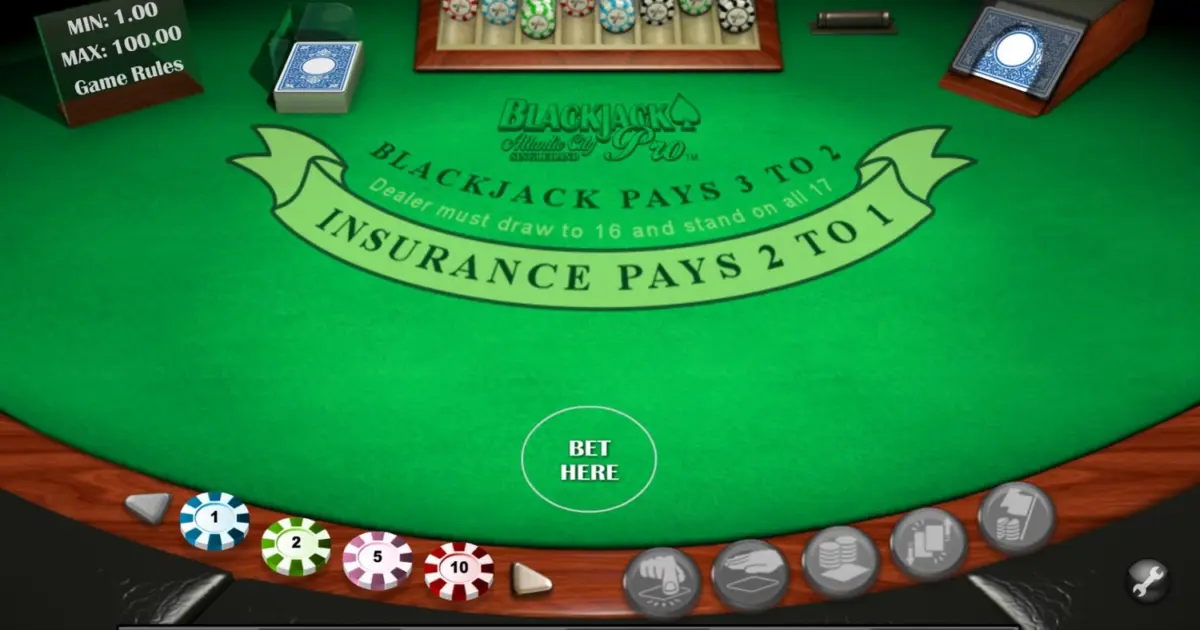
Black Jack Atlantic City SH sits above the provider’s average RTP, but it still trails the best Blackjack tables in our database. If you play perfect basic strategy on every hand, the maths are solid — but that “if” is doing a lot of heavy lifting. Here is what you need to know before you load a single hand in demo or real money.
Black Jack Atlantic City SH at a glance
NextGen Gaming powers this table under the Cards theme. A free demo is available with no download required, so you can test the interface and rule set before risking anything. The game ranks 30th in our database and sits in the 78th percentile for popularity, meaning it draws a decent crowd but is not one of the most-played titles on the site.
NextGen maintains four blackjack variants in total, with an average RTP across those tables of 98.84%. Atlantic City SH beats that provider average by 0.28 percentage points, which is a meaningful edge within the same studio’s catalogue. Against the broader corpus average of 99.41%, however, it sits 0.29% lower — a reminder that “good for this provider” and “good overall” are not the same thing.
| Provider | Nextgen Gaming |
|---|---|
| RTP | 99.12% |
| Theme | Cards |
| Free demo | Yes |
What a 99.12% RTP means at a blackjack table
An RTP of 99.12% translates to a house edge of 0.88%. In plain terms, for every $100 wagered over millions of hands, the mathematical return is $99.12 — but only if you follow perfect basic strategy on every single decision. No deviations, no hunches, no “I feel like standing here.”
Casual players who hit when they should double, or who split tens because it worked once last Tuesday, will realise a materially lower return. Basic strategy is a solved chart, not a feeling. If you do not know it cold, the real house edge you face is closer to 1.5–2.5%, depending on which mistakes you make and how often.
Demo play is useful for learning the interface and practicing basic strategy without financial risk, but it cannot predict real-money results. RNG tables reshuffle every hand, so each deal is independent — the cards have no memory.
The rules that move the house edge
The game’s name includes “Atlantic City,” which strongly suggests the standard Atlantic City rule set: eight decks, dealer stands on soft 17, and late surrender usually available. These are hints, not confirmed facts — you should check the in-game rules screen to verify before playing for real money.
Assuming Atlantic City rules hold, here is how they compare to the major house-edge movers. Dealer stands on soft 17 costs the house roughly 0.20% versus a hit-soft-17 table. Late surrender, when available, shaves another 0.07% off the edge — small, but at 99%+ RTP tables, every basis point matters. Eight decks add about 0.02% to the edge versus a six-deck shoe, which is negligible.
The single most damaging rule change in any blackjack variant is the blackjack payout. A 3:2 payout is standard at reputable tables. A 6:5 payout costs the player roughly 1.4% — more than every other rule change combined. If this table pays 6:5, walk away regardless of what the rest of the rules look like. NextGen typically uses 3:2 on their Atlantic City tables, but verify in the paytable.
Double-after-split and re-splitting aces each move the edge by a few hundredths of a percent. They matter at the margins, but they are not deal-breakers either way.
Basic strategy, and what it can and cannot do
Basic strategy is the mathematically optimal set of decisions for every possible player hand against every possible dealer up-card. It is not a system, it is not a progression, and it is not optional if you want that 99.12% RTP. It is a solved problem — there is no “better” strategy hiding behind a forum post or a YouTube video.
What basic strategy cannot do is eliminate the house edge. Even with perfect play, the dealer’s advantage on this table sits at 0.88%. Over a short session, variance dominates — you might win big or lose your entire bankroll. Over thousands of hands, the house edge grinds toward its expected value.
Card counting does not work against an RNG table that reshuffles every hand. There is no shoe to track, no penetration to exploit, no running count that means anything. If you are looking for a live dealer or shoe-dealt game where counting has any theoretical relevance, this is not it.
Betting progressions — Martingale, D’Alembert, “double after a loss” — change the shape of your variance, not the expected value. They can make small wins more frequent and large losses less frequent, but the house edge stays the same. A progression is a bankroll management choice, not a strategy, and it carries its own risk of catastrophic loss when a losing streak exceeds your table limit or bankroll.
Side bets and insurance
The available side bets for this table are not listed in the FACTS provided by NextGen Gaming. If any side bets appear in the game — Perfect Pairs, 21+3, or others — approach them with the understanding that they carry a significantly higher house edge than the base game. Side bets are independent propositions with their own maths, and they are almost always negative-expectation wagers for the player.
Insurance is a separate bet offered when the dealer shows an ace. At standard 2:1 odds, insurance is a losing bet in the long run. The true odds of the dealer having blackjack are worse than 2:1, meaning the house edge on insurance is substantial. Unless you are counting cards in a shoe-dealt game — which is not possible here — decline insurance every time.
Playing the Black Jack Atlantic City SH demo
The free demo is available with no download, directly in your browser. It uses the same RNG and rules as the real-money version, making it a genuine training tool for learning basic strategy or familiarising yourself with the interface. Treat it as practice, not as a predictor of future results — every hand is independent.
This is entertainment, not income. Set a budget before you play, whether demo or real money, and stick to it. You must be 18 or older to play. If gambling stops being fun, stop playing. There are resources available if you need help — the responsible gambling section of this site has links to support organisations.
Verdict: who should sit at this table
Black Jack Atlantic City SH is a competent, no-frills blackjack table with a 99.12% RTP that sits slightly below the site average but comfortably above the NextGen provider average. The Atlantic City rule set — if confirmed in-game — is one of the more player-friendly configurations available, with dealer stands on soft 17 and late surrender.
If you want a straightforward single-hand table with decent maths and a known rule set, this is a reasonable choice. If you are chasing the highest possible RTP, Classic Blackjack at 99.28% edges it out, and American Blackjack at 99.5% offers a better return. For a provider-comparison angle, Black Jack (MH) Portuguese matches this table’s RTP at 99.12% but adds multihand capability. The demo is free — try it, verify the rules, and decide for yourself.
Frequently Asked Questions
Can I play Black Jack Atlantic City SH for free?
Yes. A free demo is available with no download required. It uses the same RNG engine and rules as the real-money version, so you can practice basic strategy without risking anything.
What is the RTP of Black Jack Atlantic City SH?
The published RTP is 99.12%, translating to a house edge of 0.88%. This figure assumes perfect basic strategy on every hand — casual play will produce a lower effective return.
Does basic strategy guarantee a win?
No. Basic strategy minimises the house edge but cannot eliminate it. Over a short session, variance dominates; over thousands of hands, the house edge grinds toward its expected value.
Can card counting work on this table?
No. This is an RNG table that reshuffles every hand. There is no shoe to track and no penetration to exploit, so card counting provides no advantage whatsoever.
How does Black Jack Atlantic City SH compare to Classic Blackjack?
Classic Blackjack offers a 99.28% RTP, slightly higher than this table's 99.12%. The difference is small in practice, but if maximising RTP is your priority, the edge goes to Classic Blackjack.




