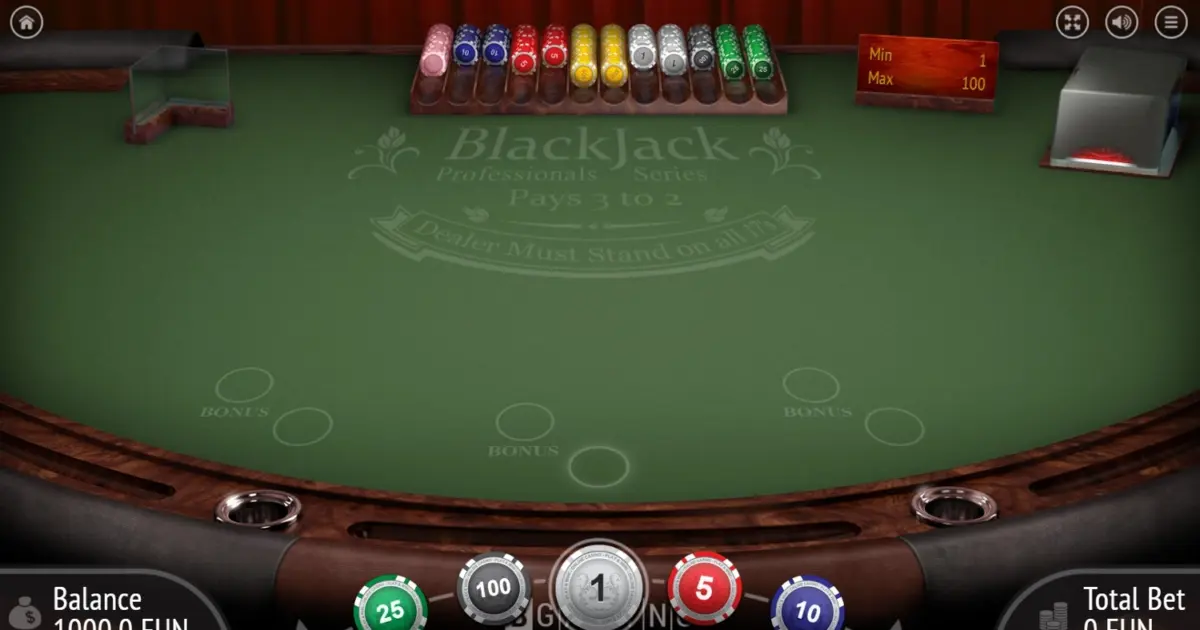
If you want a low-edge online table and you are willing to play accurately, blackjack mh pro is worth a look: BGaming lists its RTP at 99.4%, which sits at the tight end of what online blackjack offers. The catch is that BGaming does not publish the rule details for this table — deck count, dealer soft 17 behaviour, payout on a natural — so the figure arrives without the context that produces it.
That makes the free demo more than a curiosity here. It is the only way to read the actual rules screen before you stake anything.
Blackjack MH Pro in one minute
This is a BGaming title, and the “MH” in the name points to multihand play — dealing more than one hand per round against a single dealer hand. Treat that as a reading of the title rather than a confirmed feature, and check the game’s own interface before you assume how many hands you can open.
The published RTP is 99.4%. BGaming has six blackjack tables in this catalogue, averaging 99.38% RTP, so this one sits marginally above its own stablemates. It ranks 105th here and sits in the 21.8th popularity percentile, meaning it is not a heavily played table — which tells you about traffic, not about quality.
What is not published is the part experienced players care about most: how many decks are in the shoe, whether the dealer stands or hits on soft 17, whether a natural pays 3:2 or 6:5, and whether doubling after a split, re-splitting aces or late surrender are available. Every one of those moves the edge. A free demo is available, and the rules screen inside it is your source of truth.
| Provider | BGaming |
|---|---|
| RTP | 99.4% |
| Free demo | Yes |
House edge versus RTP: the numbers explained
RTP and house edge are the same number seen from opposite sides: house edge is 100% minus RTP. At 99.4% RTP, the house edge on this table is 0.6%, or six pence expected loss per £10 wagered over a very long run.
The caveat is not optional. That 0.6% assumes perfect basic strategy on every single hand — every hit, stand, double and split played to the chart, with no deviations for hunches. Play casually and the realised edge climbs quickly. Common casual errors cost real money: standing on soft 18 against a nine or ten, refusing to split eights against a strong dealer card, doubling too rarely. It is entirely possible to turn a 0.6% game into a 2% game through play alone, and the published figure will not warn you.
Rules move the number too, and here are the general magnitudes worth knowing. A 6:5 payout on blackjack instead of 3:2 is the single most damaging change in the modern game, costing roughly 1.4% — it alone would swamp the entire 0.6% edge several times over. A dealer who hits soft 17 costs you about 0.2%. More decks cost you a little, each extra deck adding a small fraction. Double after split, re-splitting aces and late surrender all give value back, typically between 0.05% and 0.15% each. Dealer peek versus European no-hole-card matters too: without a peek you can lose a doubled or split bet to a dealer natural.
How this table compares to other online blackjack
Against the wider field, 99.4% is competitive but not exceptional. The average across the blackjack tables catalogued here is 99.41%, so this table sits 0.01 percentage points below the corpus mean — a difference so small it is noise. What separates good tables from mediocre ones at this level is rule disclosure and rule quality, not the headline percentage.
Within BGaming’s own range, Blackjack MH (BGaming) lists 99.33%, so the Pro version is marginally tighter if you are choosing between the two. If you want a table that publishes a higher figure, Surrender Multihand Blackjack lists 99.48% and its name signals late surrender, a rule that genuinely returns value to a correct player. Multihand Blackjack Pro 2 lists 99.38%, effectively the same game economically.
The honest conclusion: differences of a tenth of a percent between these tables will be invisible across any session you actually play. Variance dominates at that scale. Choose on rules you can verify and an interface you find easy to play accurately in.
Basic strategy in practice
Basic strategy is not a system. It is the solved answer to the question “what is the mathematically best action for this hand against this dealer card”, derived from the rule set of the specific table. It has been computed exhaustively; there is nothing to discover and nothing to tune.
It also does not beat the house. Perfect basic strategy minimises the edge to whatever the rules allow — 0.6% here, if the published figure is accurate — and then stops. There is no line of play that takes it below zero against a fair table.
One practical wrinkle: the correct chart depends on the rules. A single-deck chart differs from a six-deck chart, and dealer-hits-soft-17 shifts a handful of decisions. Since BGaming does not publish those details, read the in-game rules first and use the matching chart. Guessing which chart applies costs more than the rule differences themselves.
Card counting is worth addressing plainly because the question always comes up. Against an RNG table that reshuffles the virtual shoe every hand, counting cannot work. Counting extracts value from the fact that dealt cards are removed from a finite shoe; if the shoe is restored before each round, there is no depletion to track and no advantage to build. If this table reshuffles per hand, and RNG blackjack normally does, a count is dead weight.
Betting systems and why they do not change the odds
Progressions — Martingale, D’Alembert, doubling after a loss, any variant — reshape the distribution of your outcomes. They do not touch expected value. Each hand’s edge is independent of the size of the bet placed on it, so multiplying stakes multiplies expected loss in exact proportion.
What a Martingale actually buys you is a high probability of many small wins and a small probability of one catastrophic loss, arriving when the losing run exceeds either your bankroll or the table maximum. The average of that distribution is the same 0.6% you started with. Table limits, which this table certainly has in some form though BGaming does not publish them, guarantee the sequence can be broken.
No hand is ever due. Each round is dealt from a fresh shuffle, independent of the last. Sensible bankroll practice is duller and more useful: pick a unit you can lose fifty or a hundred times without discomfort, keep it flat, and accept that even at a 0.6% edge a short session can swing well in either direction. Variance, not edge, decides what happens tonight.
The free demo
A Blackjack MH Pro free demo is available, and it earns its place given how much is unpublished. Use it to read the rules screen and note the deck count, the dealer’s soft 17 rule, the blackjack payout, and whether double-after-split, re-split aces and surrender are offered. Then check whether any side bets appear. Perfect Pairs and 21+3 style wagers carry house edges several times the base game — often in the 2% to 7% range — and insurance is a losing proposition at standard 2:1 odds regardless of how the hand looks.
The demo also lets you rehearse the chart until the decisions are automatic, which is where the RTP figure is actually earned. What it cannot do is predict real-money results: demo sessions are just short samples, and a good or bad run in one says nothing about the next.
Blackjack is 18+ entertainment, not income. Set a budget before you open the table, treat it as spent, and stop when it is gone rather than when you feel a turn is coming.
Verdict
A 99.4% RTP is a genuinely low-edge starting point, and BGaming’s figure is a fraction better than its sibling tables. But the published number is only the ceiling, reachable with perfect basic strategy and nothing less, and the rules that generate it are not disclosed here. Open the demo, read the rules screen, confirm the blackjack payout in particular, then decide.
Frequently Asked Questions
Can I play Blackjack MH Pro free with no download?
Yes. A free demo of Blackjack MH Pro is available in-browser with no download, running on play-money chips. It is the practical way to read the rules screen, check for side bets and rehearse basic strategy decisions. Demo results are short samples and tell you nothing about how a real-money session will go.
What is the Blackjack MH Pro RTP?
BGaming publishes 99.4% RTP for this table, equivalent to a 0.6% house edge. That figure assumes perfect basic strategy on every hand, with no deviations. Casual play raises the effective edge substantially, sometimes past 2%, through errors like standing on soft 18 or declining to split eights.
What house edge does Blackjack MH Pro have and what changes it?
The house edge is 0.6%, derived from the 99.4% published RTP. Rules move it: a 6:5 blackjack payout instead of 3:2 costs roughly 1.4%, dealer hitting soft 17 about 0.2%, while double-after-split, re-split aces and late surrender each return small amounts. BGaming does not publish these details.
Does card counting work on this table?
No. RNG blackjack normally reshuffles the virtual shoe before every hand, and counting only works when dealt cards stay out of a finite shoe. With no depletion to track, there is no advantage to accumulate. Betting progressions like Martingale fail for a different reason: they change variance, not expected value.
Who makes Blackjack MH Pro and how does it compare to their other tables?
BGaming, which has six blackjack tables in this catalogue averaging 99.38% RTP. This one lists 99.4%, above Blackjack MH (BGaming) at 99.33% and Multihand Blackjack Pro 2 at 99.38%. Surrender Multihand Blackjack lists a higher 99.48% and its name signals late surrender.




