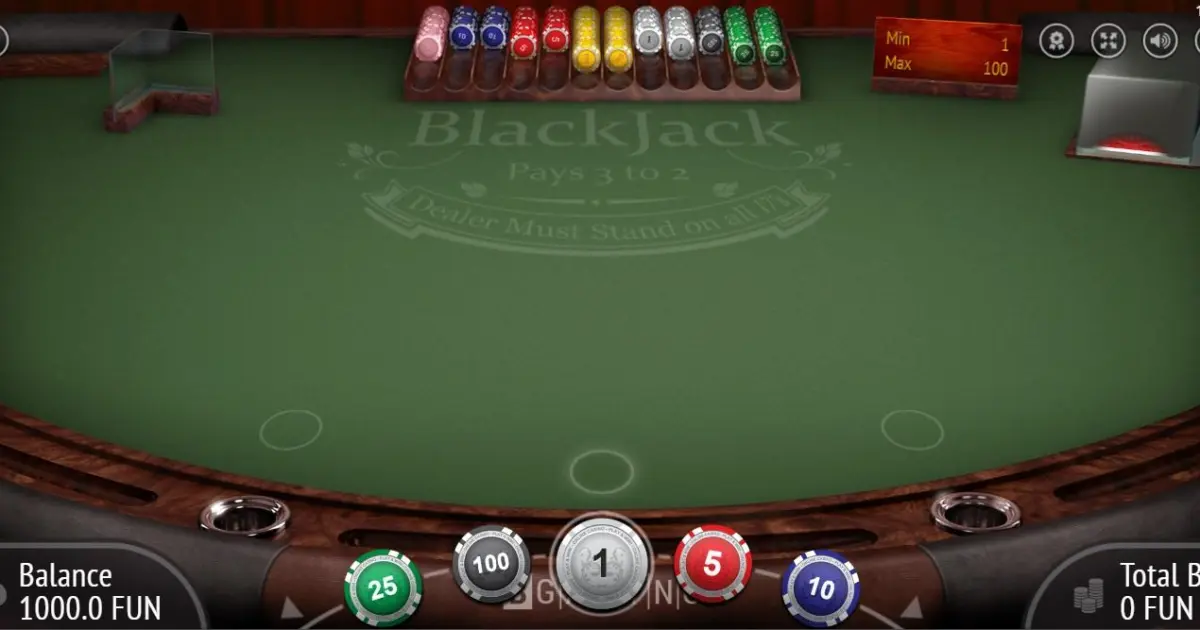
Blackjack MH (BGaming) is a solid multihand table that lets you play up to three spots simultaneously, returning 99.33% under perfect basic strategy. That figure sits a few hundredths below BGaming’s provider average of 99.38%, and the absence of published deck count or dealer rules means you’ll need to open the game and check the paytable yourself before committing real money. For a mathematically literate player, those missing details matter: each rule change moves the house edge by tenths of a percent, and a 6:5 blackjack payout alone costs you roughly 1.4%.
The “MH” abbreviation stands for multihand, so you’re betting and resolving two or three hands per round against a single dealer upcard. That accelerates action and variance but does nothing to alter the underlying edge. A free demo is available, which is the sensible place to confirm the rules and test your comfort with the faster pace before playing for money.
What kind of blackjack is Blackjack MH (BGaming)?
This is a standard RNG-based blackjack table with multihand functionality. You select one, two, or three betting circles at the start of each round, place your stake on each active hand, and play them in sequence against the dealer’s upcard. The deck reshuffles after every round, so card counting is irrelevant—there is no penetration, no shoe, and no memory between hands.
BGaming does not publish the number of decks in the shoe, whether the dealer hits or stands on soft 17, or the blackjack payout ratio in their promotional material. The game’s title offers no variant hint such as “European” or “Single Deck,” so you are working blind until you open the rules screen inside the client. For comparison, Multihand Blackjack Pro 2 from the same provider posts a 99.38% RTP with full rule transparency, and Surrender Multihand Blackjack reaches 99.48% by offering late surrender.
Multihand play suits players who want to smooth variance over a session by diversifying across multiple spots, though it also means you are putting two or three units at risk per round. It does not reduce the house edge, and it will not make a winning session more likely over any meaningful sample size.
Return to player: 99.33%
The published RTP of 99.33% translates to a house edge of 0.67%, assuming you execute perfect basic strategy on every decision. Basic strategy is the solved chart of correct plays for every possible player total versus dealer upcard, derived from combinatorial analysis of millions of simulated hands. It is not a betting system, and it does not turn the edge in your favor—it simply minimizes your long-run loss rate to that 0.67% figure.
A casual player who hits 16 against a dealer 7, stands on soft 18 against a 9, or takes insurance at standard 2:1 odds will realize a materially lower return, often in the range of 96–97%. The 99.33% figure is the ceiling, not the floor, and it requires disciplined adherence to the chart on every hand across hundreds of rounds.
| Metric | Value |
|---|---|
| RTP | 99.33% |
| House edge | 0.67% |
| Provider | BGaming |
| Provider average RTP | 99.38% |
| Corpus average RTP | 99.41% |
| Free demo | Yes |
At 99.33%, this table sits 0.05 percentage points below BGaming’s six-game blackjack catalog average and 0.08 points below the broader market average of 99.41%. That gap is small in absolute terms—over a thousand £10 hands it costs you roughly £8—but it is large enough to prefer Classic Multihand Blackjack at 99.38% if both are available at your casino and the rule sets are otherwise identical.
Deck count, dealer rules and the payout that matters most
BGaming does not publish the deck count, the dealer’s soft-17 rule, or the natural blackjack payout for this table in any external documentation. These three variables are the primary drivers of the house edge, and their absence from the marketing material is a meaningful omission.
The blackjack payout is the most critical. A traditional 3:2 payout (you receive £15 on a £10 bet) is the baseline assumption in all published house-edge figures. A 6:5 payout (you receive £12 on the same bet) increases the house edge by approximately 1.4 percentage points, turning a playable 0.67% edge into a punishing 2.07%. If this table pays 6:5 on naturals, the 99.33% RTP is incorrect, and you should not play it for real money.
The dealer’s soft-17 rule also moves the needle. A dealer who stands on all 17s (soft and hard) gives the player a lower house edge than a dealer who hits soft 17, typically by around 0.2%. The difference between a four-deck shoe and an eight-deck shoe costs the player roughly 0.06%, and the availability of double-after-split, re-split aces, or late surrender can claw back tenths of a percent in the other direction.
You must open the game client, navigate to the rules or paytable screen, and verify every one of these details before placing a real-money bet. The 99.33% figure is useless if you do not know which rule set it describes, and a single adverse rule can wipe out the entire advantage of choosing a higher-RTP table in the first place.
Playing your first ten hands
Start by opening the free demo and playing twenty or thirty hands with basic strategy in front of you. The chart is widely available online, and you should not attempt to memorize it before your first session—simply reference it on every decision until the common patterns (always split aces and eights, never split tens, hit 12 against dealer 2 or 3, stand on 17 or higher) become automatic.
Decide in advance how many hands you will play per round. Playing all three spots accelerates variance and triples your unit exposure per round, which shortens your session time if you are working from a fixed bankroll. Playing a single hand per round is slower and less volatile, and it gives you more time to consult the chart on marginal decisions.
The reshuffling RNG means you will see no streaks, no hot shoes, and no dealer bias. Every round is independent. A loss on one hand has no predictive value for the next, and a run of dealer twenties does not mean the next hand is “due” to go your way. The 0.67% edge is a long-run expectation, not a per-session promise, and short-term variance will dominate your results over ten, fifty, or even two hundred hands.
Avoid insurance. Insurance is a side bet that pays 2:1 when the dealer shows an ace and subsequently reveals a ten-value hole card for blackjack. At standard odds it is a losing proposition: roughly 30.8% of the unseen cards in a typical multi-deck shoe are ten-value, so the fair payout would be closer to 2.25:1. Taking insurance every time the dealer shows an ace increases the house edge on your overall action, and declining it every time is the correct basic-strategy play.
Side bets: the maths behind the temptation
BGaming does not disclose whether Blackjack MH offers side bets such as Perfect Pairs or 21+3 in its promotional material, so you will need to check the game interface. If side bets are present, treat them as separate propositions with separate—and significantly higher—house edges, typically in the range of 3% to 8% depending on the paytable and deck count.
Perfect Pairs pays out when your initial two cards form a pair, with higher payouts for suited pairs and mixed-suit pairs paying less. The edge on this bet varies with the number of decks and the specific payout structure, but it is always multiple times higher than the base game’s 0.67%. The same is true for 21+3, which pays on poker-hand combinations formed by your two cards and the dealer’s upcard (flush, straight, three of a kind, straight flush).
These bets are -EV (negative expected value) by design, and their appeal rests entirely on the higher volatility and larger maximum payout relative to a standard even-money or 3:2 blackjack win. If you are playing blackjack because you want the best return available on a table game, side bets are incompatible with that goal. If you are playing for entertainment and accept a higher cost per hour in exchange for occasional large wins, the decision is yours, but the maths is unambiguous.
Session limits and bankroll
Set a session budget before you open the game, denominated in buy-in units rather than hands played. A common rule of thumb is to carry at least 50 to 100 units for a session if you are playing a single hand per round, and more if you are playing multiple hands simultaneously. If your unit is £5 and you are playing two hands per round, you are putting £10 at risk each round, and a 50-unit bankroll covers 25 rounds—about fifteen minutes of play at a typical pace.
Blackjack variance is lower than slots but still significant. A 0.67% house edge does not prevent losing streaks of ten or more hands, and short-term results are dominated by the distribution of naturals, dealer busts, and double-down outcomes. Your session bankroll should be large enough to survive a drawdown of 20 to 30 units without forcing you to quit or chase losses by increasing your bet size.
Avoid any progressive betting system. Strategies such as the Martingale (double your bet after every loss) or D’Alembert (increase by one unit after a loss, decrease by one after a win) do not reduce the house edge. They change the shape of your variance—Martingale produces frequent small wins and occasional catastrophic losses, while flat betting spreads results more evenly—but your expected loss per unit wagered remains 0.67% regardless of bet sequencing. A bad run will deplete a Martingale bankroll faster than flat betting, and table limits will eventually prevent you from doubling indefinitely.
Responsible gambling is non-negotiable. Set your budget in advance, treat it as the cost of entertainment rather than a route to income, and walk away when it is gone. Blackjack offers one of the lowest house edges in the casino, but it is still a losing proposition over any significant sample size, and no strategy or system can change that. 18+. If gambling is affecting your finances or wellbeing, seek support from GamCare or a similar service in your jurisdiction.
Verdict on Blackjack MH (BGaming)
Blackjack MH (BGaming) is a competent multihand table with a respectable 99.33% RTP, placing it in the upper half of the market but slightly below BGaming’s own provider average and the corpus-wide benchmark. The multihand functionality is executed cleanly, and the free demo gives you ample opportunity to verify rules and test your approach before committing real money.
The critical weakness is the absence of published rule detail. A blackjack player choosing between tables at the same casino cannot make an informed decision without knowing the deck count, dealer soft-17 rule, and—most importantly—the blackjack payout. If this table pays 6:5 on naturals, the 99.33% figure is invalid, and you should walk away immediately. If it pays 3:2 and the other rules are standard, it is a playable option, though you may find fractionally better return at Surrender Multihand Blackjack (99.48%) or equal return with more transparent documentation elsewhere in BGaming’s catalog.
For a player who values rule transparency and wants to calculate exact house edge before sitting down, this table requires more work than it should. For a player who is comfortable opening the client, checking the paytable, and walking away if the rules are unfavorable, it is a solid choice within the multihand category. The 99.33% RTP is legitimate if the rules support it, and the game is worth your time if you confirm those rules first.
Frequently Asked Questions
Is Blackjack MH (BGaming) available to play for free?
Yes, a free demo is available. Use it to verify the full rule set—including deck count, dealer soft-17 rule, and blackjack payout—before playing for real money, since BGaming does not publish these details externally. The demo also lets you test multihand play and practice basic strategy without risk.
What is the RTP of Blackjack MH (BGaming) and does it assume perfect play?
The RTP is 99.33%, which translates to a 0.67% house edge. This figure assumes you execute perfect basic strategy on every hand across hundreds of rounds. Casual play without the strategy chart typically realizes a lower return, often in the 96–97% range, because common mistakes like taking insurance or misplaying soft hands cost you tenths of a percent per error.
Does card counting work on Blackjack MH (BGaming)?
No. This is an RNG-based table that reshuffles the deck after every single round, so there is no shoe penetration and no memory between hands. Card counting relies on tracking the changing composition of the remaining deck, which is impossible when the shuffle happens after each deal. The edge remains constant at 0.67% throughout your session.
How does Blackjack MH (BGaming) compare to other BGaming blackjack tables?
At 99.33% RTP, it sits slightly below BGaming's six-game catalog average of 99.38%. Surrender Multihand Blackjack from the same provider offers 99.48% RTP by including late surrender, which lets you forfeit half your bet on unfavorable hands and reduces the house edge by roughly 0.08%. If both are available at your casino and the base rules are otherwise identical, Surrender Multihand is the better choice.
What is the most important rule to check before playing Blackjack MH (BGaming) for real money?
The blackjack payout. A traditional 3:2 payout is the baseline for all published RTP figures, but a 6:5 payout increases the house edge by approximately 1.4 percentage points, turning a playable 0.67% edge into a punishing 2.07%. BGaming does not publish this detail, so you must verify it in the game's paytable before placing your first real-money bet.




