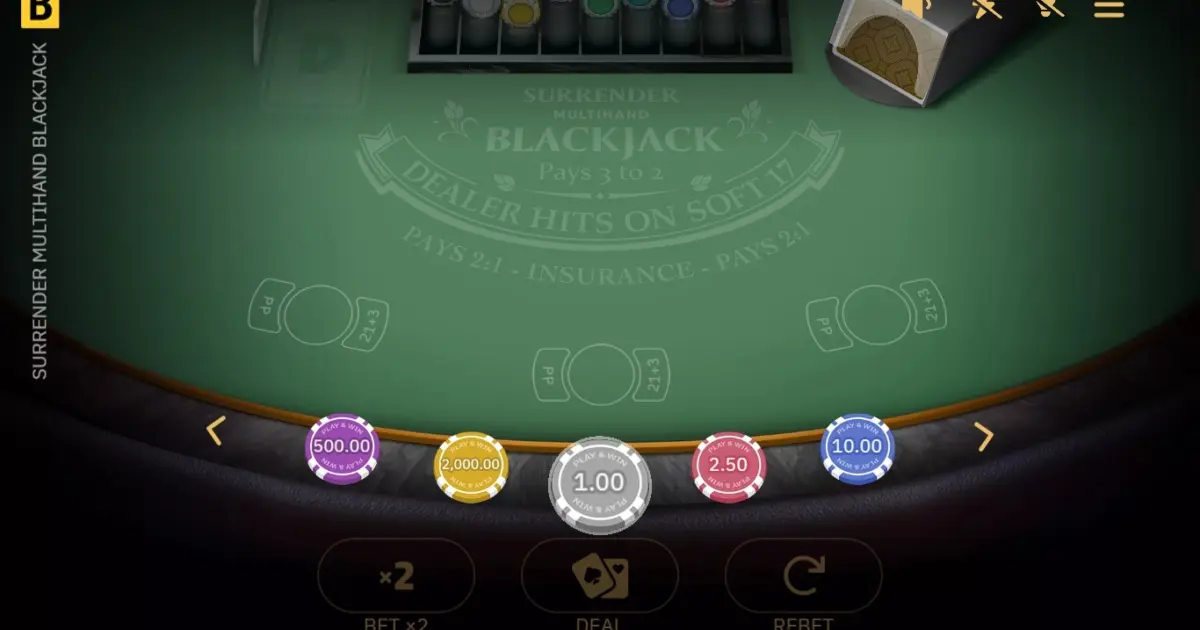
If you want a low-edge blackjack table to practise on, this one is worth your time on paper: BGaming publishes a 99.48% RTP for surrender multihand blackjack, which is a touch better than the 99.41% average across the tables reviewed here. The catch is the one that applies to every blackjack RTP figure ever published — it assumes flawless play, hand after hand.
The other thing to weigh is the multi-hand format. Dealing three or five boxes per round does not change the edge on any single hand, but it multiplies how much money crosses the table per hour. That matters more to your bankroll than a few hundredths of a percent of RTP.
Is Surrender Multihand Blackjack a fair table?
Yes, by the standard measure. A published return of 99.48% converts to a house edge of roughly 0.52%, which sits comfortably inside the range you would expect from a competently ruled RNG blackjack game. For every 100 units wagered across a very large sample of hands, the theoretical return is 99.48 units.
The caveat is not a footnote, it is the whole story. That figure is calculated on the assumption that every decision you make matches the optimal play for your hand against the dealer’s upcard. Miss a double, stand on a hand you should hit, take insurance once, and your realised return drops below the headline number immediately. Casual play typically gives back somewhere between one and two extra percentage points depending on how loose the decisions get. The RTP is a ceiling, not a promise.
It is also a long-run average. Over a single session of a few hundred hands, variance dominates completely. A 0.52% edge is invisible inside the noise of normal card distribution, in either direction. Demo results tell you nothing about what real-money play would have done.
| Provider | BGaming |
|---|---|
| RTP | 99.48% |
| Free demo | Yes |
BGaming and this table
BGaming keeps a small blackjack catalogue — six tables in total in this collection — with an average published RTP of 99.38%. This table sits above that average, so within the studio’s own range it is the stronger option on the return figure alone.
The rest of the lineup is close enough that the differences come down to rules and format rather than headline numbers. Blackjack MH (BGaming) is the studio’s plainer multi-hand table at 99.33%, so it is the natural comparison if you want to see what the surrender option is worth in return terms. Classic Multihand Blackjack lists 99.38% and is a reasonable place to start if you would rather learn the basic chart without an extra decision to remember. If you want another multi-hand table at the same 99.38% mark to compare paytables against, Multihand Blackjack Pro 2 is the other one to open.
None of these substitutes for reading the rules screen in the game itself, which is where the actual conditions live.
Rule set: what the title implies
The name carries two signals, and both are hints rather than confirmed rules.
“Surrender” indicates the table offers a surrender option, which normally means you can fold a poor hand after seeing the dealer’s upcard and recover half your stake. Where it is available, late surrender is a genuine player-favourable rule worth roughly 0.07% to 0.10% of edge — small, but free. It is also easy to misuse: surrender is correct on a narrow set of hands, mostly hard 15 and 16 against a strong dealer upcard, and folding outside that set costs you money rather than saving it. Check whether the table allows it before or after the dealer checks for blackjack, since that changes which hands qualify.
“Multihand” indicates you can play several boxes against one dealer hand in the same round. The per-hand maths is unchanged. What changes is exposure: three boxes at the same unit size means three times the money at risk per round, and the results correlate because every box faces the same dealer card.
BGaming does not publish the deck count, the dealer’s soft 17 rule, the blackjack payout, the doubling and splitting conditions, or the side bet menu for this table in the data available here. Those are the details that actually set the edge, so read the in-game paytable before you play for money.
The maths of a blackjack hand
Blackjack’s edge comes from one asymmetry: you act first, so you bust first. Everything else in the rule set adjusts how much that asymmetry costs you.
The rules that move the number most, as rules-of-thumb:
- Blackjack paying 6:5 instead of 3:2 costs the player around 1.4%. It is the single most damaging rule change in the game and it dwarfs everything else on this list.
- A dealer who hits soft 17 rather than standing costs roughly 0.2%.
- Fewer decks favour the player. Single deck is worth about 0.5% against an eight-deck shoe, all else equal.
- Double after split is worth roughly 0.15% to you; re-splitting aces adds a small amount more.
- A European no-hole-card dealer costs about 0.1% versus a peeking dealer, because you can lose doubled and split stakes to a dealer blackjack.
Basic strategy is the chart that turns those rules into the correct play for every hand. It is solved maths, not a system, and it is the reason the published RTP exists at all. It minimises the edge; it never removes it. Card counting is irrelevant here — an RNG table reshuffles every hand, so no information carries from one round to the next.
Common mistakes that cost you the edge
Insurance is the clearest one. At the standard 2:1 payout it is a losing bet regardless of your hand, and taking it because you are holding 20 does not improve it. Decline it every time.
Second is deviating from the chart on gut feel. Hitting 16 against a 10 feels wrong and is correct. Splitting 8s against a 10 feels worse and is still the better of two bad options. No hand is ever “due”, and the shuffle has no memory of the last one.
Third is side bets. Where a table offers Perfect Pairs, 21+3 or similar, the house edge on those wagers usually runs several percent — an order of magnitude above the base game. A few units per round on side bets can wipe out the entire benefit of the low base-game edge.
Finally, betting progressions. Doubling after a loss, D’Alembert, anything of that shape — these reshape your variance into rarer, larger swings. They do not change expected value by a single unit. Flat betting a unit you can afford across a full session is the honest approach.
Trying it free first
A free demo of Surrender Multihand Blackjack is available, and it is the right place to do three specific things: read the paytable and confirm the deck count, soft 17 rule and blackjack payout; drill the surrender decisions until you stop folding hands you should hit; and learn how the multi-hand interface handles doubles and splits across boxes before money is involved.
What demo play cannot do is forecast results. A good demo run and a bad one are both samples from the same distribution, and neither predicts what happens with real stakes.
Play only if you are 18 or over, set a budget before you open the table and stop when it is gone, and treat blackjack as entertainment you pay for rather than a source of income. A 0.52% edge still means the table wins over time.
Final take on Surrender Multihand Blackjack
The published return of 99.48% is genuinely competitive — above BGaming’s six-table average of 99.38% and above the 99.41% corpus average — and a surrender option, if the title reflects what the table actually offers, is a small rule in your favour. On the numbers available, this is a reasonable choice.
The honest qualifier is how much is unconfirmed. Without the deck count, the soft 17 rule and above all the blackjack payout, the 99.48% figure cannot be independently reconstructed. Open the rules screen first; if you find 6:5 blackjacks there, the maths changes more than any other detail on the page. Learn the chart, skip insurance and side bets, and size your unit for the fact that multi-hand play puts several bets on the felt at once.
Frequently Asked Questions
Can I play Surrender Multihand Blackjack for free?
Yes, a free demo of Surrender Multihand Blackjack is available with no download required. Use it to read the in-game paytable and confirm the rules BGaming does not publish externally, such as the deck count and blackjack payout, and to practise the surrender decisions. Demo outcomes do not predict real-money results.
What is the RTP of Surrender Multihand Blackjack?
BGaming publishes 99.48%, equating to a house edge of about 0.52%. That figure assumes perfect basic strategy on every hand — the correct hit, stand, double, split and surrender decision each time. Play casually and your realised return will be materially lower, typically one to two percentage points below the headline number.
How do the rules change the house edge on a blackjack table?
The blackjack payout matters most: 6:5 instead of 3:2 costs the player roughly 1.4%. A dealer hitting soft 17 costs around 0.2%, more decks cost up to 0.5%, and player-friendly rules like double after split and late surrender return small amounts. This table's specific rules are only listed in-game.
Does card counting work on Surrender Multihand Blackjack?
No. This is an RNG table, which reshuffles the deck before every hand, so no card information carries between rounds and there is nothing to count. Betting progressions such as Martingale or D'Alembert do not help either — they change the shape of your variance, not the expected value of the game.
How does it compare with other BGaming blackjacks?
BGaming lists six blackjack tables averaging 99.38% RTP, so at 99.48% this one is above the studio's own average. Blackjack MH (BGaming) sits at 99.33% and both Classic Multihand Blackjack and Multihand Blackjack Pro 2 list 99.38%, making this the strongest of the group on the published return figure alone.




