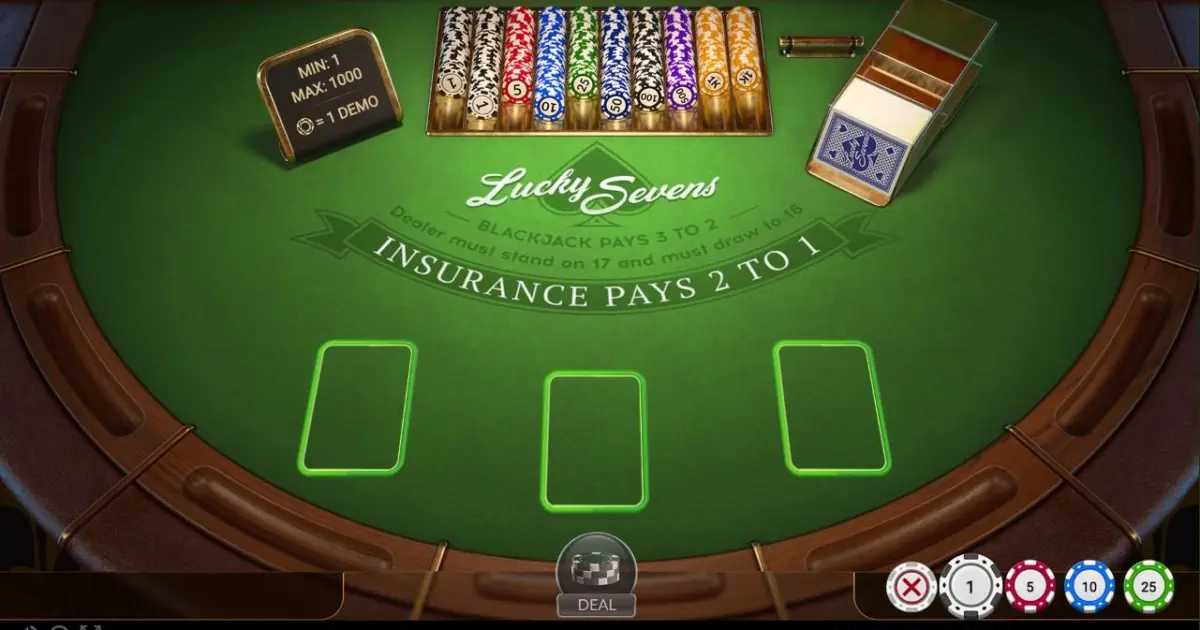
Blackjack Lucky Sevens by Evoplay posts a published RTP of 99.5%, which places it comfortably above the corpus average of 99.41% for online blackjack tables. That number, however, assumes you play perfect basic strategy on every single hand — no exceptions, no hunches. If you are a casual player who deviates from the chart even occasionally, your actual return will be materially lower. With that caveat firmly in mind, this is a table that gives you a reasonable mathematical foundation to work with.
Is Blackjack Lucky Sevens (Evoplay) a fair table?
The headline figure here is 99.5% RTP, which translates to a house edge of 0.5%. That is a competitive number in the online blackjack space, sitting 0.09 percentage points above the corpus average across all tracked tables. For context, the difference between a 99.5% RTP and a 99.0% RTP may sound trivial, but over thousands of hands it compounds: on a 99.5% table you lose roughly 50 cents per 100 units wagered in the long run, versus a full dollar on a 99.0% table. The published RTP assumes perfect basic strategy — a solved, deterministic chart that tells you the optimal play for every possible combination of your hand and the dealer’s upcard. Basic strategy does not eliminate the house edge; it minimises it. No betting system, progression, or “feel” for the cards does better. And because this is an RNG table that reshuffles before every hand, card counting is mathematically useless here. You cannot gain an edge by tracking previously dealt cards when the deck is reset each round.
| Provider | Evoplay |
|---|---|
| RTP | 99.5% |
| Theme | Cards |
| Free demo | Yes |
Evoplay and this table
Evoplay is the provider behind Blackjack Lucky Sevens, and this is one of just 2 blackjack titles in their current portfolio. Their provider average RTP across those tables sits at 99.6%, which is slightly above the 99.5% on this particular game — a difference of a tenth of a percent that reflects different rule sets or side-bet configurations between the two titles. If you want to see how Evoplay handles a seasonal twist on the same core maths, take a look at Blackjack Lucky 7s Xmas, which carries a 99.7% RTP and shares the Lucky Sevens naming convention. Evoplay is not the largest blackjack provider in the market, but having only two tables means they have concentrated their development effort rather than spreading it thin.
Rule set: what the title implies
The “Lucky Sevens” name is a strong hint at a side bet centred on sevens — a common blackjack side-bet theme where landing sevens in your initial hand or across a sequence pays a premium. However, Evoplay does not publish the full rule set for this table in the facts available to us, which means we cannot confirm specifics like the deck count, whether the dealer hits or stands on soft 17, the exact blackjack payout, or the precise mechanics of any Lucky Sevens side bet. This matters because these rules shift the house edge in measurable ways. A 3:2 blackjack payout versus 6:5 is the single most consequential rule difference in the game — 6:5 costs the player roughly 1.4% in expected value and is the rule change to watch for above all others. Dealer hitting versus standing on soft 17 moves the edge by a few hundredths of a percent. The number of decks, whether you can double after splitting, and whether re-splitting aces is allowed all contribute smaller but real adjustments. Before playing for real money, open the in-game rules or paytable screen and confirm these details yourself. The name tells you what to look for; only the paytable tells you what you actually get.
The maths of a blackjack hand
Every blackjack hand is a comparison between two totals: yours and the dealer’s. Your goal is to get closer to 21 without going over. Face cards count as 10, aces count as 1 or 11, and all other cards carry their face value. The dealer, meanwhile, plays by fixed rules — typically standing on 17 and above, hitting below. That asymmetry is the engine of the house edge: you must act first, and if you bust, you lose immediately regardless of what the dealer subsequently draws. Basic strategy accounts for this by telling you exactly when to hit, stand, double, or split based on probabilities across millions of simulated hands. The house edge in blackjack comes from two structural factors: the player busts before the dealer in roughly 16% of hands where both would otherwise have reached a valid total, and blackjacks pay less than the true odds of being dealt one (3:2 versus the roughly 2.25:1 true probability). These are not flaws in the game — they are the mathematical reality that a 99.5% RTP already reflects.
Common mistakes that cost you the edge
The most expensive mistake a player makes at any blackjack table is declining to learn basic strategy. Even small deviations — hitting a 12 against a dealer 4, or standing on 16 against a dealer 10 because it “feels” right — cost real percentage points over time. The second common error is taking insurance. Insurance is a side bet that the dealer has a blackjack when their upcard is an ace. At standard 2:1 payouts, insurance carries a house edge of roughly 7.7%, making it one of the worst bets on the felt. Declining insurance every time is part of basic strategy. The third trap is chasing side bets like Perfect Pairs, 21+3, or any Lucky Sevens variant. Side bets carry house edges that dwarf the base game — often 5% to 10% or more — because they pay infrequent large amounts. They are entertainment, not strategy. If you play them, size them as a small附加 cost of the session, not as a way to offset base-game losses.
Trying it free first
A free demo of Blackjack Lucky Sevens is available, and it is the right way to start. Demo play lets you learn the interface, confirm the rule set by reading the in-game paytable, and practise basic-strategy decisions without risking a single unit of real money. Use the demo to verify the deck count, the dealer’s soft-17 rule, and whether the Lucky Sevens side bet exists and what it pays — all the details that the title implies but that only the game screen can confirm. Treat demo results as practice, not as prediction: the RNG produces independent outcomes every hand, so a winning streak in demo tells you nothing about your next real-money session. If you decide to play for real, set a budget before you start and stick to it. Blackjack is entertainment, not income. Play within your means, be 18 or older, and stop when the session budget is gone.
Final take on Blackjack Lucky Sevens (Evoplay)
Blackjack Lucky Sevens is a solid, if unremarkable, entry in the Evoplay blackjack catalogue. The 99.5% RTP is competitive and sits above the corpus average, but it is only achievable with disciplined basic strategy on every hand. The Lucky Sevens name points toward a side-bet element that could add variety — or cost — depending on its house edge, and the full rule set needs to be confirmed in-game before you commit real money. Compared to Classic Blackjack at 99.28% RTP, this table gives you a slightly better mathematical starting point. Against Multihand Blackjack, which shares the same 99.5% figure, your choice comes down to whether you prefer single-hand or multi-hand play. If you want another Evoplay option at the same RTP, American Blackjack is worth comparing. For players who value transparency, the missing published rule details are a minor frustration — check the in-game screen and make your decision from facts, not assumptions.
Frequently Asked Questions
Can I play Blackjack Lucky Sevens (Evoplay) for free?
Yes, a free demo is available with no download required. The demo uses the same RNG and rules as the real-money version, so it is a good way to learn the interface and confirm the rule set before wagering anything.
What is the RTP of Blackjack Lucky Sevens (Evoplay)?
The published RTP is 99.5%, which assumes perfect basic strategy on every hand. A casual player who deviates from the chart will realise a lower return, so the 99.5% figure is a ceiling, not a guarantee.
Does the house edge change depending on the rules?
Yes. Rules like the blackjack payout (3:2 versus 6:5), whether the dealer hits soft 17, the number of decks, and double-after-split availability all shift the house edge by measurable amounts. Confirm these in the in-game paytable.
Can card counting give me an edge on this table?
No. This is an RNG table that reshuffles before every hand, so card counting has no effect. The deck composition resets each round, making it impossible to track card ratios for a mathematical advantage.
How does Blackjack Lucky Sevens compare to Classic Blackjack?
Classic Blackjack carries a 99.28% RTP while Blackjack Lucky Sevens posts 99.5%, giving the Evoplay table a slight edge in expected return. The difference is small over short sessions but compounds over thousands of hands.




