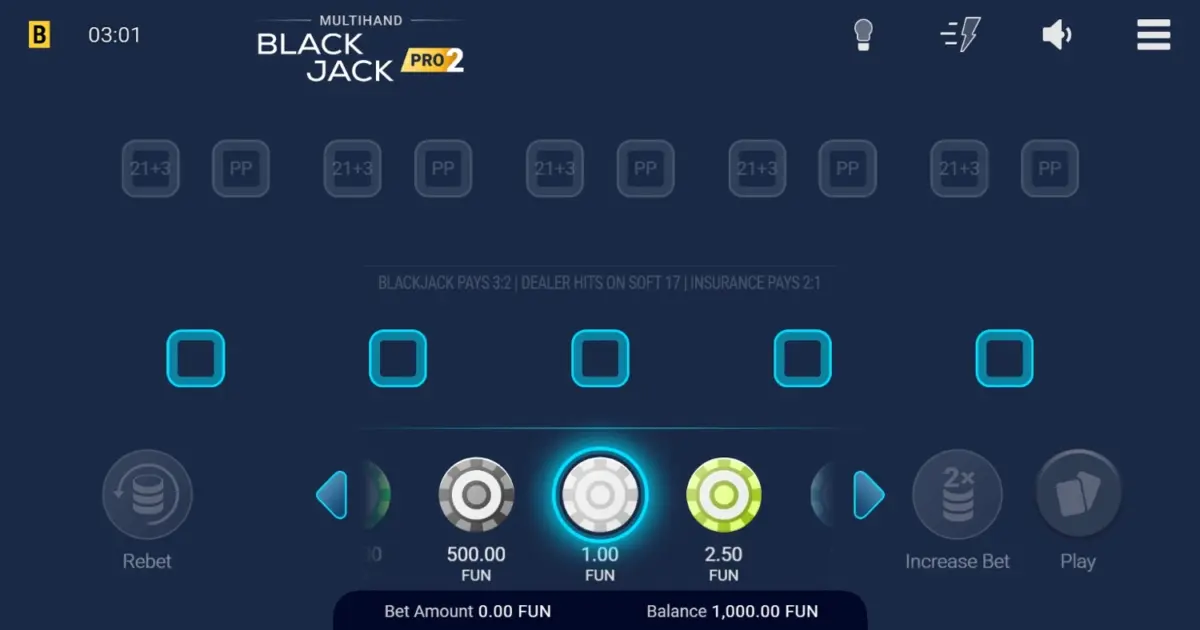
BGaming’s multihand blackjack pro 2 is a mid-tier entry in a crowded field. It sits at rank 60 with a popularity percentile of 55.6, meaning it attracts a steady but not exceptional player base. The published RTP of 99.38% is solid by industry standards, though it trails the corpus average by three hundredths of a percentage point. Whether that small gap matters depends on what else the table offers.
Multihand Blackjack Pro 2 at a glance
| Field | Value |
|---|---|
| Provider | BGaming |
| RTP | 99.38% |
| Variant | Multi-hand |
| Rank | 60 |
| Popularity percentile | 55.6 |
| Free demo | Available |
| Deck count | Not published |
| Blackjack payout | Not published |
| Soft 17 rule | Not published |
The three missing fields are the ones that most directly determine your actual edge. A 3:2 payout versus 6:5 swings the house advantage by roughly 1.4 percentage points, and the soft-17 rule shifts it by another 0.2%. Without confirming these in the game’s own rules screen, treat the 99.38% figure as BGaming’s best-case statement rather than a guarantee for your play.
What a 99.38% RTP means at a blackjack table
At 99.38% RTP, the implied house edge is 0.62%. That figure is mathematically valid only under one condition: you execute perfect basic strategy on every single hand, without exception. Basic strategy here means the optimal mathematical decision for each player-dealer card combination, derived from millions of simulation runs. A casual player who makes even a handful of errors per hour—hitting a 16 against a dealer 10, splitting tens, or taking insurance—realises a materially lower return.
Research into live blackjack play suggests that non-experts commonly add 1–2% to the house edge through suboptimal decisions. At a published 0.62%, your real edge could sit anywhere from 1.6% to 2.6% depending on how carefully you play. BGaming’s own portfolio averages 99.38% RTP across its six blackjack titles, so this table is the provider’s standard, not an outlier above it.
If you want to compare this figure against other tables in our database, Surrender Multihand Blackjack publishes a 99.48% RTP—ten basis points higher, largely attributable to the surrender option it names.
The rules that move the house edge
The game’s title and variant hint confirm it is a multi-hand table: you play several hands per round against a single dealer hand. This structure does not change the edge per hand, but it raises your hourly stake exposure proportionally. If you play three hands per round instead of one, you triple your wager per round, and a cold streak costs three times as much.
General rules-of-thumb that determine which side of 99.38% you land on:
- Blackjack payout: 3:2 is standard and favourable; 6:5 costs you roughly 1.4% and is the single most damaging rule change in the game.
- Dealer soft 17: if the dealer hits soft 17, the house gains approximately 0.2% over standing.
- Deck count: fewer decks favour the player. Single deck adds roughly 0.1–0.2% in the player’s favour compared to six or eight decks.
- Surrender: late surrender is worth about 0.07% back to the player.
- Double after split: typically adds 0.1–0.15% player value. Re-splitting aces adds another small amount.
BGaming does not publish the specific values for these parameters on this table. Open the in-game rules screen and confirm them before staking real money. The name “Pro 2” hints at a polished build but tells you nothing about the underlying rules.
Basic strategy, and what it can and cannot do
Basic strategy is a solved chart. For each combination of your two cards and the dealer’s upcard, it specifies the statistically correct action: hit, stand, double, split, or surrender. It is not a system, not a pattern, and not a prediction of future outcomes. It is a lookup table that minimises the house edge to the lowest achievable value under the given rules.
At a multi-hand table, basic strategy applies identically to each hand independently. The dealer’s upcard is shared across all your hands, so you will sometimes face the same decision on two or three seats simultaneously. The correct play does not change based on which seat you are in.
What basic strategy cannot do: eliminate the house edge. Even perfect play at the most favourable rules leaves the dealer with a small statistical advantage. No chart, no mnemonic, no “simplified” version replaces the full decision tree if you want to approach the published RTP.
Side bets and insurance
FACTS does not list specific side bets for this table. If the game offers Perfect Pairs, 21+3, or any other wager, it carries a significantly higher house edge than the base game—typically 2–7% depending on the specific side bet and its paytable.
Insurance deserves a standalone note. At standard odds, insurance is a losing proposition with a house edge of approximately 6% under common rules. Taking insurance “just in case” or “when the dealer shows an ace” is not a protective strategy; it is a separate bet with inferior mathematics. Skip it.
If you want a side-bet-free environment, compare with Classic Multihand Blackjack which may present a cleaner ruleset, though you will need to check its own paytable for details.
Playing the Multihand Blackjack Pro 2 demo
A free demo version is available through BGaming. Demo play lets you rehearse basic strategy decisions without financial risk and familiarise yourself with the multi-hand layout. However, demo play does not predict real-money results. The random number generator treats every hand independently, and outcomes in a demo carry no information about future outcomes in a funded session.
Use the demo to learn the interface and to drill decision-making under time pressure—multi-hand rounds move faster than single-hand play, and the cognitive load of tracking several simultaneous decisions is non-trivial. Set a bankroll before you play for real, treat the budget as entertainment cost, and never chase losses. You must be 18 or older to play this game for money.
Card counting does not work here. The table uses an RNG that reshuffles every hand, so no deck-composition information carries from one round to the next. Any betting progression—Martingale, D’Alembert, or otherwise—changes the shape of your variance but not the expected value. The house edge persists regardless of how you size your bets.
Verdict: who should sit at this table
Multihand Blackjack Pro 2 is a reasonable choice for players who want faster round volume and are comfortable managing multiple decisions simultaneously. The 99.38% RTP places it at BGaming’s portfolio average and within striking distance of the broader market. The main caution is the incomplete public rule data: until you confirm the blackjack payout, deck count, and soft-17 treatment in the game itself, you cannot be certain whether your actual edge matches the advertised one.
If you prefer a lower hourly exposure, Blackjack MH (BGaming) by the same provider offers a single-hand alternative at a marginally lower 99.33% RTP. The trade is straightforward: slightly worse published return, but one decision per round and proportionally lower variance per hour.
Frequently Asked Questions
Can I play Multihand Blackjack Pro 2 for free?
Yes. BGaming provides a free demo version of this table. You can play without staking real money to learn the multi-hand layout and rehearse your decisions. The demo uses the same RNG and rules as the real-money version, though outcomes are of course separate from any funded session.
What does the 99.38% RTP mean for Multihand Blackjack Pro 2?
The 99.38% RTP figure assumes you execute perfect basic strategy on every single hand without error. A casual player who makes a few incorrect decisions per hour will realise a materially lower return, potentially adding 1–2% to the effective house edge. The published number is a theoretical ceiling, not a guarantee.
Is a 0.62% house edge good for a blackjack table?
Zero point six two percent is competitive for an online blackjack game and reflects BGaming's portfolio average. However, the actual edge you face depends on rules BGaming does not publish externally, including the blackjack payout ratio, deck count, and soft-17 treatment. Confirm these in the game's own rules screen before playing.
Does card counting work on Multihand Blackjack Pro 2?
No. This is an RNG-based game that reshuffles the virtual deck every hand, so no information from previous cards carries forward. Card counting requires deck penetration and a shoe that persists across multiple rounds, neither of which exists at this table. Any strategy claiming to beat this format is not grounded in how the game actually operates.
How does Multihand Blackjack Pro 2 compare to Surrender Multihand Blackjack?
Surrender Multihand Blackjack publishes a 99.48% RTP, ten basis points higher than this table's 99.38%. The difference likely comes from the late-surrender option, which returns roughly 0.07% to the player under standard rules. If surrender is available at a table you prefer, it is worth using.




