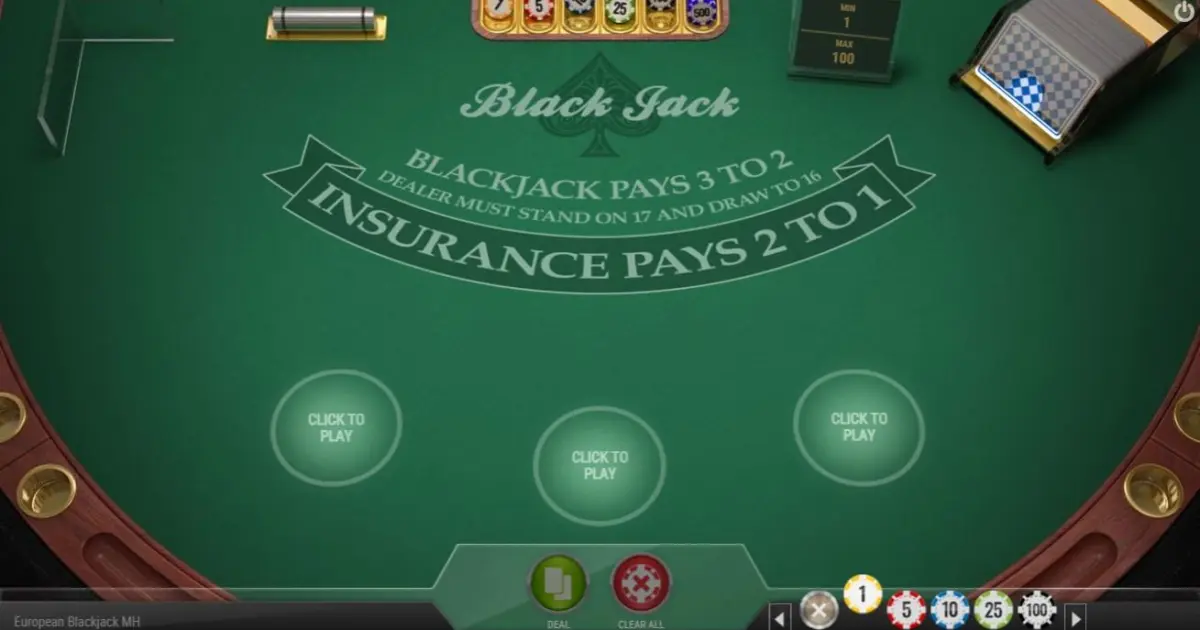
European Blackjack MH sits at the top end of the RTP range for blackjack tables, and the “MH” multi-hand format lets you play up to three hands simultaneously. The European rule set changes the flow of the game in one critical way: the dealer does not take a hole card until after you’ve completed all your actions, so a dealer blackjack can claim your doubled and split bets. That risk is small—around 0.11% of additional house edge—but it exists, and it changes correct basic strategy on a handful of marginal plays.
Play’n GO does not publish the full rule set in the lobby, so you’ll need to check the in-game paytable to confirm the deck count, the blackjack payout ratio, and whether the dealer hits or stands on soft 17. Those three figures move the house edge by enough to matter, and a single rules change can erase the difference between a strong table and a mediocre one.
What kind of blackjack is European Blackjack MH?
The title indicates European rules, which normally means the dealer takes no hole card until the player finishes all actions. In American blackjack, the dealer peeks for blackjack immediately when showing an ace or ten-value card, and the hand ends before you risk a double or split. In European blackjack, you complete your hand first—you can double down or split—and then the dealer draws. If the dealer makes blackjack, you lose your original bet plus any additional money you put into play. This is sometimes called the “no peek” or “ENHC” (European No Hole Card) rule.
The multi-hand option lets you play up to three spots at once from a single balance. Each hand is independent, and you make separate decisions for each one. The variance scales with the number of hands, so your bankroll swings will be larger than they would be on a single-hand table, even if your total bet per round stays the same.
European Blackjack MH is an RNG table that reshuffles after every hand, so the composition of the remaining deck never changes and card counting does not work. The shuffle happens whether you play one hand or three, and no betting system or progression can overcome the house edge built into the rules.
Return to player: 99.5%
Play’n GO states the RTP for European Blackjack MH at 99.5%, which translates to a house edge of 0.5%. That figure assumes you play perfect basic strategy on every hand—every hit, stand, double, and split decision taken from the solved chart for the specific rule set in play. A casual player who relies on intuition or partial strategy will realize a materially lower return, often in the range of 97–98%, because each mistake adds to the house edge.
| Metric | Value |
|---|---|
| RTP | 99.5% |
| House edge | 0.5% |
| Provider | Play’n GO |
| Popularity percentile | 97.7% |
| Free demo | Yes |
The 99.5% RTP sits in line with Play’n GO’s other blackjack tables—BlackJack MH and Single Deck BlackJack MH both publish the same figure—and slightly above the corpus average of 99.41% for blackjack games on this site. The European no-hole-card rule adds roughly 0.11% to the house edge compared to an otherwise identical American table, but that cost is already reflected in the published 99.5% figure, so you don’t subtract it again.
Deck count, dealer rules and the payout that matters most
Play’n GO does not publish the deck count, the dealer’s soft-17 action, or the blackjack payout ratio for European Blackjack MH in the game lobby. You must open the rules screen inside the game to confirm these details before you play for money, because each one moves the house edge by a meaningful amount.
The blackjack payout is the single most important rule. A 3:2 payout—meaning a £10 bet on blackjack returns £15 in winnings—is standard and correct. A 6:5 payout, sometimes offered on single-deck or low-limit tables, returns only £12 on that same £10 bet and costs you roughly 1.4% in edge. That single change is more damaging than any other rule variation, and it turns a strong table into a poor one. If European Blackjack MH pays 6:5, walk away.
The deck count matters less than the payout, but it still moves the edge. A single-deck game with otherwise identical rules gives the player an advantage of around 0.5% over a six-deck shoe. An eight-deck shoe adds roughly 0.05% to the house edge compared to six decks. The difference is small, but it compounds with the other rules, and blackjack players track these figures because the margins are tight.
Whether the dealer hits or stands on soft 17 changes the edge by about 0.2%. A dealer who stands on soft 17 (often written “S17”) is better for the player; a dealer who hits soft 17 (“H17”) gives the house a larger advantage. Check the rules screen.
Playing your first ten hands
Load the free demo and play a few hands to confirm the interface and the rule set before you commit real money. The multi-hand layout will show up to three betting circles, and you can activate as many as you want by placing chips on each spot. The minimum and maximum stakes apply per hand, so if you play three hands at the table minimum, you’re betting three times that amount per round.
Basic strategy for European blackjack differs from American strategy in a small number of situations, all involving doubles and splits against a dealer ten or ace. Because the dealer does not peek for blackjack, you can lose your doubled or split bets to a dealer natural, and that risk changes the correct play. In a European game, you should not double 11 against a dealer ace, and you should not split 8s against a dealer ace if the table does not allow surrender. These plays are correct in American blackjack, but the no-hole-card rule makes them losing moves in European blackjack.
The rest of basic strategy—hitting 16 against a dealer 7 through ace, standing on 17 or higher, doubling 10 and 11 against weak dealer upcards, splitting aces and 8s in most situations—remains the same. If you’re using a strategy chart, make sure it’s labeled for European or ENHC rules. A chart built for American blackjack will cost you money on those marginal hands.
The first ten hands will show you whether the dealer’s blackjack ends the round immediately or whether you finish your actions first. If you double down and then the dealer flips a blackjack, you’ve just confirmed the European rule is in effect. It’s a small detail, but it’s the defining characteristic of this variant, and you need to know it before you make a strategy error that costs you a doubled bet.
Side bets: the maths behind the temptation
Play’n GO does not specify which side bets, if any, are available on European Blackjack MH. Common side bets on blackjack tables include Perfect Pairs, 21+3, and insurance. All of them carry a house edge significantly higher than the base game, often in the range of 3–7%, and they are designed to increase the casino’s revenue per round, not to improve your expected return.
Insurance is offered when the dealer shows an ace, and it pays 2:1 if the dealer has blackjack. At standard odds, insurance is a losing bet. The true odds of the dealer having a ten-value card in the hole are worse than 2:1, so the house edge on insurance is around 7.5% in a multi-deck game. You should decline insurance on every hand, including your own blackjacks, unless you are counting cards in a live shoe game—and European Blackjack MH is an RNG table that reshuffles every hand, so counting does not apply.
Perfect Pairs pays if your first two cards are a pair, with higher payouts for suited or identical pairs. The house edge on Perfect Pairs varies by paytable but typically sits between 4% and 7%. 21+3 pays if your first two cards and the dealer’s upcard make a poker hand such as a flush or straight, and the edge is similarly high. Both side bets add volatility and entertainment value, but they lower your overall return. If you want to minimize the house edge, ignore the side bets and play the base game only.
Session limits and bankroll
Blackjack variance is lower than slots but higher than even-money bets on roulette. A session of 100 hands played at perfect basic strategy will see swings of several dozen units in either direction, and short-term results are a poor guide to long-term expectation. The house edge grinds slowly, and you can finish a session ahead even when the maths is against you, or down even when you played correctly.
A safe bankroll for a blackjack session is at least 50 times your average bet per hand. If you’re playing three hands simultaneously, multiply your single-hand unit by three to find your effective bet per round, and size your bankroll accordingly. A £5 single-hand player needs £250 to weather normal variance; a £5 three-hand player is effectively betting £15 per round and needs £750. These are minimums for recreational play, not guarantees against ruin.
No betting progression—Martingale, D’Alembert, doubling after a loss—changes the house edge. Progressions change the shape of the variance, making it more likely you’ll either win quickly or lose your entire bankroll, but they do not improve your expected value. The house edge applies to every pound wagered over time, regardless of how you vary your stakes.
Set a budget in advance, treat blackjack as entertainment rather than income, and stop when the money allocated to the session is gone. This is a game of skill within a negative-expectation framework: you can minimize the house edge, but you cannot eliminate it. Play only with money you can afford to lose, and remember that demo results do not predict real-money outcomes. 18+.
Verdict on European Blackjack MH
European Blackjack MH offers a strong 99.5% RTP and the flexibility to play up to three hands at once, but Play’n GO’s decision not to publish the full rule set in the lobby is frustrating for a maths-literate audience. You need to know the blackjack payout ratio, the deck count, and the dealer’s soft-17 action before you can confirm the house edge, and those details should be visible before you open the game.
The European no-hole-card rule is a legitimate variant with a solved strategy, not a trap, but it does add a small cost compared to American blackjack, and it requires adjustments to basic strategy on a handful of double and split decisions. If you’re used to American rules, take the time to review a European strategy chart before you play for money, or you’ll make mistakes that cost you doubled bets.
The multi-hand format increases variance and speeds up play, which means you’ll see more hands per hour and experience larger bankroll swings. If you prefer a slower pace or tighter control over your exposure, play one hand at a time. If you want action and can manage the variance, the three-hand option is a valid choice, but it does not improve your edge—it just compounds it across more simultaneous hands.
Compared to American Blackjack, European Blackjack MH gives up a small fraction of edge in exchange for the no-peek rule, and the published RTP is identical at 99.5%, so the difference is already accounted for. The game is solid if the blackjack payout is 3:2 and the other rules are favorable. Check the paytable first, play perfect basic strategy, and ignore the side bets. The maths works if you do.
Frequently Asked Questions
Is European Blackjack MH available in free demo mode?
Yes, European Blackjack MH offers a free demo with no registration required. The demo uses the same rule set and RTP as the real-money version, so it's a reliable way to confirm the interface, the dealer's soft-17 action, and the blackjack payout ratio before you play for money. Demo results do not predict real-money outcomes because variance dominates over short sessions.
What is the RTP of European Blackjack MH and does it assume perfect play?
Play'n GO publishes the RTP at 99.5%, which assumes perfect basic strategy on every hand—every hit, stand, double, and split taken from the solved chart for European no-hole-card rules. A casual player who makes intuitive decisions or uses partial strategy will realize a lower return, often in the range of 97–98%, because each mistake adds to the house edge.
Can I count cards on European Blackjack MH?
No. European Blackjack MH is an RNG table that reshuffles the deck after every hand, so the composition of the remaining cards never changes and card counting does not work. The shuffle happens whether you play one hand or three, and no betting system or card-tracking method can overcome the house edge built into the rules.
How does the European no-hole-card rule affect my strategy and the house edge?
The European rule means the dealer does not take a hole card until after you complete all actions, so a dealer blackjack can claim your doubled and split bets. This adds roughly 0.11% to the house edge and changes correct basic strategy on a few marginal plays: you should not double 11 against a dealer ace, and in some rule sets you should not split 8s against a dealer ace. Use a strategy chart labeled for European or ENHC rules.
Does European Blackjack MH pay 3:2 or 6:5 on blackjack?
Play'n GO does not publish the blackjack payout ratio in the game lobby, so you must check the in-game rules screen before you play for money. A 3:2 payout is standard and correct; a 6:5 payout costs you roughly 1.4% in edge and turns a strong table into a poor one. If the game pays 6:5, find a different table—the damage to your return is larger than any other single rule change.




