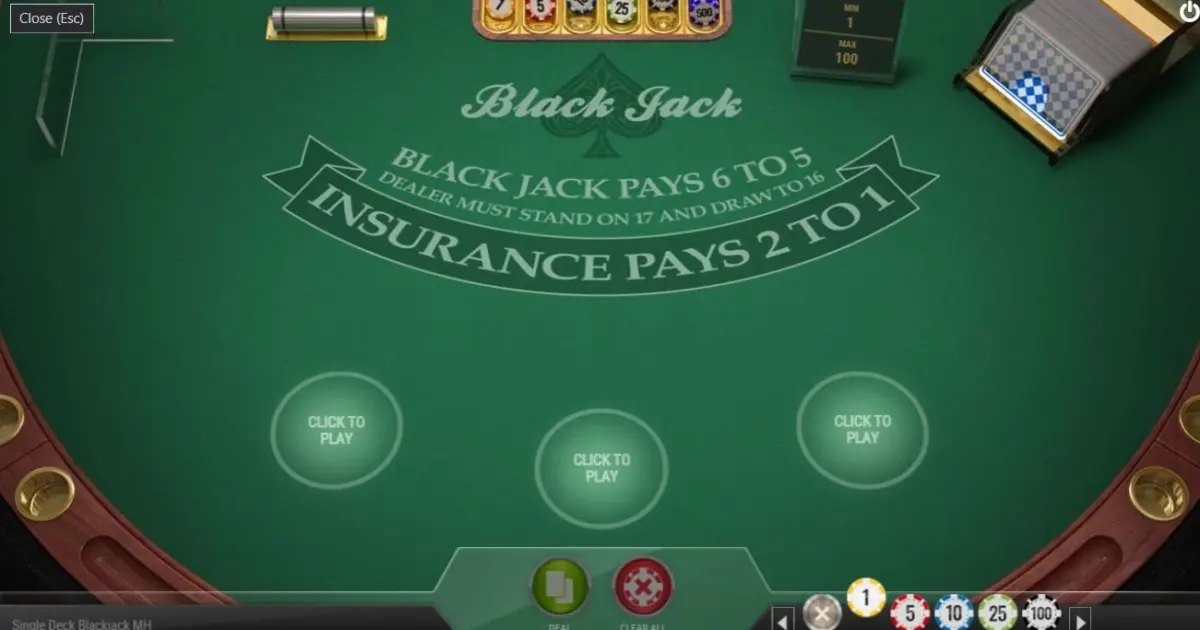
Single Deck BlackJack MH is one of three blackjack tables Play’n GO offers, and at 99.5% RTP it sits just above the 99.41% average across this review site’s entire blackjack corpus. The title’s name points to a single-deck format, which normally reduces the house edge compared to multi-deck games, but the rules that determine your actual return are not published by the provider and must be checked in the game itself before you risk money. If you already know basic strategy and want a clean, low-edge table where you can verify the rules on your own time, this is a reasonable demo to start with.
Single Deck BlackJack MH at a glance
Here is what the available data tells us and, just as importantly, what it leaves open. The table below lists every confirmed figure; everything else requires checking the in-game rules screen.
| Attribute | Value |
|---|---|
| Provider | Play’n GO |
| Published RTP | 99.5% |
| Implied variant | Single Deck (by title; confirm in-game) |
| Free demo | Available |
| Deck count | Not published |
| Blackjack payout | Not published |
| Dealer soft-17 rule | Not published |
| Side bets offered | Not published |
| Table limits | Not published |
The gaps are not trivial. In blackjack, two rules — the payout on a natural and whether the dealer hits or stands on soft 17 — can swing the house edge by more than a full percentage point. A published RTP of 99.5% is consistent with a player-friendly rule set, but without confirmation you are making an educated inference, not reading a fact.
What a 99.5% RTP means at a blackjack table
In blackjack, RTP is simply 100% minus the house edge under the game’s specific rule set. A 99.5% figure implies a house edge of roughly 0.5%, which is competitive. The critical caveat that separates a meaningful number from a hollow one is this: that figure assumes perfect basic strategy on every single hand. A player who deviates even occasionally — hitting a 16 against a dealer’s 10, or standing on a soft 18 versus a 9 — realises a materially lower return. In practice, a casual player who plays intuitively rather than chart-first might see effective RTP closer to 97–98%, sometimes lower. The number on the paytable is a ceiling, not an expectation for anyone who has not memorised the strategy card.
Play’n GO’s average across its three blackjack titles is also 99.5%, so this table is not an outlier within the provider’s own portfolio. For comparison, European Blackjack MH carries the same 99.5% RTP but implies a no-hole-card structure, which is a different risk profile entirely — you lose your full stake on a dealer blackjack when doubling or splitting, a rule that pushes the effective edge against the player even when the published number matches.
The rules that move the house edge
The title “Single Deck” is a strong hint about the format, and if confirmed in-game it carries genuine strategic implications. Fewer decks mean that removing cards from play shifts the composition of what remains more sharply than in a six- or eight-deck shoe. The mathematics of the game favours the player under these conditions — a ten-value card is proportionally more likely to be dealt from a single deck once a few tens have already appeared — and the house edge is typically several hundredths of a percent lower than in a multi-deck game with otherwise identical rules.
However, “typically” does not mean “always.” Operators claw back that theoretical player advantage through rule tweaks that cost far more than the deck count saves. The two most common and damaging are a 6:5 payout on blackjack instead of 3:2, which alone adds roughly 1.4% to the house edge, and a rule requiring the dealer to hit soft 17, which adds another 0.2–0.3%. Other moves that matter, in descending order of impact, include restricting doubling to certain totals, prohibiting double after split, not allowing re-splitting of aces, and offering no late surrender. Without Play’n GO publishing the specific rule set for this table, none of these can be confirmed or denied from the outside. Open the in-game rules or paytable screen in the demo and check each one before playing for money.
Basic strategy, and what it can and cannot do
Basic strategy is a fixed chart, not a system, a pattern, or a gut feeling. For every possible player hand against every dealer up-card, the chart specifies the single decision that minimises the house edge. It was solved computationally in the 1950s and remains the same whether you play in a land-based casino, a live dealer stream, or a fully RNG-driven table like this one. The chart is not one-size-fits-all: a single-deck game with stand on soft 17 uses slightly different decisions than an eight-deck shoe with hit on soft 17. Once you confirm this table’s rules, source the matching chart rather than relying on a generic one.
Playing perfect basic strategy does not eliminate the house edge. It brings it as low as the rules allow — nothing more. No sequence of correct plays produces a positive expected value over time. If someone tells you otherwise, they are describing a different game or selling you something.
Card counting, which does work in theory against physical shoes that are not shuffled after every hand, has no application here. An RNG table that reshuffles the deck every deal produces independent events, meaning there is no informational edge to extract from previously dealt cards. Any system that claims otherwise is mathematically incoherent in this context.
Side bets and insurance
Play’n GO does not list which side bets, if any, are available on this table. This absence is itself informative: if Perfect Pairs or 21+3 are present, their house edges typically run between 3% and 9% or more, depending on the specific paytable, which means they are substantially worse bets than the base game regardless of the 99.5% headline figure. Insurance — offered when the dealer shows an ace — is a separate bet that the dealer holds a ten-value card. At standard eight-deck odds, insurance pays 2:1 while the true probability of a dealer blackjack is roughly 30.8%, giving the bet a house edge of about 6%. A single deck slightly changes the arithmetic in the player’s favour but not enough to make insurance a positive-expectation wager under normal conditions. If this table offers insurance, treat it as a side bet and not as protection.
Playing the Single Deck BlackJack MH demo
The demo is free and available without registration, which makes it the right place to confirm what this article cannot. Play through the rules screen, note the blackjack payout ratio, check whether the dealer stands or hits on soft 17, and observe how many decks appear in the shoe graphic. If any of those details are buried or ambiguous, that itself tells you something about how seriously the table treats player transparency.
One practical note on bankroll management that applies to any blackjack table: set a session budget before you start and treat it as the cost of entertainment, not as an investment with an expected return. Blackjack variance is high enough that even a skilled player can face long losing runs against the rules. If you are gambling online, you must be 18 or older, and the amount you set aside should be money whose loss you can absorb without financial stress. No table, no strategy, and no demo session changes that arithmetic.
Verdict: who should sit at this table
Single Deck BlackJack MH earns a place on a shortlist for players who already know basic strategy cold, who take the time to verify the rules before wagering, and who want a clean RNG format without the overhead of a live dealer stream. The 99.5% RTP is solid by blackjack standards, and if the single-deck hint proves accurate and no punitive rule tweaks are in play, your actual edge will be among the lower ones available from Play’n GO’s blackjack range. If any of those conditions are not met, the number is just marketing arithmetic with your name on it. Compare it against American Blackjack, which follows a different rule lineage and may suit players who prefer multi-deck shoes with clearly stated parameters.
Frequently Asked Questions
Can I play Single Deck BlackJack MH for free?
Yes. Play'n GO's Single Deck BlackJack MH has a free demo available on this site with no registration required. The demo is useful for checking the in-game rules screen, which is the only place to confirm the blackjack payout, soft-17 treatment, and deck count that Play'n GO does not publish externally.
What does the 99.5% RTP actually mean in practice?
A 99.5% RTP implies a house edge of roughly 0.5%, but only when you play perfect basic strategy on every hand. A casual player who makes intuitive decisions instead of chart-based ones will realise a noticeably lower return, possibly in the 97–98% range depending on how many deviations occur per session.
Does the single-deck format lower the house edge?
Fewer decks generally shift the mathematical edge a few hundredths of a percent in the player's favour compared to multi-deck games. However, operators routinely compensate through 6:5 blackjack payouts or dealer hits on soft 17, each of which adds significantly to the house edge. Confirm the specific rules in-game before assuming any advantage.
Can card counting work at this table?
No. Single Deck BlackJack MH is an RNG-driven game that reshuffles the deck every hand, producing independent events with no memory of previous deals. Card counting requires a non-reshuffled shoe where composition shifts persist between rounds, conditions that do not exist at any fully automated online blackjack table.
How does it compare to European Blackjack MH from the same provider?
Both tables share the same 99.5% published RTP from Play'n GO, but the implied rule structures differ significantly. European Blackjack MH typically uses a no-hole-card format where the dealer does not check for blackjack until all player decisions are complete, meaning doubled and split stakes are lost in full to a dealer natural even when the headline edge appears identical.




