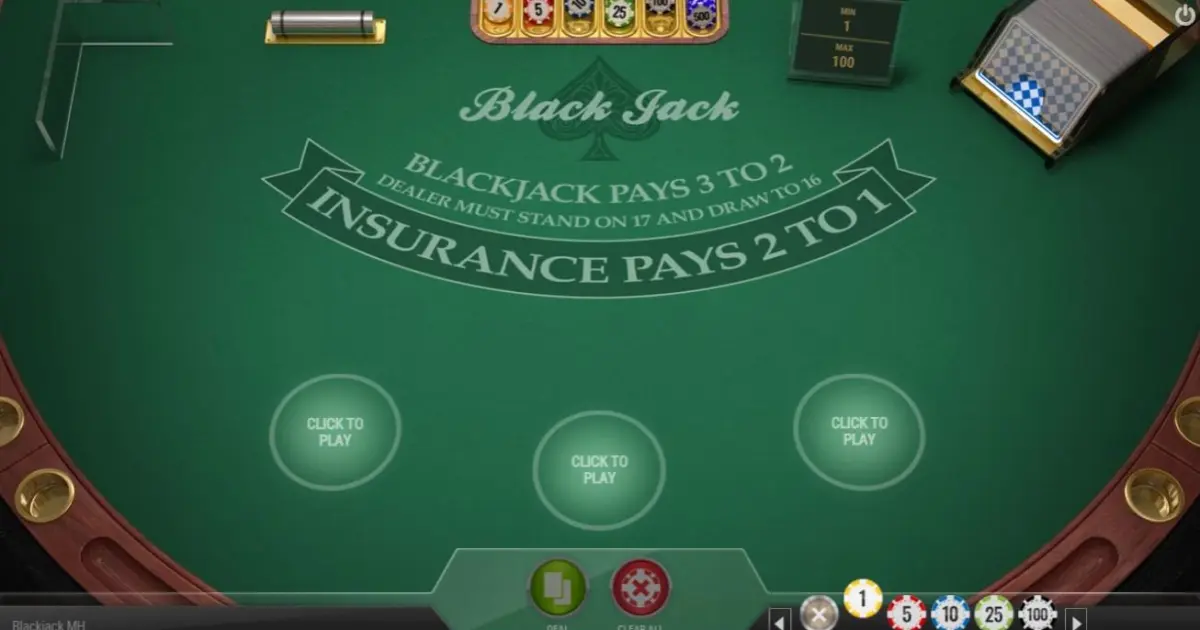
BlackJack MH sits squarely in the middle of Play’n GO’s three-table blackjack lineup, sharing its 99.5% RTP with both the European and Single Deck variants from the same provider. The half-percent house edge is competitive for an RNG table, but only if you play every hand to the basic strategy chart—casual play will cost you materially more. The “MH” designation typically signals multi-hand capability, though Play’n GO has not published full rule specifics, so confirm the exact configuration in the game’s paytable before you stake real money.
This is a solid choice for players who know the strategy chart and want a fair shake at an RNG table, but it offers no edge over the alternatives in Play’n GO’s own stable, and the missing rule transparency is a mark against it for the maths-literate crowd.
BlackJack MH in one minute
Play’n GO publishes a 99.5% RTP for this table, which translates to a 0.5% house edge assuming flawless basic strategy on every hand. The provider has not disclosed the deck count, the blackjack payout ratio, whether the dealer hits or stands on soft 17, or which double and split rules are in force—any of which can shift the edge by tenths of a percent. The game is available in free demo mode, making it straightforward to test the interface and confirm the rules before committing a bankroll.
| Attribute | Value |
|---|---|
| Provider | Play’n GO |
| RTP | 99.5% |
| House edge | 0.5% |
| Free demo | Yes |
| Popularity percentile | 94th |
The absence of published deck count and payout detail is unusual for a provider of Play’n GO’s standing. Check the in-game rules screen to confirm whether you are playing against six decks or eight, and whether blackjack pays 3:2 or 6:5—the latter costs you roughly 1.4 percentage points and is the single most damaging rule change a table can impose.
House edge versus RTP: the numbers explained
RTP and house edge are two sides of the same coin: RTP is the long-run percentage of all wagers the table returns to players, and the house edge is what the casino keeps. For BlackJack MH, 99.5% RTP means a 0.5% house edge. Over 10,000 hands of £10 each—£100,000 wagered—you would expect to receive £99,500 back, losing £500 to the edge.
That figure assumes you make the mathematically optimal play on every single hand, following the basic strategy chart without deviation. Basic strategy is a solved lookup table, not a betting system: it tells you whether to hit, stand, double, or split based on your cards and the dealer’s upcard, and it minimises the house edge without ever eliminating it. A casual player who stands on 16 against a dealer 10, takes insurance at standard odds, or doubles on a hunch will realise a materially lower return—often two or three percentage points worse.
The edge also moves with the rules. A 6:5 blackjack payout instead of 3:2 adds roughly 1.4% to the house advantage. Dealer hitting soft 17 costs you another 0.2%. Fewer decks generally help the player, shaving a few hundredths off the edge, while restrictions on doubling after split or no re-splitting of aces push it back up. Play’n GO has not published these specifics for BlackJack MH, so the 99.5% RTP is the only confirmed anchor—verify the rest in the game itself.
How this table compares to other online blackjack
The corpus average RTP for online blackjack sits at 99.41%, putting BlackJack MH’s 99.5% figure nine basis points above the mean—a negligible advantage that falls within normal variation. Play’n GO’s other two tables, European Blackjack MH and Single Deck BlackJack MH, also publish 99.5% RTP, so the three are functionally identical on paper until you examine the rule sets.
European Blackjack MH typically signals a no-hole-card game, meaning the dealer does not check for blackjack before you complete your hand—if you double or split and the dealer turns a natural, you lose all bets, not just the original stake. That rule adds roughly 0.11% to the house edge compared to an American hole-card game. Single Deck BlackJack MH, on the other hand, usually plays with one deck, which lowers the edge by about 0.5% relative to an eight-deck shoe, but single-deck games often compensate by paying 6:5 on blackjack or restricting doubles, so the net effect depends on the full rule package.
Without confirmed rule details for the base BlackJack MH table, it is impossible to say whether the RTP difference between the three is real or cosmetic. If you prefer a known quantity, American Blackjack by another provider also offers 99.5% RTP and is more transparent about its hole-card and dealer-17 rules—worth comparing if rule clarity matters to you.
Basic strategy in practice
Basic strategy is not a system that promises winnings; it is a fixed decision chart derived from combinatorial analysis of every possible hand versus every dealer upcard. Follow it, and you play at the published 0.5% house edge. Deviate, and the edge climbs. The chart tells you to hit 12 against a dealer 2 or 3, stand on 16 against a dealer 6, double 11 against anything but an ace, split 8s and aces always, and never take insurance—even when you hold a natural.
Insurance is a side bet that pays 2:1 when the dealer shows an ace and turns a 10-value card for blackjack. At those odds, you need the dealer to complete blackjack more than one time in three to break even, but the actual probability in a multi-deck shoe is closer to 30.8%, making insurance a losing proposition every time. The only scenario in which insurance becomes profitable is in a live shoe with a true count high enough to push the ten-density above 33%—and that requires card counting, which does not work against an RNG table that reshuffles after every hand.
Learn the chart, print it, keep it open in a second window during your session. No casino objects to you consulting it, because it does not beat the house—it only ensures you are not giving away extra edge through mistakes.
Betting systems and why they do not change the odds
Martingale, D’Alembert, Fibonacci, and every other progression system share one feature: they change the shape of your session variance, not your expected value. The Martingale—doubling your bet after every loss—guarantees you recover a single unit profit if you hit a win before you exhaust your bankroll or hit the table limit, but it does so by risking exponentially larger sums on each successive hand. Six consecutive losses on a £5 base bet put you £315 in the hole and require a £320 stake on hand seven. One bad run wipes out hundreds of small wins.
The house edge applies to every pound wagered, regardless of bet size or sequence. If you flat-bet £10 a hand for 100 hands, you wager £1,000 and expect to lose 0.5%, or £5. If you use a Martingale and wager the same £1,000 in total across a sequence of escalating bets, you still expect to lose £5—you have simply changed the distribution of outcomes so that you win small most of the time and lose catastrophically once in a while.
Progressions are not workable strategies; they are variance repackaging. If you enjoy the psychological texture of a system, use it for entertainment, but understand that it does not move the maths and that any streak—winning or losing—is independent of the hands that came before it. No hand is ever “due.”
The free demo
Play’n GO offers BlackJack MH in free demo mode, letting you test the interface, confirm the rules, and practice basic strategy without risking a penny. The demo runs on the same RNG as the real-money version, so the dealing pattern and randomness are identical, but demo results do not predict real-money outcomes in any meaningful sense—variance is high enough over short sessions that a lucky demo run or an unlucky one tells you nothing about what will happen when you play for stakes.
Use the demo to verify the blackjack payout ratio, the dealer’s soft-17 rule, the double-after-split and re-split options, and the presence or absence of surrender. These details determine the actual house edge, and Play’n GO’s omission of them from the published spec sheet means you must do the legwork yourself.
If you do move to real money, set your budget in advance, treat it as entertainment spend rather than income generation, and stop when you hit your limit. Blackjack is a negative-expectation game, full stop—basic strategy minimises the cost, but it does not turn the edge in your favour. Play only with money you can afford to lose, and remember that gambling is restricted to those aged 18 and over. If you feel your play is becoming problematic, seek support from a licensed counselling service immediately.
Verdict
BlackJack MH delivers a fair RTP for an RNG table and sits in the 94th percentile for popularity among online blackjack offerings, suggesting players find the interface and dealing speed agreeable. The 99.5% return is exactly at the market average, and Play’n GO’s three-table lineup gives you the option to compare European and Single Deck variants at the same published RTP before committing.
The major weakness is transparency. The absence of published deck count, blackjack payout ratio, and dealer soft-17 behaviour is a gap that maths-literate players will notice immediately, and it forces you to reverse-engineer the rule set from the game itself. For a provider of Play’n GO’s reputation, this is a surprising omission. If you value rule clarity and want to calculate your exact edge before you play, you will do better with a table that publishes its full spec sheet upfront.
That said, if you trust the 99.5% figure and you are comfortable verifying the rules in the demo, BlackJack MH is a competent option with no obvious red flags. It will not give you a better edge than its stablemates or most competing tables, but it will not cheat you either, provided you bring a strategy chart and the discipline to follow it on every hand.
Frequently Asked Questions
Is BlackJack MH available in free demo mode?
Yes, Play'n GO offers BlackJack MH as a free demo, allowing you to test the interface and confirm the rule set without staking real money. The demo uses the same RNG as the real-money version, so the dealing mechanics are identical, but demo results do not predict your real-money outcomes. Use the free version to verify the blackjack payout ratio, the dealer's soft-17 rule, and the double-after-split options before you play for stakes.
What RTP does BlackJack MH offer and what does that mean for the house edge?
BlackJack MH publishes a 99.5% RTP, which translates to a 0.5% house edge, but that figure assumes you play perfect basic strategy on every hand. Casual players who deviate from the chart—standing on 16 against a dealer 10, taking insurance, or doubling on intuition—will realise a materially lower return, often two or three percentage points worse. The half-percent edge is competitive for an RNG table and matches the corpus average for online blackjack.
Can I use card counting or a betting system to beat BlackJack MH?
No. BlackJack MH is an RNG table that reshuffles after every hand, so card counting does not work—there is no depleted shoe to track. Betting systems like Martingale or D'Alembert change the shape of your session variance but do not alter your expected value; the 0.5% house edge applies to every pound wagered regardless of bet sequence. Basic strategy minimises the edge, but it does not eliminate it, and no progression system can turn a negative-expectation game positive.
How does BlackJack MH compare to other Play'n GO blackjack tables?
Play'n GO offers three blackjack tables—BlackJack MH, European Blackjack MH, and Single Deck BlackJack MH—all publishing the same 99.5% RTP. European Blackjack MH typically plays as a no-hole-card game, costing you all doubled or split bets if the dealer turns a natural, while Single Deck BlackJack MH uses one deck but may compensate with a 6:5 blackjack payout or restricted doubles. Without full rule transparency for the base BlackJack MH table, it is impossible to say which offers the lowest actual house edge; check the in-game paytable for each before choosing.
Why has Play'n GO not published the deck count and blackjack payout ratio for this table?
Play'n GO has not disclosed the deck count, blackjack payout, or dealer soft-17 behaviour for BlackJack MH, which is unusual for a provider of this standing and a gap that maths-literate players will notice immediately. These details shift the house edge by tenths of a percent—six decks versus eight changes the edge by a few hundredths, while a 6:5 blackjack payout instead of 3:2 adds roughly 1.4%. The 99.5% RTP is the only confirmed figure, so you must verify the full rule set in the demo or the in-game paytable before playing for money.




