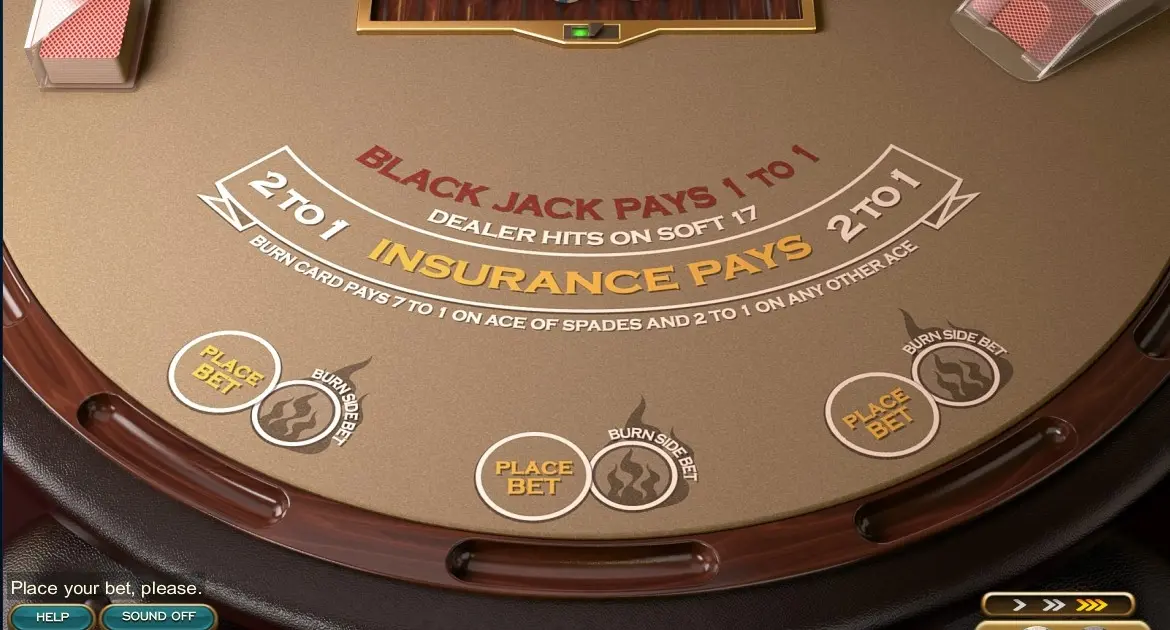
21 Burn Blackjack sits at the top of the RTP range for online blackjack, returning 99.5% to the player over the long run. That figure assumes you play perfect basic strategy on every single hand, which is a hard standard to maintain without the chart in front of you. Casual play will realise a materially lower return. The 0.5% house edge is competitive, but the “Burn” element in the title suggests a rule twist that Nucleus Gaming has not documented in the available spec sheet, so you will need to check the in-game rules screen before you commit real money.
Is 21 Burn Blackjack a fair table?
The published RTP is 99.5%, which translates to a house edge of 0.5%. That places this table in the upper tier of fairness for blackjack games. The critical caveat: this return assumes you make the mathematically correct decision on every hand, following the solved basic strategy chart for the specific rule set in play. Deviating from basic strategy even occasionally will push the house edge higher, sometimes by a full percentage point or more if you are guessing on soft hands or splits. The 99.5% figure is a ceiling, not a guarantee.
Nucleus Gaming does not publish granular rule details such as whether the dealer hits or stands on soft 17, how many decks are in the shoe, or what the blackjack payout is. Each of those variables moves the house edge by a few hundredths to a few tenths of a percent. The “Burn” mechanic in the title is not a standard blackjack rule, so you should treat this as a variant and confirm the full rule set in the paytable before you play for money. A non-standard rule can add variance or change optimal strategy in ways that are not immediately obvious.
| Attribute | Value |
|---|---|
| RTP | 99.5% |
| House Edge | 0.5% |
| Provider | Nucleus Gaming |
| Free Demo | Yes |
Nucleus Gaming and this table
Nucleus Gaming operates a small blackjack portfolio of five tables, all rated at the same 99.5% RTP. That consistency suggests the provider uses a single core rule set across its catalogue, varying only the presentation or minor mechanics. The narrow spread also makes it easier to compare tables: you are choosing between rule variants and features rather than hunting for a better edge. If you are evaluating 21 Burn Blackjack, you should also look at European Blackjack, Single Deck Blackjack (Nucleus Gaming), and American Blackjack, all of which share the same published return and differ mainly in deck count and regional rule conventions.
The provider’s average RTP of 99.5% matches the cross-provider corpus average of 99.41%, so Nucleus Gaming is neither tighter nor looser than the industry norm for blackjack. The real differentiation will come down to rule transparency, table limits, and whether the interface makes it easy to play quickly without misclicks.
Rule set: what the title implies
The “21” in the title is standard blackjack shorthand, but “Burn” is not a widely recognised rule family. In some brick-and-mortar contexts, a burn card is simply the card the dealer discards from the top of the shoe before dealing the round; in others, “Burn” refers to a side bet or a player option to discard and replace a card. Nucleus Gaming does not clarify which meaning applies here, and that ambiguity is a problem for strategy.
If “Burn” means you can pay to replace a card, that option will have a cost that affects the overall house edge, and you will need to know when it is mathematically correct to use it. If it is a side bet, it will almost certainly carry a higher house edge than the base game, as all blackjack side bets do. If it is just flavour text and the burn card is dealt face-down with no player interaction, it changes nothing about your strategy. Check the in-game rules screen to confirm which applies, and do not assume the mechanic is in your favour just because it has a name.
Without confirmed details on deck count, dealer soft-17 rules, double-after-split, surrender, or the blackjack payout ratio, you cannot calculate a precise house edge or tailor basic strategy. The 99.5% RTP suggests a player-friendly core rule set, but you are playing on trust until you verify the specifics yourself.
The maths of a blackjack hand
Blackjack is one of the few casino games where your decisions change the house edge. Basic strategy is the solved chart of optimal plays for every possible hand versus every dealer upcard. It is not a betting system, and it does not eliminate the house edge; it minimises it. Playing perfect basic strategy is what delivers the 99.5% RTP. Playing hunches or “gut feel” can push the house edge above 2%.
Specific rules move the edge in predictable directions. A 3:2 blackjack payout is standard and fair; a 6:5 payout costs you roughly 1.4 percentage points and is the single most damaging rule change a casino can make. The dealer standing on soft 17 is worth about 0.2% to the player compared to hitting soft 17. Fewer decks generally favour the player, though the effect is smaller than most people assume: eight decks versus one deck moves the edge by about 0.5%. Double-after-split, re-splitting aces, and late surrender all reduce the house edge by a few hundredths of a percent each.
Card counting does not work against an RNG-based table that reshuffles every hand. The count never builds, so there is no information to exploit. Basic strategy is your only tool here, and it is enough to keep the house edge under 1% if the rules are fair.
Common mistakes that cost you the edge
Insurance is a losing bet at standard 2:1 odds. It pays off only when the dealer has blackjack, which happens less than one-third of the time when the dealer shows an ace. The house edge on insurance is typically above 5%, far worse than the base game. Taking insurance “to protect a good hand” does not change the maths; you are making two separate bets, and the insurance bet is always -EV unless you are counting cards in a live shoe, which you cannot do here.
Side bets such as Perfect Pairs or 21+3 carry house edges in the range of 3% to 8%, depending on the paytable. They add variance and the chance of a bigger single payout, but they erode your bankroll faster than the base game. If you play them, treat them as entertainment with a cost, not as a path to profit. The base blackjack bet is always the mathematically superior choice.
Deviating from basic strategy is the most expensive mistake of all. Standing on 16 versus a dealer 10 because “it feels right” or hitting 12 versus a dealer 4 because you are frustrated costs you money every time. Basic strategy is counterintuitive in places—splitting 8s against a dealer 10 looks suicidal, but it is the correct play—and you have to trust the maths even when it does not feel good. Print the chart or keep it open on a second screen. There is no penalty for referring to it, and no medal for playing from memory if you are getting it wrong.
Trying it free first
21 Burn Blackjack is available in free demo mode, and you should use it. Demo play lets you see the rule set, test the interface, and confirm what the “Burn” mechanic actually does before you risk money. It will not predict your real-money results—variance over a few dozen hands proves nothing—but it will show you whether the table is playable and whether the rules are what you expected.
If you do play for real money, set a budget in advance and treat it as the cost of entertainment, not a way to make income. Blackjack has one of the lowest house edges in the casino, but the edge is still there, and it grinds in the casino’s favour over time. No betting progression or system changes that. Play only with money you can afford to lose, take breaks, and stop if it stops being fun. This is a game, not a job. You must be 18 or older to play for real money.
Final take on 21 Burn Blackjack
The 99.5% RTP is legitimate and competitive, placing 21 Burn Blackjack among the fairest options in the Nucleus Gaming line. The lack of published rule details is frustrating and forces you to do your own homework in the game client. If the core rule set is as strong as the RTP suggests—3:2 blackjack, dealer stands on soft 17, reasonable doubling and splitting rules—this is a solid table. If the “Burn” mechanic is a gimmick or a high-edge side bet, ignore it and play the base game.
The real test is transparency. A fair game with a 0.5% house edge is only fair if you know exactly what rules are in play and can adjust your strategy accordingly. Check the paytable, confirm the blackjack payout, and make sure you understand what “Burn” means in this context before you commit. If the rules are clear and the payout is 3:2, this table is worth your time. If the rules are vague or the payout is 6:5, walk away and try Multihand Blackjack instead.
Frequently Asked Questions
Is 21 Burn Blackjack available in free demo mode?
Yes, 21 Burn Blackjack offers a free demo version. Use it to confirm the rule set and understand what the "Burn" mechanic does before playing for real money. Demo play will not predict your real-money results due to short-term variance, but it will show you whether the interface is usable and whether the rules match your expectations. Always check the in-game paytable to verify blackjack payouts and other rule details.
What RTP does 21 Burn Blackjack offer?
The published RTP is 99.5%, which assumes perfect basic strategy on every hand. That figure translates to a 0.5% house edge, positioning this table among the fairest blackjack variants available. Deviating from basic strategy or taking side bets will lower your realized return, sometimes significantly. The 99.5% is a ceiling that applies only when you play optimally according to the solved chart for this rule set.
Does card counting work on 21 Burn Blackjack?
No, card counting does not work on any RNG-based blackjack table that reshuffles after every hand. The deck composition resets each round, so no count ever builds and there is no exploitable information. Basic strategy is your only tool for minimizing the house edge here. If you want to count cards, you need a live dealer game with a physical shoe and a clear discard tray.
Who makes 21 Burn Blackjack and how many tables does the provider offer?
Nucleus Gaming developed 21 Burn Blackjack as part of a five-table blackjack portfolio. All five tables share the same 99.5% RTP, suggesting a consistent core rule set across the provider's catalogue. Nucleus Gaming's average RTP matches the industry norm for blackjack at 99.41%, so the provider is neither tighter nor looser than competitors. The main differences between tables are likely presentation and minor rule variants.
Should I take insurance or play side bets on this table?
Insurance is a losing bet at standard 2:1 odds, typically carrying a house edge above 5%, far worse than the 0.5% edge on the base game. It does not protect your hand; it is a separate wager that pays only when the dealer has blackjack, which happens less than one-third of the time. Side bets like Perfect Pairs or 21+3 usually carry house edges between 3% and 8%, making them expensive entertainment. Stick to the base blackjack bet for the best mathematical outcome.




