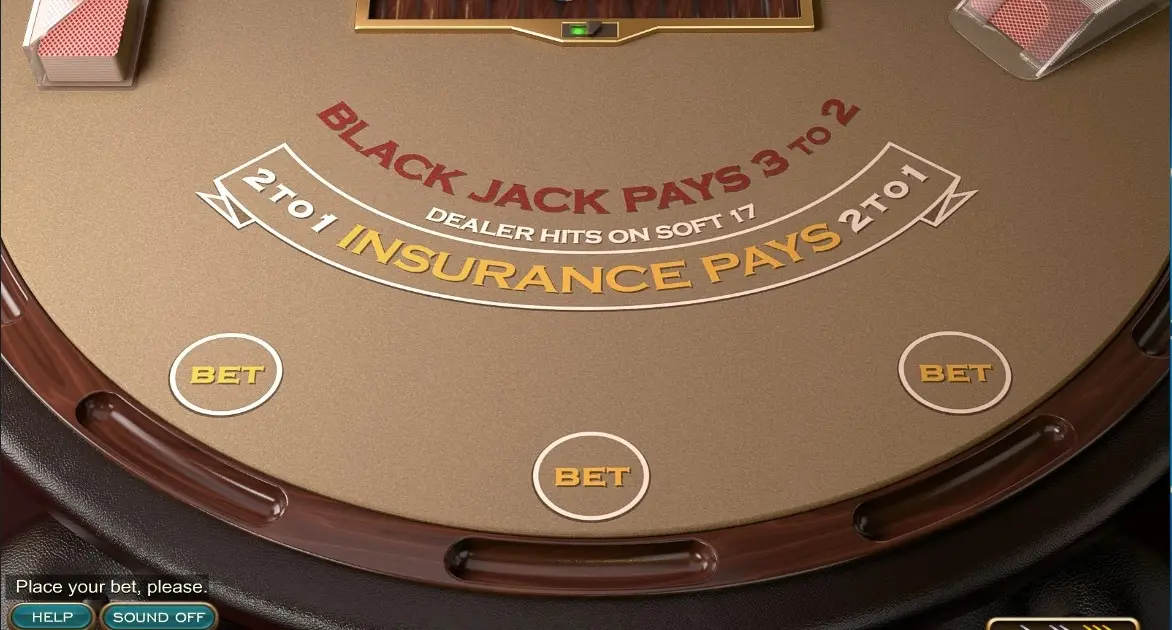
Single Deck Blackjack (Nucleus Gaming) carries a published return-to-player of 99.5%, placing it in the upper tier of RNG blackjack tables. If the name accurately reflects a single-deck format, the house edge here sits among the lowest available outside of live dealer games — but you need to verify the rules before treating that figure as gospel. A free demo is available so you can check every rule without staking a cent.
How Single Deck Blackjack (Nucleus Gaming) plays
Nucleus Gaming built this table under its Cards theme and categorises it in the Black Jack subcategory. The interface presents a standard blackjack layout: you place a bet, receive two cards, and play your hand against the dealer’s. The provider does not publish a detailed rules sheet in its game metadata, so the specifics of hitting, standing, doubling, splitting and surrender all need to be confirmed inside the game itself.
What you can verify before playing for money is the return figure of 99.5% and the fact that a free demo exists, letting you test the table’s behaviour without financial risk. The provider maintains a small portfolio of five games, all sharing the same 99.5% average RTP, which suggests a consistent mathematical engine across their blackjack range rather than one outlier title.
Because the deck count, soft-seventeen rule and blackjack payout ratio are not disclosed in any official specification, treat the in-game rules screen as your primary reference. If you are comparing across Nucleus Gaming’s blackjack range, 21 Burn Blackjack carries the same headline RTP, and European Blackjack offers a different rule structure worth testing alongside this one.
Single Deck rules and what the name tells you
The name “Single Deck” is the most important piece of information on this table, and it is also the most ambiguous. In blackjack, deck count is the single rule variable that most directly changes the mathematics: fewer decks increase the probability of being dealt a natural and slightly shift every basic-strategy decision. A true single-deck game with favourable rules can reduce the house edge to roughly 0.17% or lower under perfect play, compared to around 0.4–0.6% for a typical six- or eight-deck game.
The problem is that “Single Deck” in a game title does not guarantee a single physical deck in play. Some providers use the phrase to describe a shoe format or a visual presentation while still running a multi-deck RNG. Because Nucleus Gaming does not publish the actual deck count for this table, the only safe assumption is that the name indicates a single-deck format — which normally means a lower house edge than multi-deck — but you must confirm this in the paytable or rules screen before banking on it.
If it genuinely is one deck, check for the two rule tweaks that most commonly claw the advantage back: a 6:5 blackjack payout instead of the standard 3:2, and the dealer hitting on soft seventeen. Either one erases the single-deck benefit entirely. The 6:5 change alone costs the player roughly 1.4% of expected return.
Reading the 99.5% return figure
A published RTP of 99.5% translates to a house edge of 0.5%. That number, however, is not a guarantee of what you will experience. It assumes perfect basic strategy applied on every single hand for an infinite number of trials. Most casual players deviate from the chart often enough that their realised return falls by two to four percentage points, sometimes more.
| Metric | Value |
|---|---|
| Published RTP | 99.5% |
| Implied house edge | 0.5% |
| Provider | Nucleus Gaming |
| Provider average RTP | 99.5% (across 5 games) |
| Free demo available | Yes |
Against the corpus average of 99.41% across all blackjack games reviewed on this site, this table sits 0.09 percentage points above the median. That is a marginal difference — meaningful for a mathematician, invisible to a session-level player. The real question is not whether 99.5% is high or low in the abstract, but whether the underlying rules justify it. If the game turns out to be a six-deck shoe with a 6:5 payout, the true edge under perfect play is closer to 1.9%, and the 99.5% figure would be inconsistent with that setup. Use the demo to inspect the rules before trusting the number.
Where the house edge actually comes from
In any blackjack game, the house edge is the sum of every rule the casino controls. The player always acts first and can bust before the dealer plays a card — that structural asymmetry alone accounts for roughly 2% of theoretical edge before any rule adjustments. The published 99.5% RTP tells you the net result of all those adjustments, but not their individual components.
The rules that move the edge most, in descending order of impact, are the blackjack payout ratio (6:5 versus 3:2 costs approximately 1.4%), dealer action on soft seventeen (hitting costs roughly 0.2%), number of decks (each additional deck adds a small amount, with the jump from one to two being the largest), double-after-split availability (about 0.14% loss if prohibited), re-splitting aces (about 0.08% loss if prohibited), and late surrender (about 0.07% gain if allowed).
Nucleus Gaming does not disclose which of these rules apply here. Until you confirm them, you cannot calculate whether 0.5% is a realistic floor under perfect play or whether the true edge is meaningfully higher. The Multihand Blackjack table on this site also publishes 99.5% RTP but operates under a different rule structure, which illustrates how the same headline number can mask very different games.
Does card counting work here?
No. This is an RNG (random number generator) table, which means the software reshuffles the deck or shoe after every single hand. Card counting exploits a persistent non-random distribution across a shoe — the more high cards remaining, the more profitable the player’s decisions become. When each hand is dealt from a freshly shuffled set, the count resets to zero every time you receive your first two cards. There is no informational edge to extract.
This applies regardless of whether the game uses one deck or eight. A single deck would normally be the ideal counting environment because a small shoe produces more extreme count swings per card removed, but that only matters if the shoe is not reshuffled between hands. On an RNG table, the distinction between single and multi-deck matters for basic strategy decisions, not for counting.
No betting progression changes this either. Martingale, D’Alembert and every other system redistribute when you lose relative to when you win; none of them alter expected value. On a 0.5% house edge, your expected loss per hour is a fixed product of edge, bet size and hands per hour — systems do not touch any of those three variables.
Bankroll and unit sizing
With a 0.5% house edge under perfect play, a session of 60 hands at a $10 average bet produces an expected loss of roughly $3. The variance around that expectation is large — you will hit losing streaks of five or six hands and winning streaks that feel like you have cracked the game. Neither outcome means the edge has changed.
A practical sizing rule: your total session bankroll should be at least 200 times your average bet. That gives you enough runway to survive a normal swing without going broke before the maths settles. For blackjack specifically, a losing streak of ten hands is unusual but not rare, and it is survivable only if your unit size is small relative to your total bankroll.
This is entertainment, not income. Set a budget before you open the game, treat it as a fixed cost of the session, and stop when it is gone. If gambling stops being fun, take a break and seek support from a responsible-gambling helpline. All players must be 18 or older.
Verdict
Single Deck Blackjack (Nucleus Gaming) earns a cautious recommendation on the strength of its 99.5% published return and the availability of a free demo. If the single-deck label is accurate and the game pays 3:2 on blackjacks with the dealer standing on soft seventeen, you are looking at one of the lowest house edges available in online blackjack. That is a meaningful advantage over the typical multi-deck RNG game at roughly 0.5–0.6% edge, and it compounds over thousands of hands.
The caveat is that every favourable rule is currently unconfirmed. Nucleus Gaming does not publish deck count, soft-seventeen behaviour, surrender availability or side-bet options in its game metadata. Until you verify each of those in the rules screen, treat 99.5% as a ceiling rather than a certainty. Play the demo for an hour, read the paytable carefully, and only deposit when you can name every rule that affects the maths. The difference between a 0.2% and a 1.9% edge is not academic over a real-money session.
Frequently Asked Questions
Can I play Single Deck Blackjack (Nucleus Gaming) for free?
Yes, Nucleus Gaming makes a free demo of this table available so you can test the rules and interface without depositing money. The demo runs on the same RNG as the real-money version, meaning the shuffle and card distribution behave identically, but outcomes in demo play do not predict or influence real-money results in any way.
What does the 99.5% RTP mean for my actual returns?
The 99.5% figure means the theoretical house edge is 0.5%, but that number assumes you play perfect basic strategy on every single hand. Most casual players deviate from the chart frequently, and those deviations can push your realised edge up by two to four percentage points. The published RTP is a best-case ceiling, not a typical outcome.
What rules affect the house edge on this blackjack table?
Nucleus Gaming does not publish the deck count, soft-seventeen rule, blackjack payout ratio or surrender availability for this table, so you must confirm them in the game rules screen. In general, a 6:5 payout versus 3:2 costs about 1.4%, and the dealer hitting soft seventeen costs roughly 0.2%. These are the tweaks that determine whether 99.5% is achievable.
Does card counting help at Single Deck Blackjack (Nucleus Gaming)?
No. This is an RNG table that reshuffles after every hand, which eliminates the informational advantage card counting requires. A count needs a persistent shoe where removing cards changes the composition of remaining cards. When the deck resets every round, there is nothing to track. No betting system changes expected value either.
How does this table compare to European Blackjack from the same provider?
Both tables publish a 99.5% RTP, and Nucleus Gaming maintains that same figure across all five games in its portfolio. European Blackjack typically follows different rules — no hole card dealt until after all player actions, and specific dealer restrictions on soft seventeen. Play the free demos of both and compare their in-game rules screens to see which structure suits your strategy better.




