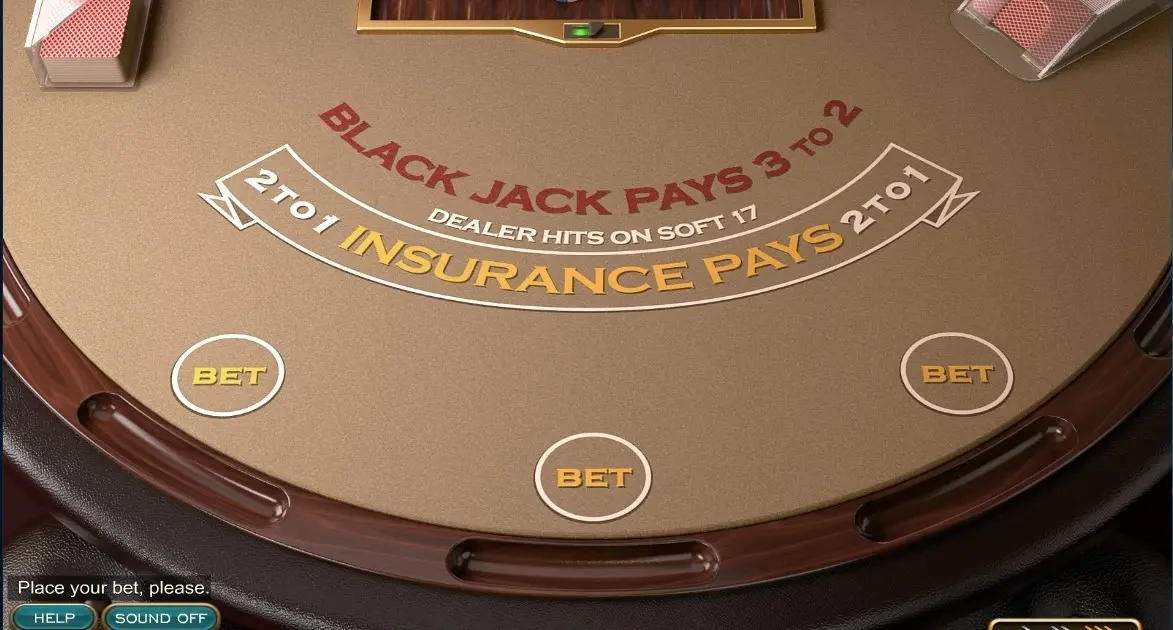
If you want a straightforward RNG blackjack table with a published return figure, this one is worth a look: Nucleus Gaming lists american blackjack at 99.5% RTP, which is the top of its own range and marginally above the 99.41% average across the blackjack tables we catalogue. A free demo is available, so you can read the in-game rules screen and test your basic strategy without staking anything.
The caveat matters more than the number. That 99.5% assumes flawless play, and Nucleus does not publish the full rule set in its game data, so several of the details that move the edge have to be confirmed at the table itself.
How American Blackjack plays
The core game is the blackjack you already know. You are dealt two cards, the dealer takes their own, and you decide whether to hit, stand, double or split based on your total against the dealer’s up-card. Beat the dealer without exceeding 21 and you are paid; bust and the hand is over regardless of what the dealer holds afterwards.
What Nucleus publishes here is thin: the name, the provider, the 99.5% return figure and the fact that a free demo exists. It does not publish the deck count, the blackjack payout, the table minimum and maximum, whether double after split or re-splitting is permitted, or whether late surrender is on the table. Every one of those changes the edge, some of them substantially, so the rules screen inside the game is not optional reading.
Because there is no confirmed side-bet list either, treat any Perfect Pairs or 21+3 circles you see on the felt as unknown quantities until you have read their paytables. Side bets in blackjack almost always carry a house edge many times that of the base game, and no published main-game RTP covers them.
American rules and what the name tells you
The title indicates American rules, which normally means the dealer takes a hole card and peeks for blackjack before you act. That structure works in your favour in one specific way: if the dealer has blackjack, the hand ends immediately and you lose only your original wager rather than the extra chips you would have committed to a double or a split. Under European no-hole-card rules, those additional wagers are exposed.
Treat that as a strong hint from the title, not a confirmed rule. Nucleus does not state the hole-card behaviour in its published data, and the difference between peek and no-peek is worth roughly a tenth of a percent, so confirm it in the game’s own rules panel before you play for money.
The name also tells you nothing about the two rules that matter most: the blackjack payout and the dealer’s soft 17 policy. Check both. If the table pays 3:2 on blackjack you are in normal territory; if it pays 6:5 you are giving up around 1.4%, which is the single most damaging rule change in blackjack and would make the 99.5% figure impossible to reach. Compare with the family’s other tables such as European Blackjack, which carries the same listed return under a different rule family.
Reading the 99.5% return figure
RTP is simply the complement of the house edge. A 99.5% return means a 0.5% edge to the house on the base game, so over a very large number of hands the table keeps half a unit per hundred wagered. That is a strong figure by blackjack standards and unusually good compared with almost any other casino game.
It comes with one condition that swallows most of the benefit for casual players: the number assumes perfect basic strategy on every hand. Basic strategy is a solved chart, not a system, and deviating from it costs real money. Hitting when the chart says stand, refusing a correct double, or splitting a pair the chart says to leave alone all push your actual return down. A player working from instinct rather than the chart will typically realise something materially worse than 99.5%, often by a percentage point or more.
The figure also describes long-run behaviour only. Across a single session of a few hundred hands, variance dominates completely, and demo results tell you nothing about what real-money play will do.
Where the house edge actually comes from
The edge exists because you act first. Bust before the dealer draws and you lose immediately, even if the dealer would have busted too. Everything else in the rule set adjusts that baseline. As general rules of thumb across blackjack:
- Blackjack paying 6:5 instead of 3:2 costs the player roughly 1.4% — the most expensive single rule change in the game.
- A dealer who hits soft 17 rather than standing costs around 0.2%.
- More decks cost the player a little; the jump from single deck to six or eight decks is worth a few tenths of a percent.
- Double after split, re-splitting aces and late surrender each hand a small amount back to the player, in the region of 0.1% or less apiece.
Side bets sit outside all of this. Perfect Pairs and 21+3 typically run edges of several percent, and insurance is a losing proposition at standard 2:1 odds regardless of how the rest of the table is configured. Declining insurance every time is the correct default. If you want to compare rule sets side by side, Single Deck Blackjack (Nucleus Gaming) shows how the same provider handles a lower deck count at the same listed return.
| Detail | Value |
|---|---|
| Game | American Blackjack |
| Provider | Nucleus Gaming |
| Listed RTP | 99.5% |
| Implied house edge | 0.5% |
| Category | Blackjack / Cards |
| Free demo | Yes |
| Provider average RTP | 99.5% across 5 tables |
| Catalogue average RTP | 99.41% |
Does card counting work here?
No. Counting exploits a shoe that depletes, letting you bet more when the remaining cards favour you. An RNG table that reshuffles after every hand has no depletion to track: the composition resets, and every hand is drawn from the same full distribution as the last. A count built over previous rounds carries zero predictive information into the next one.
Nucleus does not publish the shuffle behaviour for this table, but online RNG blackjack reshuffles each hand as standard, and you should assume that is the case unless the rules screen says otherwise. The practical consequence is that there is no advantage play available. Basic strategy is the ceiling, and basic strategy minimises the house edge without ever removing it.
The same applies to betting progressions. Doubling after a loss, D’Alembert and similar staking plans change the shape of your variance — larger swings, different distribution of session outcomes — but they leave the expected value untouched. No hand is ever due, and no sequence of past results changes what comes next.
Bankroll and unit sizing
Because the table limits are not published, plan your sizing around your own bankroll rather than the felt. A common approach is to treat one betting unit as a small fraction of your session bankroll — somewhere around 1% to 2% — so that a normal losing run does not end the session prematurely. Doubles and splits mean a single hand can commit two to four units, so leave headroom for them.
Also account for the pace. RNG blackjack deals far faster than a live table, which compresses many more hands into an hour and brings your results closer to the long-run average, in both directions. A 0.5% edge is small per hand but it applies to every hand you play.
Blackjack is for players aged 18 or over. Decide what you are willing to lose before you sit down, treat that amount as the cost of entertainment rather than a route to income, and stop when it is gone rather than topping it up mid-session. If the spending stops feeling like a choice, use the deposit limits and self-exclusion tools your operator provides.
Verdict
A 99.5% listed return puts this table at the front of the Nucleus range and slightly ahead of the wider catalogue average, and the American Blackjack free demo means you can verify the rules and drill your strategy chart at no cost. That combination makes it a reasonable choice for a player who intends to play correctly.
The reservation is the missing detail. With no published deck count, payout, soft 17 rule or limits, the 99.5% figure is a claim you cannot yet reconcile against a rule set. Open the rules screen first, confirm the blackjack pays 3:2, then decide. If you want alternatives with the same listed return, Multihand Blackjack covers players who want several hands at once.
Frequently Asked Questions
Can I play American Blackjack for free?
Yes. Nucleus Gaming provides a free demo of American Blackjack, so you can play with virtual chips, read the rules screen and practise your basic strategy chart without depositing. Bear in mind that demo sessions have no predictive value for real-money outcomes — the same maths applies, but short-run variance dominates either way.
What is the RTP of American Blackjack?
The listed RTP is 99.5%, which implies a 0.5% house edge on the base game. That figure assumes perfect basic strategy on every hand. Play from instinct instead of the chart and your realised return will be materially lower, often by a full percentage point or more, depending on how far you deviate.
Which rules affect the house edge on this table?
Nucleus does not publish the deck count, blackjack payout, soft 17 policy or surrender rules, so check the in-game paytable. As rules of thumb: 6:5 blackjack costs roughly 1.4%, a dealer hitting soft 17 about 0.2%, and extra decks a few tenths. Each one shifts the 0.5% baseline.
Does card counting work on American Blackjack?
No. RNG blackjack reshuffles between hands as standard, so there is no shoe depletion to track and no count carries information forward. Betting progressions do not help either — they reshape variance without changing expected value. Basic strategy is the best available play, and it reduces the edge rather than removing it.
Who makes American Blackjack and how does it compare to their other tables?
Nucleus Gaming, whose five blackjack tables all list a 99.5% return, including 21 Burn Blackjack and European Blackjack. On the published figures this table matches them exactly, so the deciding factor is the rule family — American rules normally mean the dealer peeks for blackjack, protecting doubled and split wagers.




