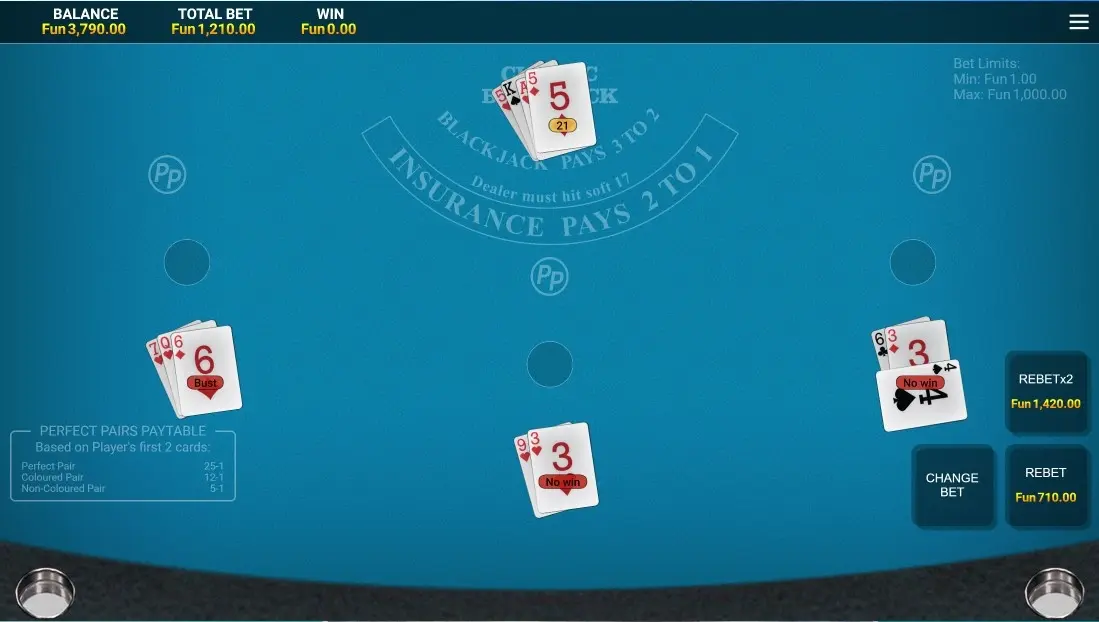
Blackjack with Perfect Pairs is OneTouch’s contribution to the genre, and at a 99.14% stated RTP it sits below the corpus average of 99.41%. That gap matters when you are deciding where to place your money, so read the sections below before you commit a single hand.
What kind of blackjack is Blackjack with Perfect Pairs?
This is a video blackjack table produced by OneTouch, a studio that has published two titles in our dataset. The game follows the standard single-player video format: you are dealt a hand against a virtual dealer, no other players are present, and the shuffle is determined by a random number generator on every single hand.
That last point has practical consequences you should understand immediately. Because each hand is independently shuffled, card counting does not work at this table or any other RNG-based video blackjack game. The deck is effectively reborn between hands, so there is no running count, no true count, and no system that exploits a depleted shoe. If you are a counter who has been frustrated by live-stream shuffles, that frustration is structural here too. What remains available to you is basic strategy: the mathematically solved decision chart that tells you the correct play for every visible card combination. That chart is what brings you closest to the published RTP.
Compared to tables like American Blackjack, which carries a 99.5% RTP, or Classic Blackjack at 99.28%, the base rules here are not the most generous in our catalogue. The difference of a few tenths of a percent compounds over long sessions, and if you are choosing between tables purely on expected value, this is the kind of spread you should weigh.
Return to player: 99.14%
OneTouch publishes a base-game RTP of 99.14% for this table. The house edge is therefore 0.86% — but this figure is only reachable if you play perfect basic strategy on every single hand without exception.
In practice, most casual players give back more. Every time you deviate from the chart — taking a hit you should have stood on, splitting a pair the chart says to keep together, or declining a double-down that carries positive expected value — you add to the house edge. A player making even one or two basic-strategy errors per hour can see their effective return drop by several tenths of a percent. The 99.14% figure describes a ceiling, not an expectation for the average session.
If you also play the Perfect Pairs side bet, which the title signals and the game interface likely offers, your combined return is materially lower. Side bets carry their own separate house edge that is never folded into the base-game RTP. The 99.14% applies to the main wager only. For comparison, OneTouch’s Bombay Blackjack publishes an identical 99.13% on the base game, suggesting this studio targets roughly the same mathematical framework across its two titles.
Deck count, dealer rules and the payout that matters most
OneTouch does not publish the deck count for this table in the data available to us. Nor do we have confirmed information on whether the dealer hits or stands on soft seventeen, what the blackjack payout is, whether doubling after split is permitted, or whether late surrender is available. These absences are not trivial. Each rule moves the house edge by measurable amounts, and the difference between a favourable rule set and a poor one can be a full percentage point.
The single most damaging rule a player can encounter is a 6:5 blackjack payout replacing the traditional 3:2. That change alone adds roughly 1.4% to the house edge — far more than any other single rule variation. At a 3:2 table, a natural pays 1.5 times your wager; at 6:5, it pays only 1.2 times. Over a session of hundreds of hands, that gap becomes significant to your bankroll.
The dealer’s soft-seventeen decision is the next most impactful rule. When the dealer hits soft seventeen, the house gains a small edge because the dealer gives themselves an additional chance to improve a total of 17 into a stronger hand, slightly reducing the number of times they bust when standing. A stand-on-soft-17 rule is better for you.
Before playing for money at this table, open the in-game rules screen and confirm: the number of decks in the virtual shoe, the soft-seventeen rule, the blackjack payout ratio, and whether double-after-split and re-splitting aces are permitted. If the payout reads 6:5, the published RTP of 99.14% is misleading for your actual expected outcome, because that figure almost certainly assumes a 3:2 game with the most player-friendly standard rules.
Playing your first ten hands
Use the free demo to establish your baseline comfort with the interface and to rehearse basic strategy until the chart feels reflexive rather than deliberative. The demo does not predict real-money outcomes in any statistical sense — the RNG does not know whether your wager carries value — but it does let you confirm that the dealing speed, the decision prompts, and the paytable layout suit your preferences before money is at risk.
On your first ten hands, focus on two things: confirming what the rules screen actually says about the payout and deck count, and identifying whether the game flags the side bet prominently enough that you might accidentally place it. In many video blackjack interfaces, the side-bet chip sits adjacent to the main wager button with no friction between them. That layout is intentional. Treat every accidental side-bet click as a cost you must avoid until you have decided whether the side bet fits your session plan.
Side bets: the maths behind the temptation
The title tells you this table includes a Perfect Pairs side bet, and OneTouch’s own variant notes confirm it carries high variance and a high house edge relative to the main game. This is consistent with what the maths predicts.
Perfect Pairs pays when your first two cards form a pair, with enhanced payouts for coloured pairs (same rank and same colour) and pure pairs (same rank and same suit). The probability of being dealt any pair from a standard deck is approximately 1 in 16.9 hands. The probability of a pure pair — the rarest and highest-paying tier — is roughly 1 in 54. Despite these low hit frequencies, the house edge on a Perfect Pairs side bet typically falls between 2% and 10% depending on the specific paytable, which is dramatically worse than the 0.86% edge on the base game played with perfect strategy.
The temptation is understandable: a large single-hit payout looks attractive against the slow grind of basic strategy. But the expected value is worse. If you place the side bet on every hand, your effective combined house edge rises substantially, and the variance of your session increases at the same time. You lose faster and more unevenly. Insurance, another common side wager, carries a house edge of roughly 6-7% at standard 2:1 odds and should be declined regardless of the dealer’s up-card.
If you enjoy the side bet purely for entertainment and size it as a small fraction of your session budget, that is your decision to make. Just enter it knowing the mathematics, not hoping against them.
Session limits and bankroll
OneTouch does not publish table limits for this game in the available data, so you will need to check the in-game information panel before depositing. Set your own limits regardless. A working framework is to treat one unit as no more than 1-2% of your total session budget, so that a losing streak of ten hands does not exhaust your funds. The number of hands per hour at a video blackjack table typically ranges from 200 to 300 depending on your decision speed, which means variance arrives faster than it does at a physical table. Ten hands of bad luck can cost you more money in five minutes than you would lose at a land-based casino in an hour.
Set a loss limit and a time limit before you start, and stop when you hit either. This game is entertainment, not income. Players must be 18 or older, and if you find yourself chasing losses or increasing stakes to recover a bad session, step away and contact a responsible gambling helpline. Blackjack with Perfect Pairs is a negative-expectation game at every stake level, and no betting progression — not Martingale, not D’Alembert, not any pattern of sizing your bets after losses — changes the expected value. They only reshape the variance, making you more likely to hit your loss ceiling during a bad run.
Verdict on Blackjack with Perfect Pairs
Blackjack with Perfect Pairs is a competent video blackjack implementation with a decent 99.14% base RTP and the convenience of a free demo. The game is not the best-paying table in our catalogue when compared to options like American Blackjack, and the absence of published rule details — deck count, soft-seventeen handling, blackjack payout — means you must do your own due diligence before playing with real money.
The Perfect Pairs side bet is the most important decision-specific consideration: it is the feature the title advertises, and it is the feature most likely to erode your return if you engage with it carelessly. If you are comfortable with a below-average house edge in exchange for the interface and game speed this provider offers, it works as a casual session game. If you are chasing the tightest possible mathematical return, there are better tables in the catalogue.
| Figure | Value |
|---|---|
| Provider | OneTouch |
| Base game RTP | 99.14% |
| Implied house edge (base game) | 0.86% |
| Corpus average RTP | 99.41% |
| Variance vs corpus | -0.27% |
| Free demo available | Yes |
| Provider game count in dataset | 2 |
Frequently Asked Questions
Can I play Blackjack with Perfect Pairs for free?
Yes. OneTouch offers a free demo version of this table that replicates the full game mechanics without requiring a deposit. The demo uses the same RNG and produces the same card sequences you would encounter with real money, but it cannot predict your future results since each hand is independently shuffled regardless of whether a wager is placed.
What is the actual RTP of Blackjack with Perfect Pairs?
OneTouch publishes a base-game RTP of 99.14%, which means the house edge is 0.86% on the main wager. This figure assumes you play perfect basic strategy on every hand without deviation. Any strategy error increases the effective house edge, and if you add the Perfect Pairs side bet to every hand, your combined return will be significantly lower than 99.14%.
How does the house edge change with different rules at this table?
OneTouch has not published the deck count, soft-seventeen rule, or blackjack payout for this specific table in available documentation, all of which materially affect the house edge. A 6:5 blackjack payout versus 3:2 adds roughly 1.4% to the edge. The player-favourable rule set would include stand on soft 17, 3:2 blackjack payout, double after split permitted, and fewer decks. Verify all of these in the game's own rules screen.
Does card counting work at Blackjack with Perfect Pairs?
No. This is an RNG-based video blackjack table that reshuffles every single hand, so there is no persistent deck composition for a counter to track. The shuffle is independent on each deal, meaning no running count or true count has predictive value. Basic strategy minimises the house edge to the published 99.14% but does not eliminate it, and no counting system works against this format.
How does this table compare to other OneTouch or popular blackjack games?
Blackjack with Perfect Pairs offers a 99.14% RTP, while OneTouch's Bombay Blackjack publishes 99.13%. Both sit below the corpus average of 99.41%. American Blackjack offers a higher 99.5% RTP, and Classic Blackjack sits at 99.28%. If your primary goal is mathematical return, tables with higher published RTPs provide a tighter house edge, assuming their underlying rules are equally player-friendly.




