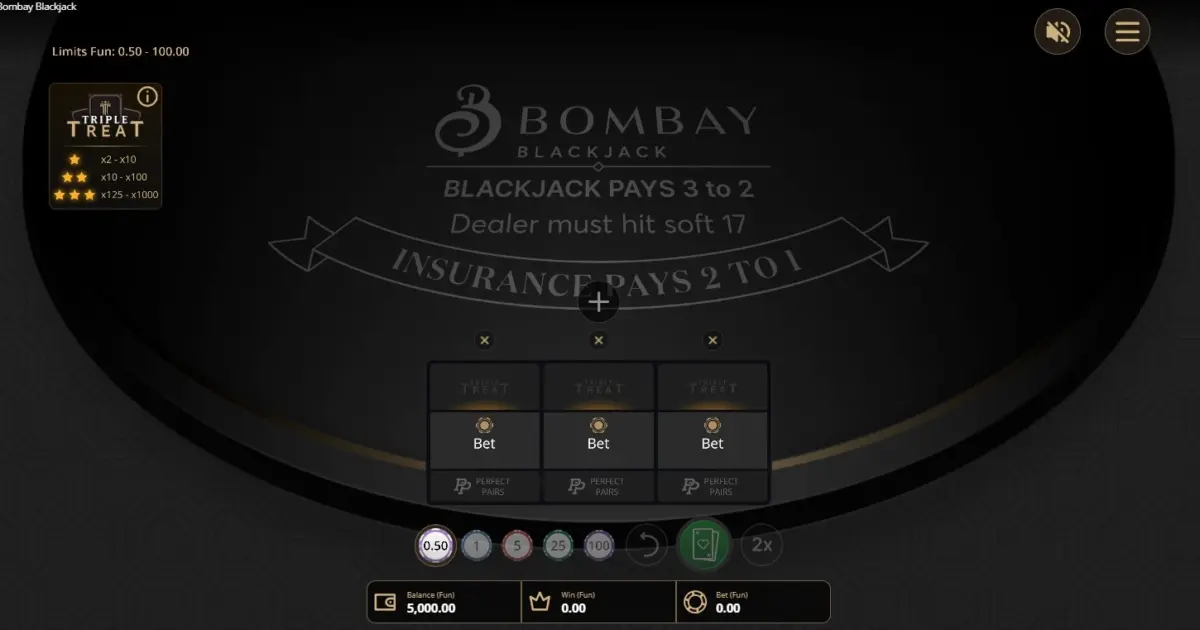
Bombay Blackjack from OneTouch delivers a 99.13% RTP when you execute perfect basic strategy on every hand, landing 0.28 percentage points below the 99.41% average across the blackjack category. That gap is meaningful over a long session, and it tells you that the rules here—deck count, dealer behaviour on soft 17, blackjack payout ratio—are slightly less favourable than the best tables in this niche. The game name hints at a regional variant, but OneTouch does not publish the complete rule set in its promotional material, so you must check the in-game paytable before you stake real money.
The 99.13% figure assumes you never deviate from the mathematically optimal play for your two cards against the dealer’s upcard. Casual play—hitting a hard 16 against a dealer 7 because it feels safer, taking insurance, or guessing on soft hands—will push your realised return materially lower, often by several percentage points over a session. If the published RTP is the ceiling, your actual experience depends entirely on how closely you stick to the chart.
Bombay Blackjack and the OneTouch table range
OneTouch operates a focused blackjack catalogue: just two tables, both carrying a 99.13% RTP. Blackjack with Perfect Pairs sits alongside Bombay Blackjack at 99.14%—a one-hundredth-of-a-percent difference that is statistically irrelevant over any realistic sample of hands. The pairing tells you that OneTouch has standardised its base rule set across both games, and any variation between them will come down to side-bet availability or cosmetic presentation rather than a fundamental shift in deck count or dealer rules.
Because OneTouch averages exactly 99.13% across its blackjack range, you know there are no hidden high-RTP tables waiting in the catalogue. If you are comparing providers, look to those that publish 99.5%+ on their flagship tables—American Blackjack at 99.5% and Classic Blackjack at 99.28% both deliver a lower house edge, and that difference compounds over every hundred hands you play. A 0.37-point gap between 99.13% and 99.5% costs you an extra 37 cents per hundred euros wagered, assuming perfect strategy on both tables.
The 99.13% figure, and the assumption behind it
Every published blackjack RTP figure rests on one hard assumption: you play perfect basic strategy on every single hand. Basic strategy is not a betting system or a hunch—it is the solved chart of mathematically optimal decisions for every possible combination of your cards and the dealer’s upcard. It minimises the house edge without ever eliminating it, because the edge is baked into the rules: the player acts first and busts first, giving the house its structural advantage.
The 99.13% RTP translates to a house edge of 0.87%. That edge applies to every hand, and it means that over the long run the house keeps 87 cents of every hundred euros you wager. The edge does not fluctuate with the count, because Bombay Blackjack uses an RNG that reshuffles the deck after every hand—there is no shoe to track, no favourable count to bet into, and card counting simply does not work. If you deviate from basic strategy, the edge widens immediately: hitting when you should stand, standing when you should hit, or taking insurance at standard 2:1 odds all hand the house a larger slice of your bankroll.
| Attribute | Value |
|---|---|
| RTP | 99.13% |
| House Edge | 0.87% |
| Provider | OneTouch |
| Free Demo | Yes |
| Provider Average RTP | 99.13% |
| Category Average RTP | 99.41% |
Rules to confirm before you bet real money
OneTouch does not publish the deck count, the dealer’s action on soft 17, the blackjack payout ratio, or the availability of double-after-split, re-split aces, or late surrender for Bombay Blackjack in its public-facing materials. Each of these rules moves the house edge by a measurable amount, and you need the full picture before you can verify the 99.13% RTP or decide whether this table suits your strategy.
The game title—Bombay Blackjack—does not map to a widely recognised rule family in the way that “European Blackjack” or “Atlantic City Blackjack” does, so you cannot infer the rule set from the name alone. The variant name may indicate a regional flavour or a cosmetic theme rather than a specific set of gameplay rules. Open the game’s paytable or rules screen before you place your first real-money bet, and confirm the blackjack payout ratio above all else: a 3:2 payout is standard, while 6:5 blackjack costs you roughly 1.4 percentage points and is the single most damaging rule change a table can impose.
If the paytable lists side bets such as Perfect Pairs, 21+3, or insurance, note that these carry a far higher house edge than the base game. Insurance, offered when the dealer shows an ace, pays 2:1 but loses money in the long run because the dealer completes blackjack fewer than one time in three. It is a bad bet at standard odds, and it should not form part of basic strategy.
Strategy: the chart, not a system
Basic strategy is a fixed chart, not a progression or a hunch-based system. It tells you the mathematically correct action—hit, stand, double, or split—for every combination of your hand total and the dealer’s upcard. The chart is solved: it has been computed by exhaustive simulation and verified over billions of hands. You do not need to memorise probability distributions or count cards; you need to follow the chart on every single decision.
Common basic-strategy rules include: always split aces and eights; never split tens; double on 11 against any dealer card except an ace (if the rules permit); hit hard 16 against a dealer 7 or higher; stand on hard 17 or higher. These are not tips—they are the plays that yield the lowest house edge over the long run. Deviating because a hand “feels” due or because you have lost several in a row increases the house edge immediately, because the mathematics of the game do not change with your recent history.
No strategy beats the house edge. Basic strategy minimises it to the 0.87% published for this table, but it does not eliminate it. Betting progressions such as the Martingale (doubling your stake after a loss) or the D’Alembert (incrementing your unit after a loss) change the shape of your variance—how quickly you can win or lose your bankroll—but they do not change the expected value of any individual hand. A hand is never “due,” and no system can overcome the structural advantage the house holds because you act first and bust first.
Variance at the blackjack table
Blackjack is a relatively low-variance game compared to slots, but variance still governs your session experience. You will win some hands, lose others, and push occasionally, and the order in which those outcomes arrive determines whether you finish a session up or down. Over a short session of fifty or a hundred hands, variance dominates: you can play perfect basic strategy and still lose steadily, or you can make suboptimal plays and finish ahead. Over thousands of hands, the house edge asserts itself and your results converge on the expected 99.13% return.
Bankroll management and unit sizing are the tools you use to survive variance without exhausting your budget before the mathematics can play out. A common rule of thumb is to bring at least fifty times your base unit to the table, so that a string of losses does not force you out of the session prematurely. If you are betting €2 per hand, a €100 bankroll gives you room to absorb the swings. Increasing your unit size when you are losing—whether through a progression system or frustration—accelerates your path to zero, because each hand still carries the same 0.87% edge against you.
Side bets amplify variance sharply because they pay at much longer odds and hit far less frequently. A Perfect Pairs bet might pay 25:1 or 30:1 for a suited pair, but the probability of that outcome is low enough that the house edge on the side bet typically exceeds 5%, sometimes reaching double digits. If you play side bets, treat them as entertainment with a high cost, not as a way to recover losses on the main game.
Free play first
Bombay Blackjack offers a free demo mode, and you should use it. Demo play lets you open the paytable, confirm the rules that OneTouch does not publish externally, and practice basic strategy decisions without risking your bankroll. The RNG in demo mode is identical to the real-money RNG—the outcomes are equally random—but demo results do not predict your real-money session because variance governs the short term and your sample size in demo play is not large enough to surface the true house edge.
Use the demo to verify the blackjack payout ratio, the dealer’s action on soft 17, and whether you can double after splitting or re-split aces. Check whether the game offers late surrender, which returns half your stake if you fold before the dealer acts and lowers the house edge by around 0.08 percentage points when used correctly. If the rules screen does not list the deck count, you will not find it in demo play either, but you can at least confirm the rules that matter most before you deposit.
Set a budget before you play for real money, and treat that budget as the cost of entertainment, not as an investment or a route to income. Blackjack carries a house edge on every hand, and no session is ever a sure win. Play only with money you can afford to lose, never chase losses, and take breaks if you find yourself increasing your unit size out of frustration. This is entertainment for adults aged 18 and over; if gambling is causing harm, stop and seek support from a recognised service.
Who this table is for
Bombay Blackjack suits players who want a straightforward blackjack experience from a smaller provider, who have access to the game through their existing casino, and who are comfortable with a return that sits below the category average. The 99.13% RTP is not poor—most blackjack tables fall between 99.0% and 99.6%—but it is not best-in-class, and if you are comparing tables purely on RTP, you will find better options at 99.5% or higher.
This table is not for players who want a high-RTP flagship game or who need published rule transparency before they commit. OneTouch does not list the deck count, dealer rules, or blackjack payout in its external materials, so you must extract that information from the in-game paytable, and if you are evaluating tables in bulk that adds friction. If you play casually and do not follow basic strategy, the 99.13% ceiling will not apply to you—your realised return will be lower, and the gap between this table and a 99.5% table will widen.
If you are already familiar with basic strategy, have a disciplined bankroll plan, and want a solid mid-range table from OneTouch, Bombay Blackjack delivers a fair game with a known RTP. Just confirm the rules in the paytable, avoid the side bets unless you are treating them as a high-cost novelty, and keep your expectations anchored to the house edge: 0.87% against you on every hand, forever.
Frequently Asked Questions
Is Bombay Blackjack available in free demo mode?
Yes, Bombay Blackjack offers a free demo mode that lets you confirm the rules, check the paytable, and practice basic strategy without risking your bankroll. The RNG in demo play is identical to real money, but demo results do not predict future sessions because variance governs short-term outcomes and your sample size is too small to reveal the true house edge.
What is the RTP of Bombay Blackjack and does it assume perfect strategy?
Bombay Blackjack returns 99.13% when you play perfect basic strategy on every hand, translating to a house edge of 0.87%. That figure assumes you never deviate from the mathematically optimal decision for your cards against the dealer's upcard; casual play that ignores the strategy chart will deliver a materially lower return, often several percentage points worse over a session.
Does card counting work on Bombay Blackjack?
No, card counting does not work on Bombay Blackjack because it uses an RNG that reshuffles the deck after every hand. There is no shoe to track, no count to exploit, and no opportunity to bet into a favourable distribution of high cards, so any counting system is useless here and basic strategy is the only tool that reduces the house edge.
How does Bombay Blackjack compare to other OneTouch blackjack tables?
OneTouch operates just two blackjack tables, and both carry a 99.13% RTP: Bombay Blackjack and Blackjack with Perfect Pairs at 99.14%, a one-hundredth-of-a-percent difference that is statistically irrelevant. The provider has standardised its base rule set, so any variation between the two tables comes down to side-bet availability or cosmetic presentation rather than a change in deck count or dealer rules.
Should I take insurance when the dealer shows an ace in Bombay Blackjack?
No, insurance is a losing bet at standard 2:1 odds because the dealer completes blackjack fewer than one time in three, giving the house a significant edge on the side wager. Insurance is not part of basic strategy, and taking it increases the overall house edge you face; it should be declined on every hand regardless of your cards or recent results.




