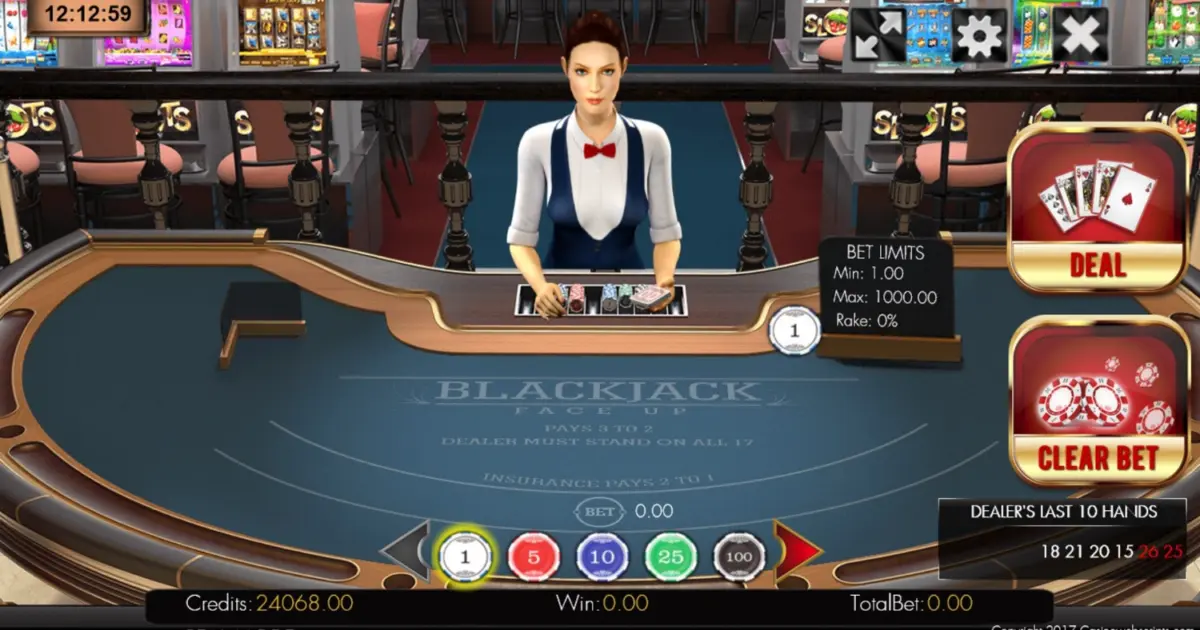
BlackJack 21 FaceUp 3D Dealer sits at 99.61% RTP, twenty basis points above the blackjack corpus average, and the face-up dealer format is the reason you’re here. Both dealer cards dealt face-up changes the information flow and the correct strategy chart, and if you’ve learned basic strategy for a standard peek game, you’ll need to adjust a handful of decisions here. Casino Web Scripts does not publish the full rule set—deck count, soft-17 treatment, double restrictions, and blackjack payout ratio are not confirmed—so check the in-game rules screen before you play for money.
How BlackJack 21 FaceUp 3D Dealer plays
The distinguishing mechanic is in the name: both dealer cards are dealt face-up at the start of the hand. You see complete information about the dealer’s total before you act on your own hand. In a traditional game the dealer checks for blackjack when showing an ace or ten, and your hand either loses immediately or play continues with uncertainty. Here there is no peek and no mid-hand surprise—if the dealer has 21, you know it; if the dealer has 16, you know that too, and you can size your doubles and splits with full information.
Casino Web Scripts has not published whether the dealer hits or stands on soft 17, how many decks are in the shoe, whether you can double after split, or whether surrender is offered. The title includes “FaceUp” and “3D Dealer,” which signals the visual presentation and the core rule variant, but nothing about the edge-sensitive rules. That missing detail matters: a single-deck game hitting soft 17 with no double-after-split plays very differently from an eight-deck shoe standing on soft 17 with full double and re-split permissions, and the house edge can swing by half a percentage point depending on the configuration.
FaceUp rules and what the name tells you
The face-up variant—sometimes called “double exposure” in live casinos—normally compensates for the player information advantage by paying even money on blackjack instead of 3:2, and ruling all dealer ties as a push except for a dealer blackjack, which beats a player 21 made with more than two cards. Casino Web Scripts does not confirm whether this table uses that compensation structure or a different one, so you must verify the blackjack payout and the tie rules in the game client.
If blackjack pays even money, the player gives back roughly 2.3% in edge compared to the standard 3:2 payout, which is a larger penalty than the 1.4% cost of a 6:5 payout in a standard game. The face-up information advantage is worth roughly 0.8% in isolation, so the net effect of the variant depends entirely on which offsetting rules the house applies. A face-up game paying even money on blackjack will have a higher house edge than a standard 3:2 game with the same deck and double rules, even though you see both dealer cards.
Basic strategy changes substantially under face-up rules. You will double more aggressively when the dealer shows a stiff total, and you will surrender or stand earlier when the dealer shows a strong total, because you are working with certainty rather than probability. Pre-made basic strategy charts for standard blackjack do not apply here; you need a chart built for the face-up rule set and the specific compensation rules this table uses.
Reading the 99.61% return figure
The 99.61% RTP assumes you play perfect basic strategy on every single hand. That strategy is a solved chart of roughly 250 unique situations, and it depends on the exact rule set in force—double restrictions, soft-17, split permissions, and the face-up compensation rules all change the correct play for dozens of hands. A player using rough intuition or a strategy chart built for a different variant will realize a materially lower return, often 2% to 4% below the published figure.
The 0.39% house edge that corresponds to 99.61% RTP is excellent for a blackjack table when the rules are favourable, but without knowing the deck count, blackjack payout, and soft-17 treatment, you cannot verify whether that figure reflects a liberal rule set with standard payouts or a tighter rule set that has been offset by the face-up advantage. The provider’s average RTP across its blackjack catalogue is 98.86%, which places this table 75 basis points above the Casino Web Scripts mean.
| Metric | Value |
|---|---|
| RTP | 99.61% |
| House edge | 0.39% |
| Provider | Casino Web Scripts |
| Provider average RTP | 98.86% |
| Free demo available | Yes |
Where the house edge actually comes from
The irreducible core of the blackjack house edge is that the player acts first and busts first. When both player and dealer bust on the same round, the house keeps the player’s wager—that structural asymmetry is worth roughly 8% to the house before any rules are applied. Every player-favourable rule (3:2 blackjack, double-down, split, surrender, dealer standing on soft 17) buys back a portion of that 8%, and the face-up information advantage buys back another portion.
The rules that move the edge the most are the blackjack payout and the soft-17 treatment. A 6:5 blackjack payout instead of 3:2 costs the player roughly 1.4%; an even-money payout costs 2.3%. The dealer hitting soft 17 instead of standing costs the player about 0.2%. Deck count matters less than players assume: moving from a single deck to eight decks costs about 0.5% when all other rules are held constant, and most of that loss comes from reduced blackjack frequency rather than a change in drawing probabilities.
Side bets such as Perfect Pairs or 21+3, if offered, carry a house edge between 3% and 7%, which is an order of magnitude worse than the base game. Insurance, offered when the dealer’s up-card is an ace in a standard game, is a losing bet at the standard 2:1 payout—it pays as though the dealer has a one-in-three chance of a ten in the hole, but the actual probability is slightly worse than that, giving the house an edge around 7% on the insurance wager alone. In a face-up game where both dealer cards are visible from the start, insurance is not offered because there is no hidden card to insure against.
Does card counting work here?
No. This is an RNG table that reshuffles the deck after every hand, which resets the count to zero before you act on any information. Card counting works in live casino shoes because the deck composition changes as cards are dealt and not replaced, and a deck rich in tens and aces favours the player. When the shuffle happens after every hand, no card has any memory, and the count never moves.
Even if this table used a finite shoe and dealt multiple hands before reshuffling, the face-up rule changes the counting strategy because you see two dealer cards instead of one, which gives you more information per round but also forces the house to use offsetting rules that reduce the value of a favourable count. Face-up games in live casinos are almost always dealt from a continuous shuffle machine for exactly this reason.
Basic strategy is the only mathematically sound approach for this table or any RNG blackjack game. It is a chart, not a system, and it minimises the house edge without ever eliminating it. No progression or staking pattern—Martingale, Fibonacci, D’Alembert, doubling after a loss—changes the expected value of the game; those systems change only the shape of the variance, often by increasing the risk of ruin in exchange for more frequent small wins.
Bankroll and unit sizing
A conservative rule for a session bankroll is 40 to 50 times your base unit, which gives you enough runway to survive a bad variance swing without reloading. If you sit down with £200 and bet £5 per hand, you have forty units, and your risk of busting the session bankroll before variance turns is around 10% when playing perfect basic strategy. A more aggressive player using twenty units accepts a session-ruin risk closer to 30%.
Blackjack variance is lower than slots but higher than baccarat, with a standard deviation around 1.1 to 1.15 times the base bet per hand, depending on how often you double and split. Over a hundred hands you will move roughly ten to fifteen units in either direction purely from variance, even when every decision is correct. The face-up information advantage may reduce variance slightly because you fold or reduce your bet more often when you see a strong dealer total, but Casino Web Scripts does not publish variance figures for this table.
Set your budget in advance and treat it as the cost of entertainment, not an income source. Blackjack has one of the lowest house edges in the casino, but the edge is always there, and over a long enough session the expected value is a loss. If you find yourself chasing losses or increasing bets to recover, stop. This is a game of skill within fixed mathematical boundaries, and no amount of skill converts a house edge into a player edge. You must be 18 or older to play, and free demo mode is available for this table if you want to test the rule set and practice the face-up strategy adjustments before playing for money.
Verdict
BlackJack 21 FaceUp 3D Dealer delivers a strong 99.61% RTP and a rare rule variant that changes the strategy in interesting ways, but the lack of published detail about deck count, blackjack payout, and soft-17 treatment is a problem for a mathematically literate player. The face-up format is worth trying if you are comfortable building or finding a strategy chart tailored to the specific compensation rules this table uses, and the free demo gives you a no-risk way to confirm those rules before committing money. If you want a more transparent rule set from the same provider, BlackJack 21 Classic offers 99.64% RTP with a standard format, or try BlackJack 21 3D Dealer at the same 99.64% return. For a comparison outside the provider catalogue, Multihand Blackjack sits at 99.5% RTP and lets you play multiple hands per round under conventional rules.
Frequently Asked Questions
Is there a free demo version of BlackJack 21 FaceUp 3D Dealer?
Yes, a free demo is available. Use it to confirm the blackjack payout ratio, soft-17 treatment, and exactly which tie rules apply under the face-up format, because Casino Web Scripts does not publish those details and they directly affect the house edge and the correct strategy chart.
What does the 99.61% RTP mean for my session?
The 99.61% return assumes you play perfect basic strategy for the face-up rule set on every hand. A casual player using standard blackjack strategy or intuition will realize a return two to four percentage points lower, and over any single session variance dominates—your result will move ten to fifteen units in either direction over a hundred hands regardless of skill.
Does the FaceUp rule make card counting viable?
No. This is an RNG table that reshuffles after every hand, so the deck composition resets before you can act on any count. Card counting requires a finite shoe dealt over multiple hands, and even then face-up games in live casinos use continuous shuffle machines or offsetting rules that neutralise the counting advantage.
How does BlackJack 21 FaceUp 3D Dealer compare to BlackJack 21 Classic from the same provider?
BlackJack 21 Classic offers 99.64% RTP, three basis points higher, and uses a standard rule format where only one dealer card is visible until you complete your hand. The face-up variant here changes strategy decisions significantly and may require an even-money blackjack payout or other offsetting rules that the provider has not disclosed, so check both in demo mode and choose based on which rule set you prefer.
What is the house edge and can basic strategy eliminate it?
The house edge is 0.39%, derived from the structural rule that the player busts first combined with the specific rules for blackjack payout, soft-17, splits, and doubles that Casino Web Scripts applies. Basic strategy minimises that edge but cannot eliminate it—no skill or staking system converts a house edge into a player edge, and the expected value over a long session is always a loss equal to 0.39% of total money wagered.




