Rambo: Mega Mines Scratch Card is worth a try if you want a fast, one-decision ticket from Atlantic Digital rather than a feature-heavy slot. Its published return of 96.44% sits clearly above the average for scratch cards in this catalogue, and a free demo is available so you can see the reveal flow before spending anything. There is no strategy to master, only bankroll choices to make.
Rambo: Mega Mines and the Atlantic Digital ticket range
Atlantic Digital is a compact provider in this catalogue, and Rambo: Mega Mines is its sole scratch card listed here. That context matters because you cannot judge this ticket against a large house style or a long series of sister tickets from the same studio. With a provider game count of one, there is no broader Atlantic Digital scratch portfolio to compare volatility or prize structures against, so this card has to be assessed on its own published facts. It is ranked 16th in its subcategory and sits at the 94.7th percentile for popularity, which indicates it sees a lot of traffic compared with other scratch cards, but popularity does not change how any single ticket behaves.
The catalogue lists the game under Scratch cards, and this provider has not published additional titles that would let you infer a shared maths model. Some readers look for studios that reuse a ticket template across several themes, but that pattern does not apply here. If you enjoy sampling different providers to compare presentation and paytables, you can contrast this ticket with another high-profile scratch option such as Holmes and Moriarty Scratch, which comes from a different studio and carries its own published return. Exploring a second provider helps you see how the same one-reveal format can feel different in pacing and layout without implying that one card influences the next.
Because the provider average return is also 96.44%, that figure simply reflects this single game rather than an average across many releases. The theme count for this specific theme is listed as zero, so there is no cluster of similarly themed tickets to benchmark it against here. Treat the provider information as background, not as a signal about whether the next ticket you buy is more or less likely to win.
The 96.44% figure and how it was built — rambo: mega mines scratch card
The published return to player for this ticket is 96.44%, which is a fixed, long-term design value rather than a short-session promise. For a digital scratch card, that percentage is set when the studio designs how prize tiers are distributed across a very large batch of virtual tickets. Think of it as a lottery-style payout structure: the studio decides how many tickets in the batch pay nothing, how many pay a small prize, and how many pay larger tiers, and the aggregate of those tiers produces the single RTP figure for the whole batch.
That is different from how many players imagine slots work. A slot uses a spinning-reel RNG with hit frequencies and feature triggers that create a sense of near-misses and streaks. A scratch card does not have hit frequency in the slot sense. Each virtual ticket is pre-generated with an outcome, and scratching the panels on screen only reveals that outcome. The corpus average RTP for scratch cards in this data set is 87.84%, so this ticket’s return sits 8.6 percentage points above that average. That comparison is useful for context, but it does not promise that your session will return 96.44% of what you spend.
Over a small number of tickets, actual returns can swing far above or below the published figure because the prize distribution is spread across a huge number of tickets. The RTP is most meaningful as a way to compare one ticket design against another, not as a predictor for your next purchase. Where a provider has not published a return, it is common for scratch cards to require you to check the in-game rules or paytable screen to find it, but in this case the figure is provided directly, so you can make that comparison without hunting through the game help pages.
| Fact | Detail |
|---|---|
| Game name | Rambo: Mega Mines |
| Provider | Atlantic Digital |
| Subcategory | Scratch cards |
| RTP | 96.44% |
| Free demo available | Yes |
| Popularity percentile | 94.7th |
| Subcategory rank | 16 |
What actually happens when you buy a ticket
When you buy a ticket, the outcome is generated the instant the ticket is created. Dragging or clicking to scratch the panels does not change or determine the result; it is a reveal animation layered over a result that already exists, exactly like a physical printed scratch ticket where the ink already hides winning or losing symbols. There is one purchase decision per play and no in-round choices after that point. You do not hold, cash out, adjust a bet mid-round, or make any decision that alters the odds of the ticket you are about to buy.
This single-decision structure is why scratch cards feel fast. You pay, you reveal, you see the outcome, and you decide whether to buy another. Some digital scratch products in general layer a small bonus reveal or pick-a-prize mini-game on top of the base ticket for presentation, but nothing in the FACTS for this specific card confirms that such a feature exists here, so you should not expect one until you see it described in the game’s own rules or paytable. The theme label may suggest visual presentation, but the FACTS do not detail artwork, sound, or animation style, so any description beyond the name would be speculation.
Because each ticket is independent and pre-generated, a losing streak or a winning streak on previous tickets has no bearing on the next one you buy. There is no shoe to count and no reel state to read, which means timing purchases or buying several tickets in quick succession does not improve the odds of any individual ticket. If you use the free demo, you are seeing the same reveal flow you would see in real play, but demo outcomes do not predict real-money outcomes; they exist so you can understand the interface before committing funds.
Reveal zones, panels and what they mean here
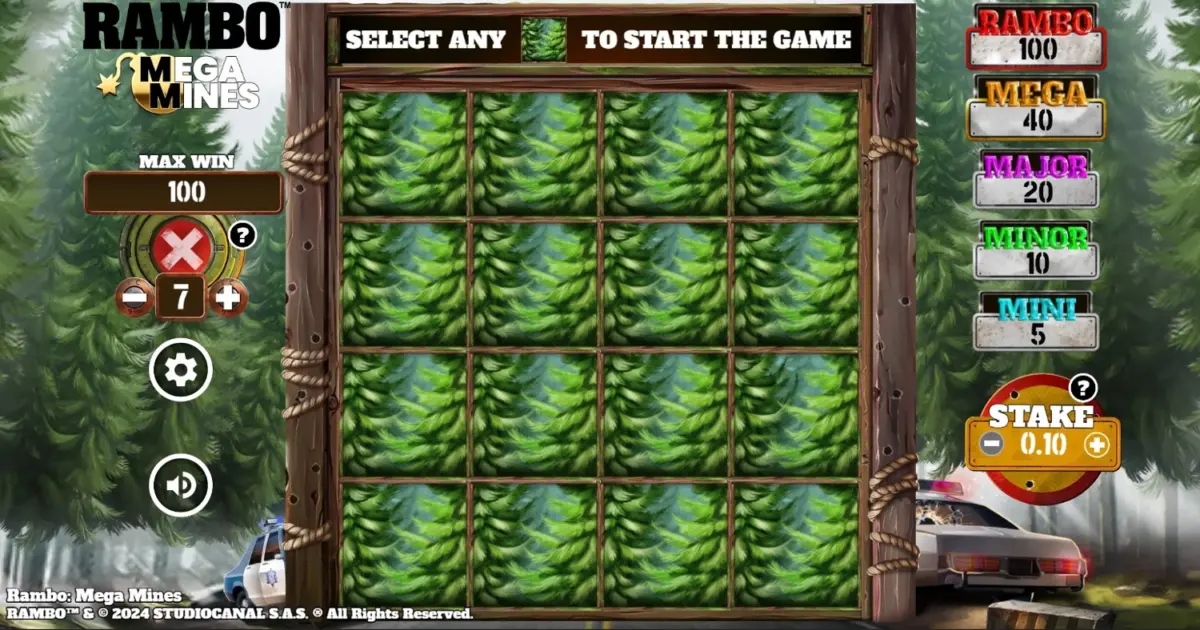
Digital scratch cards are typically built around a set of reveal zones or panels that you clear to show symbols, numbers or prize amounts. Where a FACTS block lists a reel-like count for a scratch game, it should be read as the number of reveal zones or panels on the card, not as a slot reel count, and slot terminology should not be borrowed to describe it. For Rambo: Mega Mines, the FACTS available do not specify how many reveal zones or panels are on the ticket, nor the exact layout or whether the card uses matching symbols, total-value reveals, or another mechanic.
That absence matters for how you set expectations. Without a published panel count or paytable detail, you cannot infer hit patterns, bonus triggers or prize tier structure from this review alone. The most useful step is to open the game’s own rules screen before you buy in, where the studio will show the number of zones, what combination pays, and how any prize amounts are presented. This is the same screen that would confirm whether the game uses a simple match-three style reveal, a mine-themed collection reveal implied by the name, or another presentation, but none of those specifics are confirmed in the FACTS provided here.
It also helps to keep the format in perspective. Because the ticket’s outcome already exists before you scratch, the panels are not separate chances to influence the result. Clearing them faster or in a different order does not change what is underneath, and stopping halfway through a reveal does not leave the outcome undecided. Seeing the number of panels, if and when the game displays it, tells you how long the reveal will take and what visual check to perform, but it does not give you a way to improve your chances on the next purchase.
Variance in scratch cards versus slots
Players often ask whether a scratch card is high or low variance, but the term means something different here than in slots. In a slot, variance describes how often wins occur and how they are distributed between frequent small hits and rarer large feature pays, driven by reel math and bonus frequency. In a scratch card, variance is a by-product of how the studio spreads prize tiers across the ticket batch. A batch can be designed to pay many small prizes across many tickets, or to concentrate value into fewer, larger tiers with more losing tickets, and both designs could still show the same overall RTP.
The FACTS for this card do not include a published variance label or a top-prize amount, so no specific variance claim can be made for it. What can be said generally is that scratch cards as a format do not have bonus buy options, free-spin chains or cascading mechanics to smooth or spike returns; you receive the single ticket result. Compared with a slot, the experience is less about session texture and more about discrete, independent outcomes. If you want to compare how different returns feel in practice, you might look at a contrasting scratch card such as Mega 777, which lists a 97.00% return, or at Shamrock Winnings, where the provider has not published a return figure, illustrating how availability of RTP itself varies across the catalogue.
Because variance is not published here, the only practical takeaway is to treat each purchase as an independent lottery-style event funded from a budget you set in advance. The absence of a variance label is common for scratch cards, since studios often communicate the prize structure only inside the game’s paytable rather than as a single-word volatility rating. Checking that paytable, when accessible, will tell you more about how prizes are tiered than any general label could.
Playing responsibly
The purchase-and-reveal loop on scratch cards is fast and inexpensive to repeat, which makes session limits especially important. Set a budget before you start, treat the money you spend as the cost of entertainment rather than a way to make income, and stop when that budget is reached regardless of earlier results. You must be 18+ to play where real money is involved, and you should use available tools such as deposit limits, time reminders or self-exclusion if you ever feel your play is no longer just for fun. If you are trying the Rambo: Mega Mines free demo, remember that free play is for learning the interface and is not an indicator of what will happen with real funds.
Verdict on Rambo: Mega Mines
Rambo: Mega Mines stands out mainly for transparency and placement: a clearly published 96.44% return that sits above the scratch card corpus average, high popularity within its subcategory, and access via a free demo if you want to preview the reveal without commitment. As a one-reveal ticket from a provider with only this scratch card in the current data set, it offers no complex mechanics to learn and no mid-round decisions that affect your odds. That simplicity will appeal to players who want a quick, lottery-style ticket rather than a session built around features.
The trade-off is the same as with any scratch card. Because there is only one purchase decision per play and no in-round strategy, you cannot improve the odds of the next ticket through timing, bet patterns or playing through a losing streak. Each ticket’s outcome is independent and already determined at purchase, so the responsible way to engage is to decide in advance how many tickets your entertainment budget covers and to view any win as a possibility, never an expectation. If that straightforward, chance-based structure suits how you want to play, the published return and the availability of free preview make this an easy ticket to evaluate before you commit.
Frequently Asked Questions
Can I try Rambo: Mega Mines for free before I buy a ticket?
Yes. The FACTS list free demo availability as true, so you can preview the reveal flow without payment. Free demo is useful for learning how the ticket reveals, but demo results do not influence or predict real-money outcomes since each real ticket is independently generated.
What is the RTP for Rambo: Mega Mines and what does it mean for a scratch card?
The published return is 96.44%. For a scratch card this is a long-term design figure set by how prize tiers are spread across a very large batch of virtual tickets, not a short-session guarantee. It lets you compare this ticket against others, but individual purchases can still return more or less than that average.
Is there any strategy or timing that improves my odds on the next ticket?
No. Each ticket is pre-generated and independent. Scratching panels is only a reveal animation, and there are no in-round choices like hold or cash-out. Buying multiple tickets, changing speed, or playing after losses does not change the odds of the next ticket you purchase.
Who makes Rambo: Mega Mines?
The provider is Atlantic Digital. In this catalogue that studio has one scratch card listed, this title, with a provider average RTP of 96.44% which reflects this single game. It ranks 16th in its subcategory and sits at the 94.7th percentile for popularity.
How does Rambo: Mega Mines compare with Holmes and Moriarty Scratch?
Both are single-reveal scratch cards, so the format is similar, but the published returns differ. Rambo: Mega Mines lists 96.44% while Holmes and Moriarty Scratch lists 95.44%. Neither figure predicts short-term results. Use the in-game rules for each to compare reveal layouts and prize tiers, since batch design varies by studio.