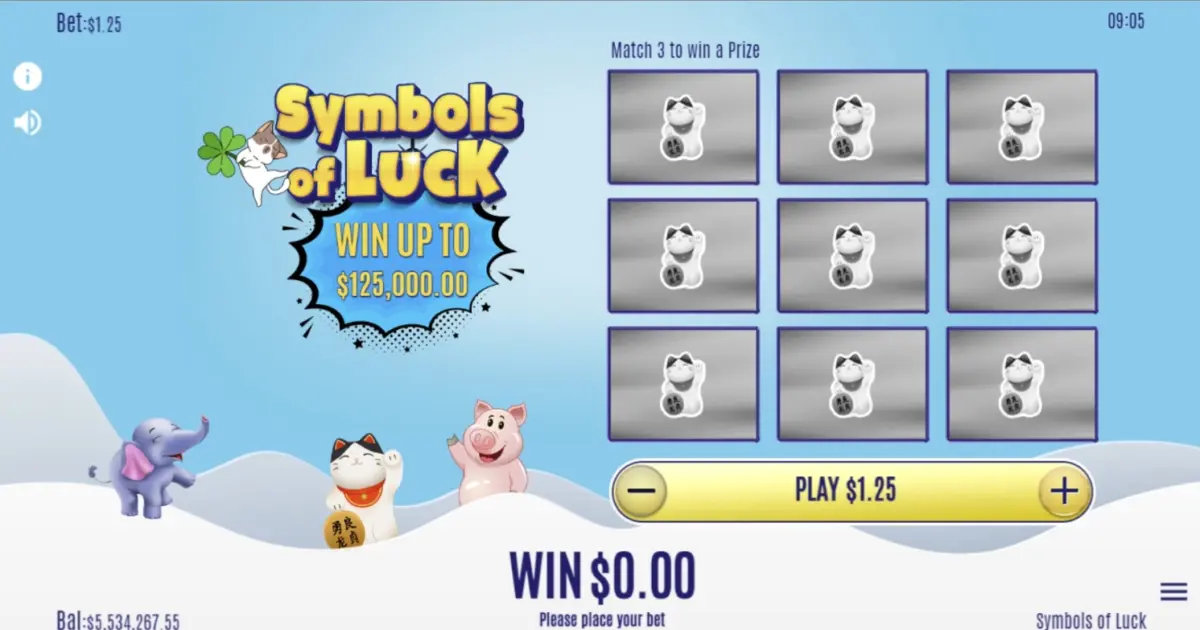
Symbols of Luck is a digital scratch card that delivers its outcome the instant you buy in. The 57.84% RTP is the first number you need to know, because it sits 30 percentage points below the scratch card category average and twelve points below FlipLuck Games’ own portfolio mean. That gap matters more here than it would in a slot, because there is no feature round or bonus trigger to chase — you pay, you reveal, you collect or you don’t. The free demo gives you a risk-free way to see the reveal flow and decide whether the theme holds your interest.
Symbols of Luck in one minute
Symbols of Luck is a one-purchase, one-reveal ticket. You buy in at a fixed price, the outcome is generated immediately by the server, and the on-screen scratch animation simply unveils a result that already exists. There is no spin, no hold, no decision point after you commit your stake. FlipLuck Games has built this card around a luck-themed visual presentation, but the publisher has not disclosed the number of reveal panels, the prize tier structure, or the top prize amount. What you do know is the RTP: 57.84%, meaning that for every 100 currency units wagered across the entire batch of virtual tickets, the game is designed to return just under 58 units as prizes.
| Attribute | Detail |
|---|---|
| Provider | FlipLuck Games |
| RTP | 57.84% |
| Theme | Luck symbols |
| Free demo | Available |
The scratch card format is fundamentally a lottery-style payout, not a spinning-reel random number generator. The studio distributes a fixed pool of prizes across a very large batch of pre-generated tickets, and your purchase draws one ticket from that pool. Because the outcome is decided before you scratch, there is no timing strategy, no pattern to read, and no way to influence the result once you click buy.
Return to player: 57.84%
The 57.84% RTP is a long-run statistical average calculated across the entire batch of tickets FlipLuck Games generated for this card. It does not predict your next ticket, your next ten tickets, or your session today. It tells you how the prize pool was divided when the game was designed. In concrete terms, if one thousand players each bought one hundred tickets at one currency unit per ticket, the total wagered would be 100,000 units, and the total returned as prizes would be 57,840 units. The remaining 42,160 units is the house edge, which funds the platform, the studio, and the operator.
That 57.84% figure sits 30 percentage points below the scratch card category average of 87.84%, and 12.37 points below FlipLuck Games’ own portfolio average of 70.21%. For comparison, Journey of Ra Scratchcards from the same provider carries a 95.5% RTP, meaning a significantly larger share of each ticket’s price is returned as prizes over the long run. The gap here is wide enough that it should shape your decision before you buy in.
RTP does not tell you how prizes are distributed — whether the batch has many small wins or a few large jackpots — but it does tell you the size of the pool you are drawing from. A lower RTP means a smaller prize pool relative to the total amount wagered, which translates to either fewer winning tickets, smaller average prizes, or both.
How prize tiers are built into the batch
Every digital scratch card is a pre-generated lottery. The studio decides the prize structure at design time: how many tickets will win nothing, how many will return exactly the purchase price, how many will pay two times, five times, fifty times the stake, and how many will hit the top prize. Those tickets are shuffled into a virtual deck, and each purchase draws one card from that deck. The RTP is the mathematical result of that prize distribution, calculated by multiplying each prize tier by its frequency and dividing by the total number of tickets.
FlipLuck Games has not published the prize-tier breakdown for Symbols of Luck, so you cannot see how many tickets in the batch are winners, what the smallest and largest prizes are, or how the studio chose to allocate the 57.84% return across different payout levels. Some scratch products concentrate the prize pool into a few large jackpots, creating long losing streaks punctuated by rare big hits. Others distribute smaller prizes more frequently, offering more winning tickets but lower individual payouts. Without the published tier structure, you are working blind.
Because the outcome is pre-generated, there is no volatility setting you can adjust, no bet level that changes your odds, and no feature trigger that adds variance. The ticket you buy has already won or lost before the first panel is revealed on screen. The RTP and the hidden prize tiers are the only mechanisms shaping your long-run results, and only the RTP is public here.
Digital versus physical scratch cards
A physical scratch card is a printed ticket with a latex coating over pre-printed symbols. The outcome is fixed at the moment the ticket is manufactured, and scratching the coating reveals information that was always there. A digital scratch card works the same way in principle: the server generates the result when you click buy, and the on-screen scratch animation is a visual reveal layer placed over a result that already exists. The difference is speed and interface. A digital card can be purchased, revealed, and settled in seconds, with no need to validate a physical ticket or visit a retailer to claim a prize.
That speed is a double-edged feature. The faster reveal loop makes it easier to burn through a session budget quickly, especially when the RTP is low and losing tickets arrive in clusters. A physical scratch card forces a natural pause between purchases — you have to return to the retailer, hand over cash, and scratch the next ticket by hand. A digital card removes that friction entirely. You can buy and reveal a dozen tickets in the time it would take to scratch two physical ones, which makes session discipline more important, not less.
Digital scratch cards also allow free demo play, which no physical lottery ticket can offer. The demo mode generates outcomes using the same prize structure and RTP as the real-money version, giving you a risk-free way to see how often winning tickets appear and how the reveal interface works. If the demo shows long losing streaks and low hit frequency, the real-money version will behave the same way over a similar sample size.
Common misconceptions about hot tickets
There is no such thing as a hot ticket, a cold ticket, a due ticket, or a ticket that is more likely to win because the last five tickets lost. Every ticket’s outcome is independent and pre-generated. The batch of virtual tickets FlipLuck Games created for Symbols of Luck contains a fixed number of winners and losers, shuffled into a random order. When you buy a ticket, you draw one card from that shuffled deck. The result of the previous ticket, the previous hundred tickets, or the previous thousand tickets purchased by other players has no bearing on the ticket you are about to buy.
This is not the same as a slot machine, where each spin is an independent random event generated in real time by a random number generator. A scratch card is closer to a raffle: the tickets are printed (or, in the digital case, generated) in advance, and each purchase claims one ticket from the pool. The difference is that the pool is so large — often millions of tickets — that it behaves like a continuous distribution for any individual player. You will never deplete the pool, and you will never know where you are in the shuffle.
Some players believe that buying multiple tickets in a row increases the chance of hitting a winner, on the theory that winners are “spread out” across the batch. This is not how independent random draws work. If the batch contains one winning ticket for every ten losing tickets, your chance of drawing a winner on any single purchase is one in eleven, whether you buy one ticket or one hundred. Buying more tickets gives you more chances, but it does not change the odds of any individual ticket, and it does not guarantee a win within any fixed number of tries.
Trying the demo first
Symbols of Luck offers a free demo, and you should use it. The demo generates outcomes using the same RTP and prize structure as the real-money version, so a hundred demo tickets will give you a realistic picture of how often winning tickets appear, how large the typical win is, and how long losing streaks can run. If the demo shows ten, fifteen, or twenty losing tickets in a row, expect the same pattern when you play for real money. The demo is not rigged to show better or worse results than the paid version — it is the same game with the financial risk removed.
The demo also lets you see the reveal interface and decide whether the theme holds your interest. A scratch card has no gameplay depth beyond the initial purchase decision, so the visual presentation and the speed of the reveal animation are the only variables that differentiate one card from another at the same RTP. If the demo feels repetitive after twenty tickets, the real-money version will feel the same way, and no amount of stake adjustment will change that.
Set a budget before you play, whether in demo or real money, and treat that budget as the cost of entertainment, not an investment with an expected return. The 57.84% RTP means the game is designed to return less than sixty cents for every dollar wagered over the long run, which is a steep cost for a one-reveal ticket. Scratch cards are fast to play and easy to repeat, so the budget you set can disappear in minutes if you chase losses. If you are buying in with real money, decide in advance how many tickets you are willing to purchase, and stop when you hit that number, win or lose. This is not a game where skill, timing, or pattern recognition can improve your odds. You are paying for a draw from a fixed pool, and the pool is weighted against you. You must be 18 or older to play, and the game is provided for entertainment only.
Who should try Symbols of Luck
Symbols of Luck is a fit for players who want the simplest possible casino game, with no decisions after the initial buy-in and no learning curve. If you prefer instant-reveal outcomes over the multi-spin buildup of a slot, and if the luck-symbols theme appeals to you, the free demo gives you a way to try it without financial risk. The 57.84% RTP, however, is a significant drawback. It is 30 points below the category average and 12 points below FlipLuck Games’ own portfolio mean, which means a smaller prize pool and longer losing streaks compared to higher-RTP scratch cards.
This card is not a good fit for players seeking value or long session play. The low RTP and the one-reveal format combine to create a fast, expensive experience, especially if you purchase multiple tickets in quick succession. If RTP is a deciding factor for you, Viking Crown Scratchcard from the same provider offers 70.24%, and Kings of War Scratchcard carries 69.84%, both of which return a larger share of your stake as prizes over the long run. The 57.84% figure here is among the lowest in the FlipLuck Games catalogue, and you should weigh that cost against the appeal of the theme before you buy in.
If you do try Symbols of Luck, use the demo first, set a ticket limit before you start, and accept that the majority of tickets will lose. The game does not reward patience, pattern recognition, or timing. It is a lottery-style draw from a fixed pool, and the pool is small relative to the amount wagered. Treat it as entertainment you pay for, not a route to profit, and stop when you hit your limit.
Frequently Asked Questions
Is there a free demo for Symbols of Luck scratch card?
Yes, Symbols of Luck offers a free demo that uses the same 57.84% RTP and prize structure as the real-money version. The demo generates outcomes from the same virtual ticket batch, so a hundred demo tickets will show you how often winning tickets appear and how long losing streaks typically run. Use the demo to see the reveal interface and decide whether the theme and pacing suit you before you buy in with real money.
What does the 57.84% RTP mean for Symbols of Luck?
The 57.84% return to player is the long-run average calculated across the entire batch of pre-generated tickets FlipLuck Games created for this card. It means that for every 100 currency units wagered, the game is designed to return 57.84 units as prizes. That figure is 30 percentage points below the scratch card category average and 12 points below the provider's own portfolio mean, which translates to a smaller prize pool and fewer winning tickets over time.
Can I improve my odds by timing my ticket purchases?
No. Every ticket's outcome is pre-generated the instant the server creates the batch, and your purchase draws one ticket from a shuffled pool. There is no timing strategy, no pattern to read, and no way to predict which ticket in the pool will be drawn next. Buying tickets after a losing streak, at a specific time of day, or in rapid succession does not change the odds of any individual ticket. Each purchase is an independent draw from a fixed distribution.
How does Symbols of Luck compare to other FlipLuck Games scratch cards?
Symbols of Luck carries a 57.84% RTP, which is the lowest among the FlipLuck Games scratch cards with published return-to-player figures. Journey of Ra Scratchcards from the same provider offers 95.5%, Viking Crown Scratchcard returns 70.24%, and Kings of War Scratchcard pays 69.84%. The 12-point gap between Symbols of Luck and the provider's 70.21% average means you are drawing from a smaller prize pool here, with fewer winning tickets and lower average payouts over the long run.
What happens if I buy a losing ticket on Symbols of Luck?
If the ticket you draw is a loser, the stake is settled immediately and the ticket is removed from play. There is no carry-over, no consolation prize, and no second chance. The outcome was decided the moment you clicked buy, and the on-screen scratch animation is a reveal layer placed over a result that already existed. You can buy another ticket, but the new ticket is an independent draw from the same pool, with the same odds and the same 57.84% RTP. A losing ticket has no bearing on the next one.