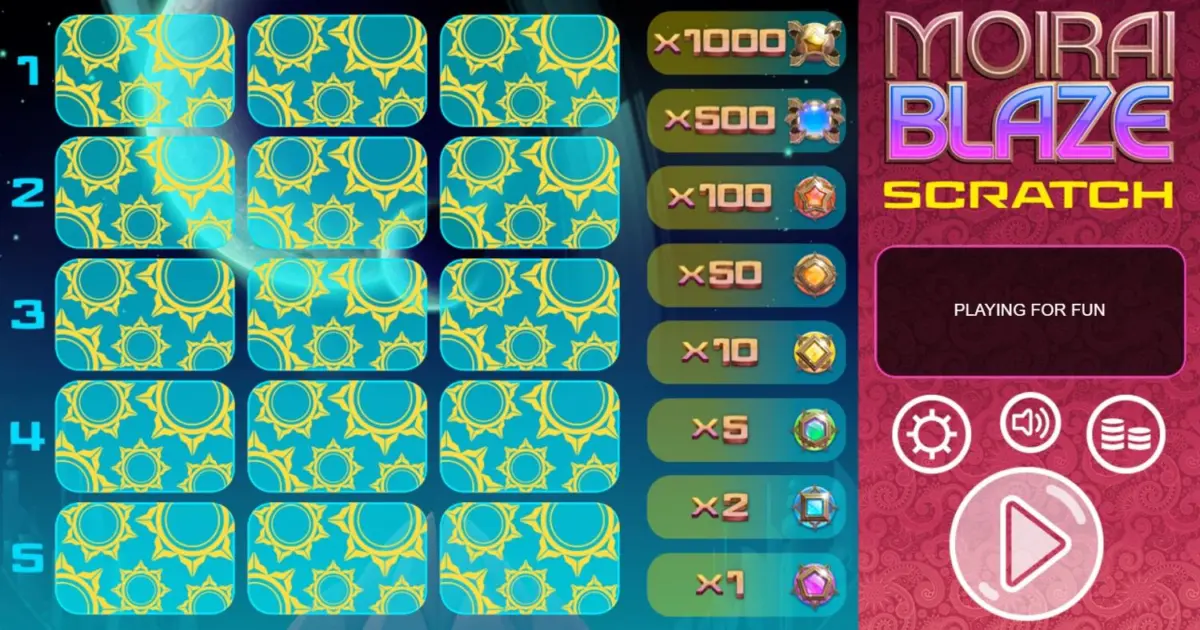
Is Moirai Blaze Scratch worth a try if you like fast, simple instant-win games? If you want a one-reveal ticket with no decisions after you buy in and a clearly published return figure, it is an easy one to understand, though there is not much depth to unpack beyond that single moment.
You buy a virtual ticket, reveal the outcome, and that is the round. There is no second phase to learn and no way to influence the result once the ticket is generated. For a quick session where you just want to see a result instantly, that simplicity is the whole point.
How Moirai Blaze Scratch plays
A digital scratch card works differently from a slot or table game, and this is the most important thing to grasp before you buy your first ticket. The outcome is generated the instant you buy in. What you see on screen — the panels you drag or click to reveal — is an animation layered over a result that already exists, exactly like a physical printed scratch ticket where the ink hides a prize that was determined at the factory.
That means there is exactly one decision per play: whether to buy the ticket and at what stake level the game allows. Once you confirm, there are no holds, no cash-outs, no bet adjustments mid-round, and no second choice that can improve the ticket you just bought. The reveal is for entertainment; it does not change the maths.
For many players that is the appeal. You do not need to learn paylines, bonus triggers, or feature ladders. You click to buy, you reveal, you see win or loss immediately. The loop is very fast, which is why session planning matters more than any in-game tactic, a point we return to below.
The FACTS available for this specific ticket do not specify a ticket price, the number of reveal zones or panels on the card, or any particular visual presentation beyond the name itself. Without that, we cannot describe the art, how many areas you scratch, or what symbols you will see. What we can say is universal: digital scratch cards show your result through a set of hidden areas, but the count and layout vary by title and do not affect the underlying lottery-style maths.
Because each ticket is independent and pre-generated, your previous tickets have no bearing on the next one. A run of losing tickets does not make the next ticket more likely to win, and a win does not make the next one less likely. There is no shoe to count and no reel state to track. Every purchase is a fresh draw from the same large virtual batch.
If you approach moirai blaze scratch expecting a light, instant-result game rather than a feature-heavy slot, you will not be surprised. If you are looking for layered mechanics or choices that affect volatility during the round, a different format will suit you better, since a scratch card by design offers one moment of reveal and nothing more.
Iron Dog Studio and this ticket
Moirai Blaze Scratch comes from Iron Dog Studio, a studio with 14 games in the tracked set. The studio’s average return across those titles sits at 95.0%, which gives you a useful sense of where this ticket sits within its own catalogue — right on the provider average, not an outlier in either direction.
At rank 25 in its subcategory and in the 91.5th percentile for popularity in that group, this is a well-trafficked scratch card rather than an obscure entry. Popularity does not change the odds of any one ticket, but it does tell you that many players have at least tried the demo and come back, which is often a sign that the presentation is clean and the buying and revealing loop feels responsive.
Iron Dog Studio also issues several other scratch cards built on the same one-reveal idea. If you want to compare how different themes handle the same format, Si Xiang Scratch keeps the maths at the same 95.0% level with a different visual approach, and Neon Jungle Scratch offers another take on the instant-reveal structure from the same provider. Looking at a couple of stablemates is a practical way to see whether you prefer one presentation over another without changing the core mechanic.
Another related option to consider is Viking Wilds Scratch, which again comes from Iron Dog Studio and uses the same single-purchase model. None of these comparisons suggest one ticket is due or hot; they simply show the studio’s consistent use of the scratch-card format across themes.
| Detail | Value |
|---|---|
| Provider | Iron Dog Studio |
| RTP | 95.0% |
| Subcategory | Scratch cards |
| Provider game count | 14 |
| Popularity percentile | 91.5th |
Reading the 95.0% figure
This ticket has a published return to player of 95.0%. For a scratch card, that figure means something specific and worth spelling out, because it is not a slot-style hit frequency or a guarantee for your session.
The RTP is fixed at design time by how the studio distributes prize tiers across a very large batch of virtual tickets. In effect the game is a lottery. A huge number of tickets are imagined — many with no prize, some with small prizes, a few with larger ones — and the average return across that entire batch is 95.0%. Your individual purchase is a random draw from that distribution. You could reveal a win on your first ticket or go many tickets without one; both are normal.
At 95.0%, this ticket sits 7.16 percentage points above the corpus average RTP of 87.84% for comparable games in the data set. That is a meaningful gap on paper, but it does not promise you will keep 95% of your stakes. It is a long-run average across millions of tickets, not a short-session forecast. Variance is high by design in lottery-style maths: most tickets lose, a smaller number win, and a very small number at the top tier drive much of the return.
Where a slot might publish hit rates and feature frequencies, scratch cards generally do not. There is no slot-like hit frequency to quote, only the overall batch structure. If you want to understand prize tiers for this ticket specifically, the best source is the game’s own rules or paytable screen, which will list the tiers and their relative scarcity if the provider has chosen to show them.
Think of the 95.0% as context for the ticket batch as a whole: how much, on average, the batch pays back over its lifetime. For any single purchase, the outcome is binary — win or loss — and the amount is set before you scratch.
What decides the outcome before you even scratch
It helps to picture what happens technically when you press buy. The game system generates a ticket from its prize-tier distribution at that moment. That ticket already has an outcome attached — either a losing ticket or a winning ticket at a set prize amount. The scratching you do afterwards simply uncovers it.
This is why there is no strategy that can change the odds of the ticket you are about to buy. Timing your clicks, scratching in a particular order, buying after a losing streak, or switching stake if the game allows different levels does not alter the generation step. Each purchase is independent and uses the same underlying distribution, so past results cannot inform future ones.
The studio determines the distribution by deciding how many virtual tickets at each prize level to include in the batch. Those decisions create the published RTP and the volatility of the experience, but they are invisible during play. You see only your ticket’s result, not the batch it came from.
This also explains why digital and physical scratch tickets feel so similar. In both cases, the prize exists before the reveal coating is removed. The digital version just generates the ticket on demand rather than printing it months in advance. The role of randomness is the same: a pre-set prize is hidden, then shown.
For you as a player, the practical takeaway is to treat each buy as a standalone event with fixed odds. Bankroll and session length are the only levers you control. How you scratch, how quickly you reveal, or what you did on the previous ticket does not affect the next ticket’s outcome.
Bonus reveals, if this ticket has one
Some digital scratch games add a small bonus reveal or pick-a-prize mini-game on top of the base ticket as a presentation layer. When present, that extra step is still part of the same pre-generated outcome — it is a way of showing a prize, not a second chance to change it.
For this specific card, the available FACTS do not confirm whether such a bonus reveal exists, how it would trigger, or what it would pay. The theme, description and FACTS block provided do not list a bonus feature, prize multipliers, or a secondary game. That absence does not mean the game is bare; it means we should not invent a feature that is not documented.
If a bonus-style reveal were present, it would work like this in general scratch-card terms: the system has already decided whether your ticket is a winner and at what level, and the bonus animation simply displays that decision in a different visual form — for example, revealing an extra panel or letting you pick one of several hidden prizes that all resolve to the same pre-set amount. It looks interactive, but the result is still determined at purchase.
Because we lack specifics for this ticket, the honest approach is to check the in-game rules before you buy. The rules screen will state clearly whether there is any additional reveal beyond the main card, how it is presented, and how prizes are calculated. If no such feature is listed there, treat the product as a straightforward single-reveal ticket.
This matters for expectations. Do not choose this card expecting a layered feature set unless the paytable shows one. Its value, if any, is in a clean one-step loop, not in chasing a bonus that may not exist on this ticket.
Free play before real money
Free demo is available for this ticket, which is the most useful way to see if the pacing and presentation suit you without spending. Demo lets you buy virtual tickets, go through the same reveal animation, and get a feel for how quickly rounds resolve. It does not predict real-money outcomes, and a win in demo does not make a win more likely when you play for real, since each ticket’s outcome is independent.
Use demo to answer practical questions: do you like the speed of the loop, is the reveal clear to read, and does the stake range, where shown in-game, fit the session length you have in mind? Those are matters of taste and budget, not of odds.
Because the purchase-and-reveal loop is fast and cheap to repeat, it is easy to buy more tickets quickly without noticing time passing. Set a budget in advance and treat it as the price of entertainment, not as a way to earn income. Play only with money you can afford to lose, decide on a time or spend limit before you start, and stop when you reach it. You must be 18+ to play. If you feel play is no longer just entertainment, use the responsible-gambling tools offered by the site or app — deposit limits, time-outs, or self-exclusion — and seek support if you need it.
Demo is also a good place to open the rules and paytable. Confirm the RTP, the prize structure if shown, and whether any extra reveal exists, so your first real-money ticket is bought with clear expectations rather than assumptions.
Final take on this scratch card
This ticket does what a scratch card is supposed to do: one purchase, one instant outcome, no mid-round decisions to learn. The published 95.0% return places it above the broader corpus average, which is helpful context for the batch as a whole, but it does not change the fact that any single ticket is still win-or-lose and independent of the last.
We cannot judge the art, the exact number of panels, ticket price, or any bonus layer from the FACTS provided, so we will not invent them. What we can say is that Iron Dog Studio has positioned this as a popular, straightforward scratch product in line with its other scratch cards at the same return level. If you value transparency about RTP and a clean, quick loop, it is a sensible one to try in demo first.
If you prefer games with choices during the round or feature-heavy variation, a slot will give you more to engage with. If you prefer lottery-style instant wins where the result is set at purchase and the scratch is just the reveal, this format fits. Try a handful of free tickets, check the in-game rules for prize tiers, and decide from there whether the pacing suits the session you have planned.
Frequently Asked Questions
Can I try Moirai Blaze Scratch for free before playing for real money?
Yes. Free demo is available, so you can buy virtual tickets and see the reveal flow without spending. Demo uses the same one-purchase, instant-result structure, but it does not predict real-money outcomes since each ticket is independently generated.
What does the 95.0% RTP mean for a scratch card like this?
It is the long-run average across a very large batch of virtual tickets. The studio sets prize tiers so that, over millions of tickets, about 95.0% of stakes are returned. For any single ticket the result is simply win or loss at a pre-set amount, not a guaranteed share of the percentage.
Is there any strategy or timing that changes my odds on the next ticket?
No. The outcome is generated the instant you buy in and revealed by scratching. Timing, scratch order, or buying after a streak does not affect the next ticket. Every ticket is independent, so only bankroll and session length are within your control.
Who makes Moirai Blaze Scratch?
Iron Dog Studio, a provider with 14 games in the tracked set and a provider-average RTP of 95.0%. This ticket sits exactly on that average and ranks in the 91.5th percentile for popularity in its scratch-card subcategory.
How does Moirai Blaze Scratch compare to Si Xiang Scratch?
Both are Iron Dog Studio scratch cards with a published 95.0% RTP and the same single-purchase, instant-reveal mechanic. The difference is presentation and theme, not maths. Try both in demo to see which reveal style you prefer, knowing the lottery-style odds model is identical.