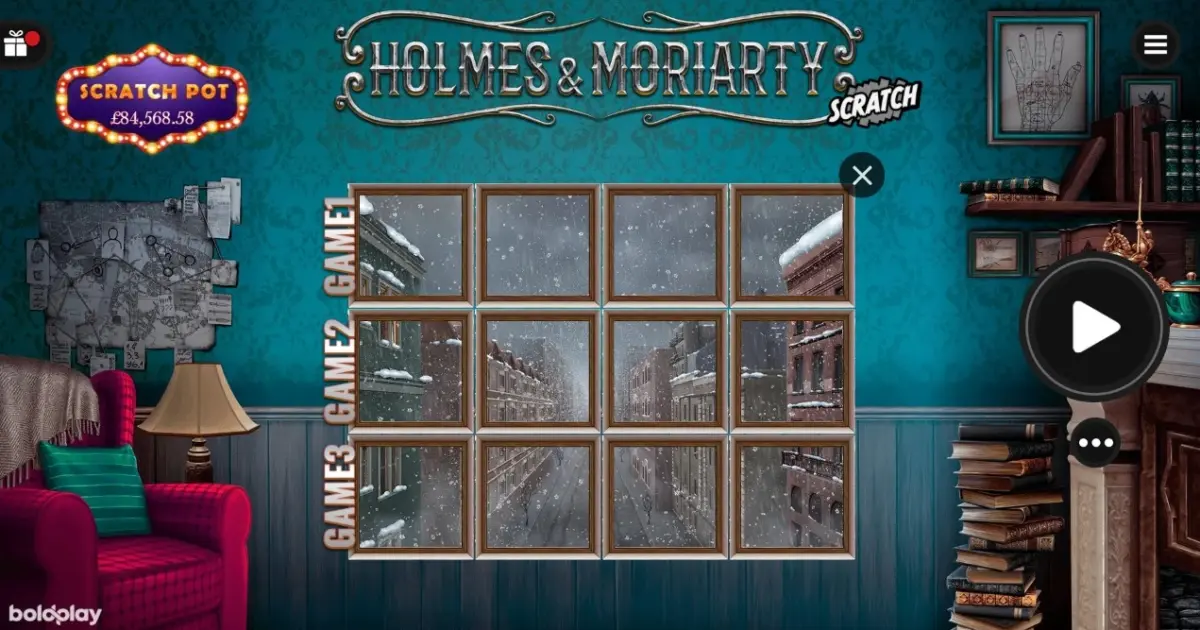
Holmes and Moriarty Scratch is worth trying if you want a higher-than-average return figure in a scratch card format and you like detective fiction themes. The 95.44% RTP puts it 7.6 percentage points above the typical scratch card in the market, and Boldplay has published that figure, which many scratch card studios do not. The free demo lets you see the reveal animation and prize structure without buying in.
How Holmes and Moriarty Scratch plays
A digital scratch card generates its outcome the instant you purchase the ticket, before any panels are revealed on screen. What looks like progressive scratching is a presentation layer over a result that already exists, exactly like a physical lottery scratch ticket printed in a factory. You make one purchase decision, the card reveals its outcome through whatever animation the studio designed, and the round ends. There are no holds, no mid-round bets, no cash-out decisions.
The Sherlock Holmes and Moriarty theme here suggests a detective mystery presentation, likely with period Victorian artwork and perhaps symbol-matching across the reveal zones, but the fundamental mechanic remains the same single-reveal structure every scratch card uses. You will not find strategy choices during the reveal because the ticket’s prize tier was assigned when you bought it, drawn from the batch distribution Boldplay set at design time.
| Property | Detail |
|---|---|
| Provider | Boldplay |
| RTP | 95.44% |
| Theme | Sherlock Holmes detective fiction |
| Free demo | Yes |
Boldplay and this ticket
Boldplay operates a 37-game catalogue with an average RTP of 94.47% across those titles, which sits above the 87.84% corpus average for scratch cards as a format. Holmes and Moriarty Scratch at 95.44% is slightly above even that studio average, placing it among the better-returning products in Boldplay’s range. The studio has published the figure, giving you a concrete number to compare rather than forcing guesswork.
If you are already familiar with Boldplay’s other scratch offerings, you might compare this to Warriors and Warlocks Scratch at 92.97% RTP or Gold Creek Superpays Scratch at 93.60%, both of which return less over the long term than Holmes and Moriarty Scratch. The studio also produces Book of Amduat Scrach at 95.38%, nearly identical to this card’s figure, so the choice between the two comes down to whether you prefer Egyptian mythology or Victorian detective fiction as your reveal-animation backdrop.
Reading the 95.44% figure
The 95.44% RTP is a long-run statistical average over the entire batch of virtual tickets Boldplay generated for this product. It means that for every £100 wagered across all players buying Holmes and Moriarty Scratch tickets, £95.44 is returned as prizes and £4.56 is kept by the house. This is not a per-session promise and not a guarantee for any individual ticket you buy. One ticket might pay its top prize, another might lose, and a third might return a smaller win — the 95.44% describes the prize distribution across thousands or millions of tickets, not your next purchase.
Scratch cards work like lottery tickets, not slot machines. The payout structure is designed at the start: Boldplay decides how many top-tier prizes, mid-tier prizes, and losing tickets exist in the batch, then assigns each virtual ticket a tier when it is generated. The RTP is fixed by that design, not by an RNG deciding outcomes spin-by-spin. Because your ticket’s outcome is pre-generated and independent of all other tickets, no pattern of previous wins or losses tells you anything about the next ticket you buy. A losing streak does not make the next ticket more likely to win, and a win does not make the next ticket “due” to lose.
The 7.6 percentage point advantage over the 87.84% scratch card average is meaningful over hundreds of tickets, but on any single purchase the variance is too high for the RTP difference to guarantee anything. A 95.44% card and an 88% card can both lose ten tickets in a row, and both can hit a large prize on the first try. The higher RTP tilts long-term results in your favour, but it does not change the fact that most individual tickets in any scratch product lose, by design.
What decides the outcome before you even scratch
The result of your Holmes and Moriarty Scratch ticket is determined the moment the server generates it, before the first panel is revealed on your screen. The scratching animation is purely presentational, a way to show you the result that already exists rather than a process that creates the result as it unfolds. This is identical to how a physical scratch card works: the prize tier is printed under the latex coating at the factory, and scratching the coating off simply reveals what was always there.
Because each ticket is independent and its outcome pre-assigned from the batch distribution, nothing you do changes the odds of the ticket you are holding. Scratching panels in a different order, waiting between purchases, buying tickets at different times of day, or playing after a series of losses or wins — none of these actions alter the prize tier your ticket was assigned. The only decision that affects your expected return is whether to buy a ticket at all, and if so, how much you spend per ticket and over the session.
This is why “strategy” for scratch cards is limited to bankroll management and session discipline. You cannot read the game, time your purchases, or adjust your approach mid-round to improve your odds. The ticket you just bought has already been placed in a prize tier, and the only thing left is to see which tier it is. This makes scratch cards the simplest possible casino format: one purchase, one reveal, one outcome.
Bonus reveals, if this ticket has one
Some digital scratch cards layer a small bonus round or pick-a-prize mini-game on top of the base ticket reveal, typically triggered when certain symbols or patterns appear. These bonus features are presentational flourishes that show you a prize already assigned to your ticket, not separate gambling rounds where new outcomes are generated. If Holmes and Moriarty Scratch includes such a feature — for example, a “solve the mystery” pick game or a multiplier reveal tied to the detective theme — understand that the bonus outcome was decided when the ticket was generated, just like the base result.
The FACTS provided for this card do not specify whether a bonus round exists, which is common for scratch card listings since the bonus is part of the reveal animation rather than a separate mechanical layer. If you want to know before you buy in, check the game’s own rules screen or paytable, typically accessible from the main menu. The RTP figure of 95.44% already accounts for all prizes the ticket can award, including any bonus-round results, so the presence or absence of a bonus feature does not change the long-term return.
Do not mistake a bonus reveal for a second chance to win. The ticket has one prize tier, and the bonus — if present — is simply how the game chooses to display part or all of that prize. The outcome is still determined at purchase, not during the bonus animation.
Free play before real money
Holmes and Moriarty Scratch offers a free demo, which means you can try the reveal animation, see the paytable, and understand the presentation without risking real money. This is valuable for scratch cards because the entire gameplay experience is the reveal itself — there are no rounds, no decisions, no features to learn over time. One demo ticket shows you everything the game does.
The demo uses the same prize distribution and RTP as real-money play, so it gives an accurate picture of how often tickets win and lose. However, because each ticket’s outcome is independent and drawn from a batch with high variance, a few demo tickets tell you almost nothing about what will happen when you buy in for real. You might see three demo wins in a row and then lose ten real-money tickets, or vice versa. The demo’s value is in showing you the theme and presentation, not in predicting outcomes.
If you decide to play for real money, set a budget in advance and treat it as entertainment spending, not income. Digital scratch cards make it very easy to buy ticket after ticket in quick succession, and the low per-ticket cost can disguise how much you spend over a session. A losing streak of ten or twenty tickets is not unusual given the prize distribution, and no pattern of previous results tells you the next ticket will win. Play only with money you can afford to lose, and recognize that the house edge — even at 4.56% for this card — means that over time, the cost of playing adds up. You must be 18 or older to gamble. If scratch card play stops being entertainment and starts feeling like a problem, use the responsible gambling tools your casino offers or contact a support organization.
Final take on Holmes and Moriarty Scratch
Holmes and Moriarty Scratch is a better-than-average scratch card on the single metric that matters most: the RTP. At 95.44%, it returns more over the long run than the typical scratch product, and Boldplay has published that figure so you are not guessing. The Sherlock Holmes theme gives the reveal animation a narrative hook, but the fundamental experience is still one purchase, one reveal, one outcome, just like every other scratch card.
This is not a game with strategic depth, because no scratch card has strategic depth. You cannot read patterns, time your purchases, or make in-round decisions. The only strategy is deciding whether to buy a ticket at all, how much to spend per ticket, and when to stop for the session. If you want a scratch card with a published RTP above 95%, a detective fiction theme, and a free demo to preview the presentation, Holmes and Moriarty Scratch delivers exactly that. If you want more than a single-reveal lottery-style game, look at slots or table games instead, because scratch cards — even well-designed ones — offer nothing beyond the instant outcome.
The free demo is available, the RTP is published and competitive, and the provider is established. That is the entire decision. Try the demo if the theme appeals to you, set a session budget if you play for real, and understand that most tickets lose because that is how the prize distribution is designed. The 95.44% RTP gives you better odds than most scratch cards, but it does not change the fact that this is a lottery product, not a skill game.
Frequently Asked Questions
Is there a Holmes and Moriarty Scratch free demo?
Yes, Holmes and Moriarty Scratch offers free demo play. The demo uses the same prize distribution and RTP as real-money tickets, so it shows you the reveal animation, theme, and paytable without risking money. One or two demo tickets are enough to see everything the game does, since a scratch card has no rounds or features that unfold over time — it is a single reveal per ticket.
What does the 95.44% RTP mean for Holmes and Moriarty Scratch?
The 95.44% RTP is the long-term average return across all tickets in the batch Boldplay designed. For every £100 wagered by all players, £95.44 comes back as prizes and £4.56 is kept by the house. This is not a per-session or per-ticket guarantee — individual tickets can win large, win small, or lose, and the RTP only describes the distribution over thousands of tickets. It does mean Holmes and Moriarty Scratch returns more than the 87.84% average for scratch cards.
Can I improve my odds by timing when I buy Holmes and Moriarty Scratch tickets?
No. Each ticket's outcome is pre-generated and independent, drawn from the prize distribution Boldplay set at design time. The result exists before you scratch, and no pattern of previous wins or losses affects the next ticket you buy. Waiting between purchases, playing at different times, or buying after a losing streak does not change the odds. The only decision that matters is whether to buy a ticket at all and how much to spend over the session.
Who makes Holmes and Moriarty Scratch and what else do they offer?
Boldplay makes Holmes and Moriarty Scratch. The studio has 37 games in its catalogue with an average RTP of 94.47%, above the scratch card market average. If you like this card's return figure, you might compare it to Book of Amduat Scrach at 95.38%, nearly identical odds with an Egyptian mythology theme, or try Warriors and Warlocks Scratch at 92.97% for a fantasy setting with slightly lower long-term return.
What happens if my Holmes and Moriarty Scratch ticket loses?
The round ends immediately and your wager is lost. A digital scratch card is a single-outcome lottery product — there is no bonus round to save a losing ticket, no gamble feature, no respin. Most tickets in any scratch product lose by design, because the prize distribution assigns top and mid-tier prizes to a small fraction of the batch and losing tiers to the majority. The 95.44% RTP means that over many tickets, 95.44% of all wagers come back as prizes, but individual tickets are either winners or losers with no in-between.