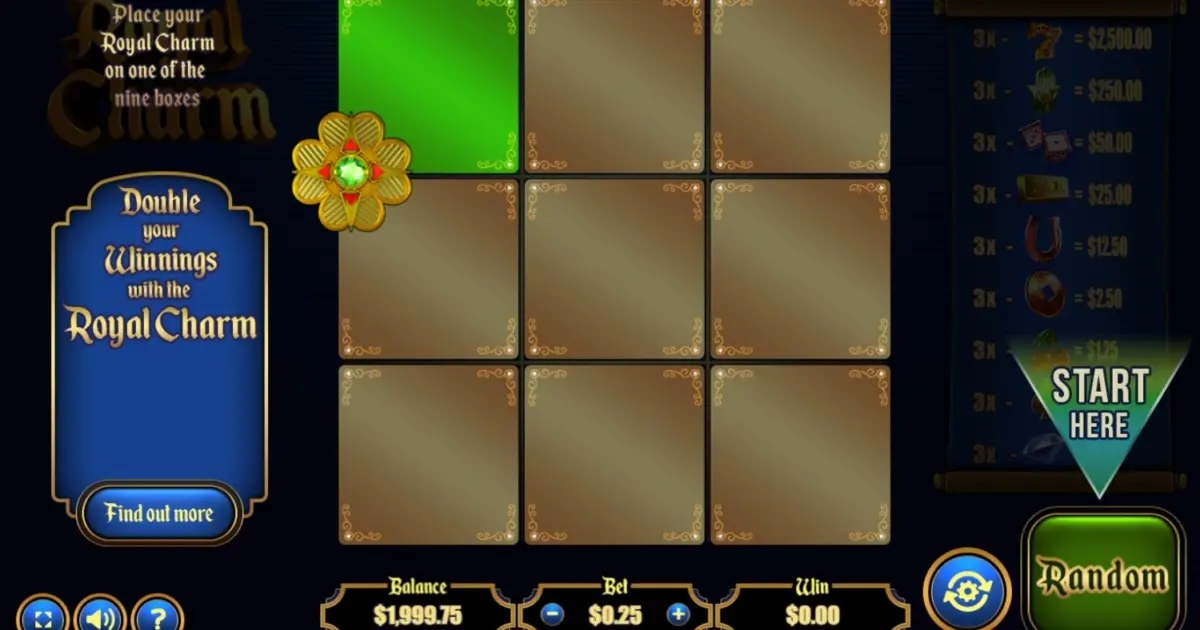
Royal Charm Scratch Card is worth a try if you want the fastest possible casino format with no learning curve: you buy a ticket, reveal it, and the result is already decided. There is no strategy that changes your odds, so the decision comes down to whether you enjoy instant-win lottery play and whether the published return suits your budget. The free-demo option lets you see the reveal flow without spending before you decide.
Royal Charm in one minute: royal charm scratch card
Royal Charm Scratch Card is a digital scratch card from Wizard Games, listed under the Scratch cards subcategory. Like every digital scratch ticket, its outcome is generated the instant you buy in — the scratching animation on screen is only a reveal layered over a result that already exists, exactly as with a physical printed ticket. There is one purchase decision per play and no choices to make mid-round, no hold, no cash-out and no bet adjustment once the ticket is issued.
That simplicity is the whole appeal. You do not need to learn paylines, bonus triggers or strategy charts, because there are none that affect the ticket you hold. FACTS lists this title at rank 9 with a popularity percentile of 97.2, which suggests many players have sampled it, but popularity does not change the maths of any single ticket.
The provider has 11 games in this catalogue and an average return across them of 92.95%, so this card sits below that provider average. Its theme count is listed as 0 for this specific theme label, meaning there is little theme-specific comparison to draw within the catalogue — you are evaluating this ticket on its own reveal experience and its published return, not on theme depth.
| Detail | Value |
|---|---|
| Game | Royal Charm Scratch Card |
| Provider | Wizard Games |
| Return to player | 85.0% |
| Subcategory | Scratch cards |
Because the details that would describe presentation are not in FACTS — ticket price, top prize, number of prize tiers, number of reveal zones or panels, artwork or bonus pick — this review does not assume them. If you want to see how the panels are laid out, open the game’s own rules or paytable screen; that is the authoritative place for ticket cost and prize structure.
Return to player: 85.0%
Royal Charm Scratch Card has a published return to player of 85.0%. For a scratch card, that figure does not mean you get back 85% on any one ticket. It is a long-run theoretical average across a very large batch of virtual tickets, fixed at design time by how the studio distributes prize tiers. Some tickets win, most do not, and the average across millions of tickets trends toward that number if the design holds.
At 85.0%, this ticket is below both the provider average of 92.95% for Wizard Games and the corpus average of 87.84% across the wider catalogue compared here, a difference of -2.84 points versus that corpus average. That gap is decision-relevant: over a long session, a lower RTP batch retains more of total stakes on average than a higher RTP batch, even though any single ticket remains independent and unpredictable.
It helps to think of RTP for scratch cards as lottery-style batch maths rather than slot-style spin maths. There is no reel strip, no hit frequency in the slot sense, and no volatility model built around frequent small pays versus rare large pays in the same way. The studio decides how many tickets at each prize level go into the batch, and the RTP is the sum of all prizes divided by the sum of all ticket costs in that batch design.
What this means in practice is simple. If you buy one ticket, your outcome is that ticket’s prize tier or a loss — the RTP does not nudge it. If you buy many tickets over time, your average return will tend to reflect the batch design, but with wide variance in the short term. Use the 85.0% figure to set expectations for cost of play, not to predict the next ticket.
How prize tiers are built into the batch
A scratch card’s payout structure is built before any ticket is sold. The studio creates a large virtual batch — imagine millions of printed tickets in a roll — and assigns a fixed count to each prize tier, with the majority assigned to no win and a decreasing count to higher tiers. The cost to buy a ticket is the same for every ticket in the batch, and the prizes are funded from the pool of ticket purchases according to that distribution.
Because FACTS for Royal Charm does not list specific prize tiers, ticket price or top prize, this review cannot quote them. That absence is normal for some scratch products, where the full tier table lives only on the game’s own help screen. Treat any site that lists a top prize or tier count without citing that in-game screen as unverified for this specific card.
The principle still helps you frame the session. A batch with a lower RTP typically funds fewer or smaller prizes in aggregate relative to total ticket cost. It does not mean losing tickets cluster together or that wins are evenly spaced. Each ticket is an independent draw from the batch distribution, pre-generated at purchase, so the batch design shapes the long-run average, not a sequence you can read.
For bankroll management, the only levers you have are how many tickets you buy and the price per ticket where the game offers choices. Those choices do not change the odds of the ticket you just bought; they change how long a set budget lasts and how variance feels. A lower-priced ticket stretches a small budget across more reveals, while a higher-priced ticket concentrates the same spend into fewer chances.
Digital versus physical scratch cards
The core idea is identical in both formats. A physical scratch ticket is printed with its win or loss already determined, hidden under latex. A digital scratch card is generated the instant you buy in, with the result hidden under virtual panels. Scratching with a mouse or finger is presentation, not participation — you are not influencing the result by how or where you scratch.
Digital cards add convenience and speed. You do not travel to a shop, you do not handle coins for change, and the reveal is instant with an auto-reveal option on many products. They also keep an accurate history in your game log, which paper tickets do not. That speed is worth noting for session control: you can buy and reveal far faster online than you can scratch paper tickets by hand.
Physical cards offer a tactile ritual that some players prefer and a natural pause while you scratch each zone. Digital cards replace that with animation and sound. Neither format changes the underlying maths category; both are lottery-style batches with a fixed RTP set by tier distribution.
Another difference is information access. A paper ticket prints the odds and top prizes on the back. A digital ticket should show ticket price, prize tiers and RTP in its rules or paytable screen. If that screen is missing for Royal Charm in a particular lobby, treat the game’s return as unverified in that location and check the provider’s own listing. The FACTS used here lists 85.0% for this title, which you can cross-check in-game.
Common misconceptions about hot tickets
Because scratch cards resolve so quickly, it is easy to form narratives about patterns that do not exist. The most common is the idea of hot or cold tickets, streaks that mean a win is due, or timing purchases to catch a good batch. None of these apply. Each ticket’s outcome is independent and pre-generated at the moment you buy it, with no memory of previous tickets you or anyone else bought.
A losing streak does not make the next ticket more likely to win. A winning ticket does not make the next one more likely to lose. There is no shoe to count and no reel state to track. The batch distribution describes the whole population of tickets, not a short sequence you can predict. Buying more tickets does not change the odds of any one ticket; it only buys more independent chances at the same distribution.
The same caution applies to provider-level comparisons. Wizard Games has other scratch products such as Cash Cuisine and Mega Love, both listed at 94.9% in FACTS, which is higher than this card’s 85.0%. That does not make this card due to balance the average, nor does it mean results on one title affect another. Each game’s batch is separate.
If you find yourself chasing after a run of no wins, that is variance doing what variance does in a high-volume, low-information game. Step away, keep ticket purchases within a pre-set limit, and remember that entertainment value comes from the reveal, not from trying to outguess a random draw.
Trying the demo first
A free demo is available for Royal Charm Scratch Card in FACTS, and it is the sensible first step. The demo shows you the panel layout, reveal speed and where the rules screen sits, without spending. It does not predict real-money outcomes, and a win or loss in demo has no bearing on paid tickets, because paid outcomes come from a separate real-money batch.
Use the demo to answer practical questions: how clear are the prize labels, is there an auto-reveal, how do you exit after a ticket, and where the ticket cost is confirmed before purchase. If you like instant-win formats generally, you may also want to sample a different Wizard Games scratch for contrast, such as Cops and Robbers (Wizard Games), to feel how presentation can differ while the core buy-and-reveal loop stays the same.
Keep sessions short and budgeted. This is the one place responsible play needs more than a passing mention, because the purchase-and-reveal loop is fast and cheap to repeat. You must be 18+ to play. Set a budget in advance that you can afford as entertainment you pay for, not as income you expect, and stop at that limit whether you are ahead or behind. Do not increase stakes to recover losses, and take regular breaks — use deposit limits or time-outs if the one-click buying feels too automatic. If gambling stops being fun, seek support from a recognised help organisation in your jurisdiction.
After the demo, if you decide to play for real, check the in-game paytable one more time to confirm ticket price and any prize-tier information shown there. That screen overrides any review if there is a discrepancy, since it reflects how the operator has configured the ticket in your region.
Who should try Royal Charm
Royal Charm suits players who want zero learning time and an immediate result. If you enjoy lottery tickets and prefer a single decision per play — buy, reveal, done — this format is built for you. There is no strategy to study that changes your odds, so the appeal is the pace and the simplicity, not depth.
It is a less natural fit if your enjoyment comes from features, choices or extended bonus rounds. Scratch cards, by definition, have no in-round decisions, and FACTS does not list a bonus mini-game for this specific card, so do not expect layered mechanics. Many digital scratch products in general layer a small pick-a-prize moment on top for presentation, but you should not assume that exists here unless the game’s own screen shows it. Judge the ticket on the one-reveal promise.
The return figure should also inform the choice. At 85.0%, this ticket keeps more of stakes on average than the provider’s 92.95% average and the corpus 87.84% comparator. Some players will be comfortable with that for short, low-cost sessions; others will prefer higher-RTP scratch options from the same studio. Either preference is reasonable as long as it is framed as cost-of-entertainment, not as a path to profit.
If that sounds like your kind of quick play, start with the free demo, confirm the ticket price in the rules, and buy only as many tickets as your pre-set budget allows. If you want the quickest possible decision, treat the demo as the trial and let one or two paid tickets tell you whether the reveal rhythm feels fun enough to repeat.
Frequently Asked Questions
Can I try Royal Charm Scratch Card for free before I buy tickets?
Yes. FACTS lists a free demo as available for Royal Charm Scratch Card. The demo shows the reveal flow and rules screen without spending. Demo outcomes do not predict real-money results, since paid tickets come from a separate real-money batch with the published 85.0% return.
What does the 85.0% RTP mean for a scratch card like Royal Charm?
It is the theoretical average return across a very large batch of virtual tickets, not per ticket. For Royal Charm Scratch Card the studio set 85.0% by distributing prize tiers across the batch. One ticket either wins its tier or loses; the RTP describes long-run batch maths, not your next reveal.
Is there any strategy or timing that improves my odds on Royal Charm Scratch Card?
No. Each ticket's outcome is generated the instant you buy in and is independent of previous tickets. No scratching technique, purchase timing or streak-reading changes the odds. The only control you have is bankroll management — how many tickets you buy and at what price.
Who makes Royal Charm Scratch Card and what else do they offer?
Wizard Games is the provider listed in FACTS, with 11 games in this catalogue and a provider average RTP of 92.95%. Related Wizard Games scratch products in the data include Cash Cuisine and Mega Love, both at 94.9% in the supplied comparison.
What happens after I reveal a losing ticket on Royal Charm — am I due a win?
No. Losing tickets are the most common outcome in any scratch batch, and a loss does not change the next ticket's odds. Royal Charm Scratch Card tickets are independent draws from the batch distribution, so there is no due win after a losing streak.