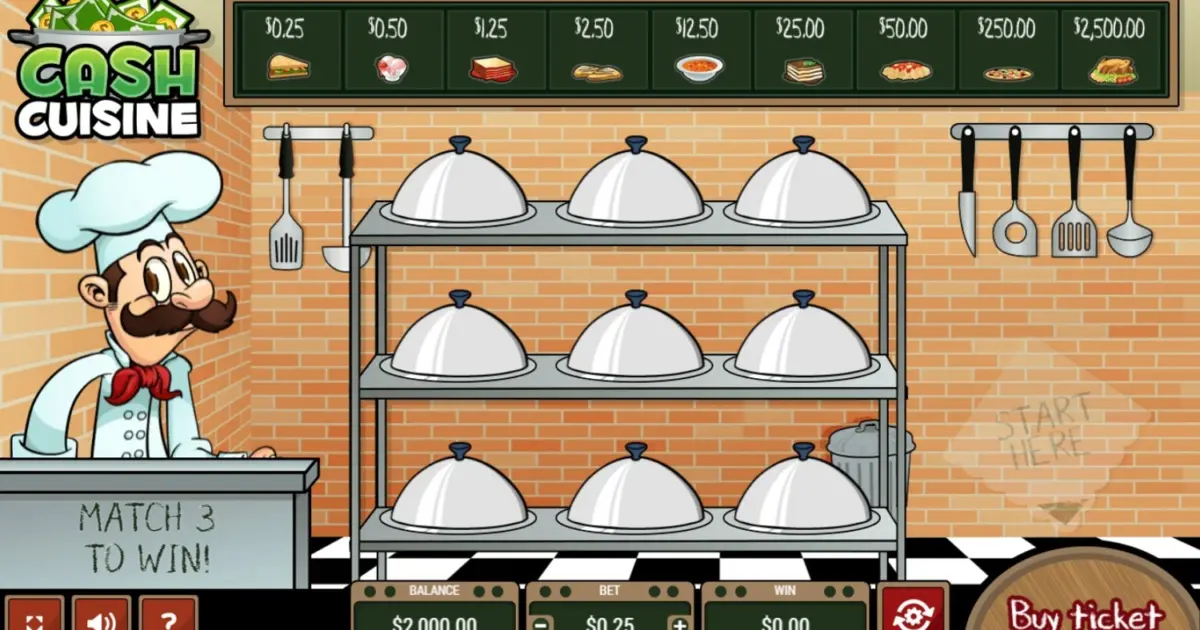
Cash Cuisine Scratch Card is worth a try if you want a quick, food-themed scratch ticket with an above-average return to player of 94.9% and no learning curve. The cash cuisine scratch card gives you one purchase and one instant outcome with nothing to study between rounds, so you can see in a free demo whether you enjoy that loop before you spend anything.
Is cash cuisine scratch card worth a try?
If you like the simplest kind of casino game — buy, reveal, done — this one fits that brief. There is no hand to play, no reels to follow, and no decision to make after you buy the ticket. You decide the stake, you reveal the panels, and the result that was already generated at the moment of purchase is shown to you.
That simplicity is the whole point of a digital scratch card, and it is also its limitation. You are not buying depth or a feature ladder; you are buying a short entertainment loop that resolves in seconds. For many players that is a positive: you know exactly what you are paying for, how long it will take, and that the next ticket is independent of the last.
From the facts available, two things stand out. First, the provider is Wizard games, a studio with 11 scratch-style titles in this corpus, so this is not a one-off experiment. Second, the published return to player is 94.9%, which for a scratch ticket is on the higher side of what you typically see, though it still means the batch as a whole is designed to return less than it takes in. If those two points — a known provider and a clearly stated RTP — matter to you, this card is a straightforward candidate to sample in free demo.
The popularity signal also helps decide. Ranked 20th in the scratch card group with a 93.3rd percentile for popularity, it is among the more frequently encountered tickets, which usually means the rules screen and paytable are easy to find and the presentation has been kept simple enough to load quickly.
Where the return to player actually comes from
A digital scratch card does not work like a slot. There are no reels, no hit frequency in the slot sense, and no near-misses that tell you anything about the next ticket. When you click to buy in, the system generates an outcome instantly from a large virtual batch of tickets that the studio has designed in advance. The scratching animation you see afterwards is just a reveal. The result already exists.
The published figure of 94.9% is the designed return for that entire batch, not a promise for your session. It is the average that would emerge if you could buy a very large number of tickets from the same prize-tier distribution — for example, thousands or tens of thousands — with prizes allocated across tiers from small returns up to a top tier. The studio sets that distribution at design time: how many tickets pay nothing, how many pay a small multiple, how many pay a larger multiple, and so on, until the maths averages to the stated percentage.
Because that structure is fixed, there is no way to influence which ticket you get by scratching faster, scratching in a pattern, or timing your purchase. Each ticket is independent and pre-generated. A run of losing tickets does not change the design of the batch, and a winning ticket does not make the next one less likely to win. The RTP describes the batch, not a single buy.
For you as a player, the useful takeaway is practical rather than tactical. Check the in-game rules or paytable screen to see whether the provider lists the RTP there as well, and treat the figure as a comparison tool between tickets, not as a forecast for the next reveal. This provider has published a figure for this ticket, which is genuinely helpful because many scratch products do not.
| Detail | Value |
|---|---|
| Game | Cash Cuisine Scratch Card |
| Provider | Wizard games |
| Return to player | 94.9% |
| Subcategory | Scratch cards |
| Free demo | Available |
What the name tells you about the theme
The FACTS block lists no specific visual details, so the theme can only be read from the name itself. Cash Cuisine points to a food and restaurant presentation — the kind of shorthand some scratch games use to make a ticket feel more distinct without adding mechanics. Think of it as a label for the artwork, not a description of extra features.
Without a theme description in FACTS, there is nothing concrete to report about how many reveal zones the card shows, whether it uses coin or dish icons, or whether a bonus pick is layered on top. Those choices vary widely across digital scratch products: some tickets show three matching symbols, some show a grid of panels, some add a small second-stage reveal where you pick a dish or chest for presentation. None of those should be assumed for this specific card unless the game screen itself shows them.
What you can take from the name is intent. A cuisine name is usually chosen to make the quick reveal feel lighter and more immediate than a numbers-only ticket. It does not change the underlying maths — the ticket is still a single-purchase, instant-result item from a pre-generated batch — it just frames the few seconds of the reveal.
If theme matters to your choice, the free demo is the honest way to judge it. Load the ticket and look at the paytable: you will see the actual panel layout, the symbols, and whether the studio has added any presentation-only bonus reveal. That screen is the only reliable source for this card, because the FACTS provided do not define those elements and they should not be invented.
One purchase, one outcome: what that means for your bankroll
Every digital scratch ticket works the same way financially: one decision to buy, one outcome, no in-round choices. You cannot hold a panel, cash out early, or adjust the stake while the card is being revealed. Once you commit, the ticket is resolved and your balance updates to reflect a win or a loss on that ticket alone. The next ticket starts the loop again from zero.
Because the action resolves so quickly, session management matters more than it does for slower games. The cost per ticket is fixed at the moment of purchase, but the time per ticket is short, so it is easy to buy more tickets in a few minutes than you intended. That speed does not change the odds — each ticket remains independent and pre-generated — but it does change how quickly spending can accumulate if you are not tracking it.
There is no strategy that alters the odds of the ticket you are about to buy. No pattern of buying, pausing, or switching stake changes the prize-tier distribution the studio designed for the batch. What you can control is entirely outside the ticket: how much you allocate to the session in advance, how many tickets that allocation represents, and when you stop, whether you are ahead or behind.
A practical approach is to decide before you start how many tickets you want to play and what that total spend is, then treat any wins as part of the same budget rather than as extra to immediately replay. If you use free demo first, use it to get comfortable with the reveal speed and the paytable layout, not to predict what a real-money ticket will do — demo play does not forecast real outcomes.
How Cash Cuisine compares to other scratch cards
The most objective comparison between scratch tickets is the published return to player for the ticket batch as a whole, understood as a long-run average across many tickets, not a promise for your next purchase. Cash Cuisine is published at 94.9%, which sits above the corpus average for scratch cards in this dataset of 87.84% by about seven points. That difference is meaningful in this category, where many tickets cluster in the high-80s to low-90s.
Against its own studio, the picture is closer. Wizard games averages 92.95% across its 11 scratch cards in the corpus, so this ticket is about two points above the provider’s own average. That suggests the studio has positioned this card toward the more generous end of its own range, while keeping it recognisably in line with its other products.
Two other Wizard games scratch cards make for direct reference points. Mega Love is listed at the same 94.9% and shows how the same provider can keep the maths identical while changing the theme wrapper, while Royal Charm at 85.0% illustrates the lower end of the same studio’s range and how much the batch design can vary even within one catalogue. If you try Cops and Robbers (Wizard Games), also at 94.9%, you will see another example of that upper tier from this provider.
Popularity does not change the maths, but it is worth noting for context. Ranked 20th and at the 93.3rd percentile, Cash Cuisine is more widely encountered than most tickets in the group, which often correlates with a cleaner presentation and a paytable that is easy to read. When you compare tickets, keep the focus on the published RTP and the ticket batch concept, not on how often you have seen a game mentioned.
Session limits and spending
Because a scratch card resolves in seconds, it helps to set your boundaries before the first purchase, not during the loop. Decide on a total amount you are comfortable spending as the price of entertainment, a maximum number of tickets that amount represents, and a time limit. If you reach any limit, stop, regardless of whether the last ticket won or lost. This is not a way to improve your odds — no limit or system changes the prize-tier distribution — it is a way to keep the fast repeat-purchase cycle from outrunning your plan.
There is no strategy, timing trick, or pattern of buying that makes the next ticket more likely to win. Each ticket’s outcome is independent and pre-generated, so chasing a loss with another immediate purchase only adds spend without changing probability. Wins and losses on previous tickets have no bearing on the one you are about to buy, and stretching a session because you feel the batch is due to pay is not how lottery-style maths works.
You are 18+ and you should only play with money you can afford to treat as an entertainment expense, not as income or as a way to recover money already spent. If you need to pause, use the reality checks, deposit limits, and time-outs available where you play, or step away entirely. If gambling stops feeling like entertainment you pay for, seek support from a responsible-gambling organisation in your jurisdiction.
Verdict
Cash Cuisine Scratch Card does what a scratch card should do: one purchase, one instant reveal, no extra rules to learn, with a clearly published 94.9% return that compares well to both the provider average and the wider scratch category here. The food-themed name gives it a lighter wrapper without implying added mechanics that are not documented in FACTS.
The limits are the same as for any ticket in this format. There is no in-round strategy, no way to affect which prize tier the next ticket comes from, and no meaning to streaks. The RTP describes the whole batch over a very large number of tickets, not your next few buys.
Try the free demo to see whether you like the reveal speed and the paytable presentation. If you decide to play for real, set a budget in tickets rather than time, keep the loop deliberate, and treat each independent purchase as entertainment you pay for, not as a step toward a guaranteed return.
Frequently Asked Questions
Can I try Cash Cuisine Scratch Card for free before I buy a ticket?
Yes. FACTS lists free demo as available, so you can load Cash Cuisine Scratch Card without payment and see the reveal and paytable. Use demo to judge the presentation and speed; it does not predict what a real-money ticket will pay since each ticket is independent and pre-generated.
What is the RTP for Cash Cuisine Scratch Card and what does it mean for a scratch card?
The published return to player is 94.9%. For a scratch card that figure describes the entire virtual batch of tickets the studio designed, averaged across many thousands of tickets and prize tiers, not a single purchase. Your next ticket is still independent and could pay nothing or a prize regardless of that average.
Is there a strategy or timing trick that improves my odds on a scratch ticket?
No. The outcome is generated the instant you buy the ticket and the scratch animation is just a reveal, so no pattern of scratching, pausing, or changing stake changes the odds. The only useful controls are bankroll and session limits: decide in advance how many tickets and how much spend you are comfortable with.
Who makes Cash Cuisine Scratch Card?
Cash Cuisine Scratch Card is by Wizard games, which has 11 scratch cards in this corpus and averages 92.95% RTP across them. This ticket at 94.9% sits about two points above the provider average and about seven points above the corpus average of 87.84% for scratch cards.
How does Cash Cuisine compare to Royal Charm from the same provider?
Cash Cuisine at 94.9% is designed to return more across the full batch than Royal Charm at 85.0%, also from Wizard games. Both are single-purchase, instant-result tickets where each outcome is independent, but the higher RTP suggests a different prize-tier distribution. Check each paytable in demo to compare ticket cost and tier layout.