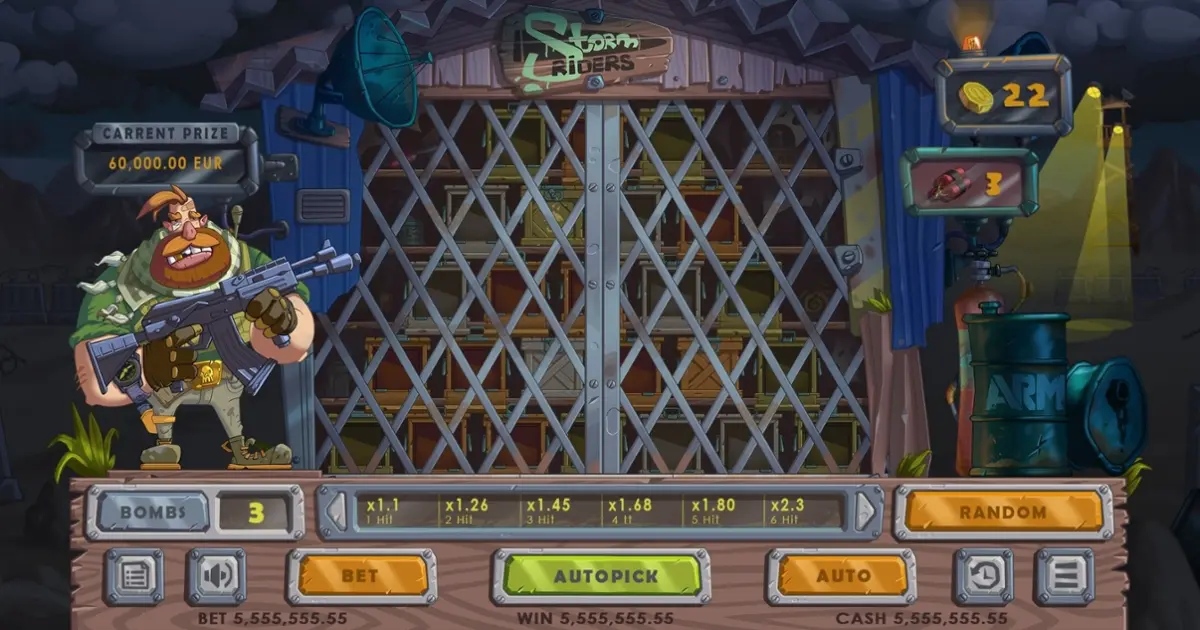
The storm riders crash game from Pixmove is a straightforward rising-multiplier title with a published RTP of 95%, and a free demo you can open without an account. The single number that should shape your decision is that RTP: at 1.2 percentage points under the 96.2% average across the crash games listed here, it is on the expensive side of the format over a long session. If you want the mechanic itself rather than the best available margin, the demo costs nothing.
What kind of crash game is Storm Riders?
It belongs to the crash category, which means the round structure is fixed and universal. A multiplier starts at 1.00x and climbs. At a point determined before the curve begins moving, it stops. If you cashed out before that instant, you keep your stake multiplied by whatever the figure read when you pressed the button. If you were still in, the stake is gone. There is no partial outcome and no consolation result.
Pixmove lists 20 games in total, and the average RTP across that catalogue is exactly 95.0% — this title sits on the house standard rather than above or below it. Beyond the crash label and the provider, Pixmove has not published details of the presentation, so anything you read elsewhere about visual specifics or bonus layers should be treated as unverified. Check the in-game information screen, which is the only source that always matches the build you are actually playing.
| Provider | Pixmove |
|---|---|
| RTP | 95.0% |
| Free demo | Yes |
| Site-wide average RTP | 96.2% |
The maths of a single round
Each round’s crash point is generated independently. That word carries the whole argument: the outcome of the previous round contributes nothing to the next one. A run of crashes at 1.10x does not make a long climb more likely, and a 40x round does not mean the game now owes you low results. Any commentary framing a sequence as “due” or “warmed up” is describing a pattern the generator cannot see.
What you genuinely control is the cash-out point, and that is a variance decision, not an odds decision. Setting an auto-cashout at 1.30x means you win small amounts often and lose occasionally. Waiting for 20x means you lose most rounds and occasionally win a lot. Both routes carry the same house margin; you are choosing the shape of the swings, not the size of the edge.
This is why progression systems fail here. Doubling after a loss, cashing out at a third of your previous multiplier, alternating bet sizes — none of it touches the distribution of crash points. Each new round starts from the same odds as the last, whatever your account balance did in the meantime.
Where the 95% comes from
The 95% RTP is a long-run statistical property of how crash points are distributed, not a promise attached to any round or session. In practical terms, across an enormous number of rounds, total returns tend toward 95% of total stakes, leaving roughly 5 units retained per 100 staked. Over a hundred rounds, actual results can land anywhere; the figure only asserts itself across volumes no individual player reaches.
The comparison worth holding onto is the corpus average of 96.2%. That 1.2-point gap sounds small and is not: on 1,000 rounds of 1 unit each, the difference in expected cost is around 12 units. It does not make this a bad game, but it does mean you are paying a little more for the same mechanic than the format’s median asks.
Note also that the RTP assumes standard play. Cashing out at 1.01x every round does not squeeze a better return out of it, and neither does chasing 100x — the edge is baked in before you make either choice.
Reading the rules and max multiplier before you bet real money
Pixmove has not published a maximum multiplier cap for this title, and it has not stated whether the game uses a provably-fair seed system or a conventional certified RNG. Both matter enough to check yourself.
A multiplier ceiling defines the best possible outcome. If a game caps at, say, 100x, a round that would theoretically have run to 500x pays 100x, which quietly changes the value of high-target strategies. Without a published figure, treat any number quoted on a third-party page as unconfirmed.
Provably fair, where a game offers it, means each round’s crash point derives from a seed you can verify after the fact, so you can confirm the result was not altered once your bet was placed. It is a transparency feature, not a better-odds feature — a provably-fair game and an RNG game can carry identical house edges. Since nothing in the published data confirms which system applies here, the game’s own rules screen is where to look. Bet limits are likewise unpublished, so open the demo and check the stake range before deciding whether the game fits your budget.
How the storm riders crash game compares to other crash games
Against the wider field, the position is simple: same mechanic, slightly thinner return. The 95% figure trails the 96.2% corpus average, so if RTP is your deciding factor, better-priced crash titles exist.
Within the Pixmove catalogue there is no RTP advantage to find, because the studio prices consistently. Swoop is the closest comparison if you want a second Pixmove crash title at the same 95% return. If you would rather see how the studio handles a different format at identical odds, King Thimbles and Sheriff’s Coins both publish 95% RTP as well, which makes them useful for judging whether you prefer the rising-curve decision or a pick-based one at the same cost.
The practical takeaway: choose between Pixmove titles on which mechanic you enjoy, because the maths will not separate them.
Free demo and staying in control
A free demo is available, and for a crash game it is genuinely informative. You can watch how often the curve dies below 2x, test an auto-cashout setting against a couple of hundred rounds, and learn the interface before money is involved. What it cannot do is forecast real-money results — demo sessions run on the same independent rounds, so a good run in play mode carries no information about a paid one.
Worth stressing with a format this fast: crash rounds resolve in seconds, which makes it easy to stake far more per hour than you intended. Play only if you are 18 or over, set a budget before you open the game and stop when it is spent, and treat the money as the price of the entertainment rather than a source of income. If tracking your spend stops feeling easy, that is the point to close the tab.
Final verdict
Storm Riders delivers the crash format cleanly at a 95% return, which is honest but unremarkable — 1.2 points below the average of the crash games listed here, and exactly in line with the rest of Pixmove’s 20-game catalogue. The absence of a published multiplier cap and any statement on provable fairness means the in-game rules screen deserves a read before you stake real money.
Try the free demo if the mechanic appeals; it costs nothing and answers the questions the published data does not. For real-money play, go in knowing the edge is fixed, no cash-out rule alters it, and the 5% margin is the price of admission.
Frequently Asked Questions
Can I play Storm Riders for free?
Yes, a free demo is available, so you can run the game without depositing or creating an account. It is useful for learning the cash-out interface and testing auto-cashout settings. Bear in mind demo rounds use the same independent crash points as real-money rounds, so results in play mode do not predict paid outcomes.
What is the Storm Riders RTP?
Pixmove publishes 95.0% return-to-player. That is a long-run average across an enormous number of rounds, not a session guarantee, and it implies roughly 5 units retained per 100 staked over time. It sits 1.2 percentage points below the 96.2% average across the crash games listed here.
Does cashing out at the right moment improve my odds?
No. Cash-out timing changes the shape of your results, not the expected value. Cashing out at 1.20x wins often for small amounts; holding for 20x wins rarely for large ones. Both carry the same 95% RTP, and no progression or one-third rule alters the distribution of crash points.
Is Storm Riders provably fair?
Pixmove has not published this, so check the game's information screen. In general, provably fair means each round's crash point comes from a seed you can verify afterwards, confirming the result was not changed after you bet. It is a transparency feature and does not lower the house edge.
How does Storm Riders compare to Swoop?
Both are Pixmove crash titles publishing 95.0% RTP, so there is no mathematical advantage either way. The studio prices its 20 games consistently at that figure. Choose between them on which presentation and pacing you prefer, and check each game's own rules screen for multiplier caps and stake limits.




