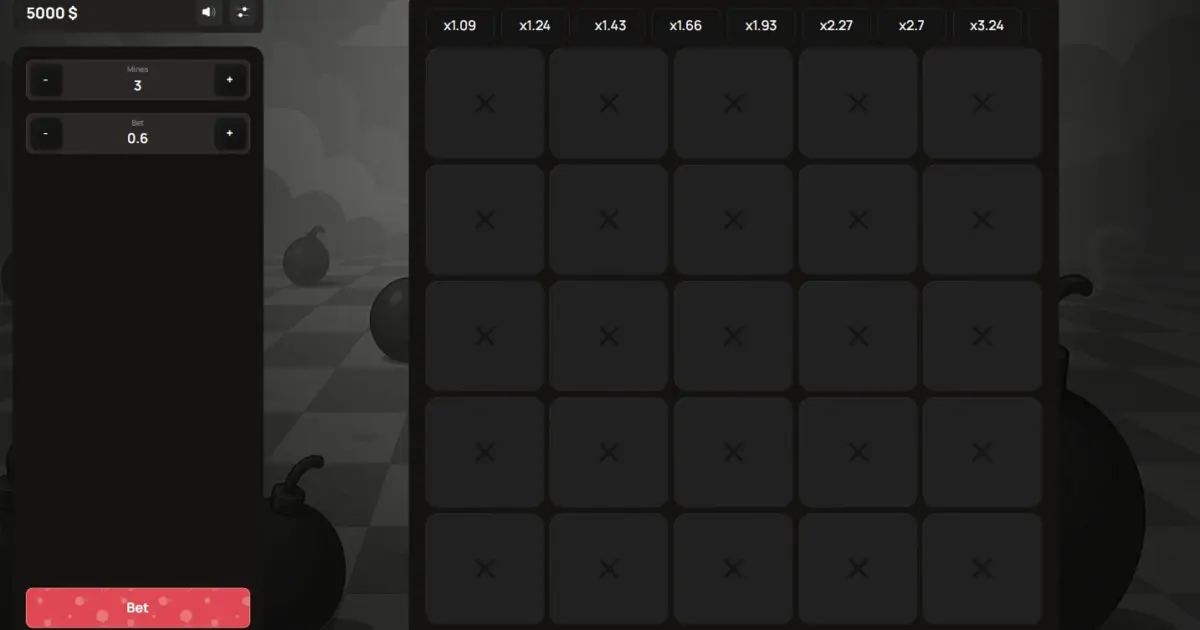
The most decision-relevant fact about the mines (book of zoomies) crash game is what is missing: 1Fün has not published a return-to-player percentage for it, and no maximum multiplier figure is on record either. A free demo is available, which is the sensible way to see how the round rhythm feels without committing a budget. If you want a published RTP number in front of you before you stake anything, that is a reasonable line to hold, and this title does not currently give you one.
How Mines (Book Of Zoomies) plays
Crash games all share the same skeleton. A round opens at a 1.00x multiplier and climbs. At some point determined before the curve starts moving, it stops — the crash. If you cash out before that moment, you are paid your stake multiplied by whatever the multiplier read when you pressed the button. If you are still in when it crashes, the stake is gone. There is no third outcome, no partial recovery, no consolation tier.
That means your only input is timing. Cash out at 1.30x often and you collect small, frequent returns. Hold for 8x and most rounds will end before you get there, with the occasional one that pays for several failures. Neither approach is smarter than the other in expected-value terms; they are different variance profiles of the same underlying maths.
Most crash titles offer auto-cashout, where you set a target multiplier in advance and the game exits for you, and auto-bet, which repeats your stake across rounds. These are discipline tools. They stop you from freezing on a hold you did not plan, and they keep your stake size consistent. They do not shift the odds by a fraction of a percent. If this game includes a live bet feed showing other players cashing out, treat it as decoration on identical mathematics — someone else’s 40x tells you nothing about your next round.
| Provider | 1Fün |
|---|---|
| Free demo | Yes |
| Site-wide average RTP | 96.2% |
1Fün and this game
1Fün is the provider behind this title, and it is a small catalogue: five games in total on record here. That is a studio with a narrow, recognisable output rather than a broad library, which in practice means the presentation and interface conventions tend to carry over from one release to the next. If you get on with one 1Fün crash game, the others will feel familiar quickly.
Its other crash titles are worth a look if you want to compare how the same core loop is dressed differently. JetCat takes the standard rising-curve setup, and Chicken Rough is the studio’s better-known entry in the format, with Chicken Rough Xmas as its seasonal variant. None of those three has a published RTP on record either, so the comparison is about feel and interface rather than about picking the mathematically better option.
Popularity is one thing that does separate this game from the pack. It sits at rank 37 in this category and in the top 87th percentile for traffic, so plenty of people are searching it out. That says something about visibility and word of mouth. It says nothing about the return you should expect.
Reading the missing RTP figure
There is no RTP percentage published for this game, so anything you see quoted for it elsewhere is unverified. Check the game’s own information screen before you play for money, and if the number is absent there too, factor that into your decision.
For context on what you are missing: across the crash games covered on this site, the average published RTP sits at 96.2%. That is a long-run figure, not a session forecast. An RTP of 96.2% means that over an enormous number of rounds, the game is designed to pay back about 96 units for every 100 staked, with the remaining edge kept by the operator. Across fifty rounds it tells you almost nothing — you can finish well ahead or wiped out at any RTP in that range.
The house edge in a crash game lives in the distribution of crash points, not in any single round. Low crash points occur often enough, and high ones rarely enough, that the long-run average lands wherever the studio designed it. Without a published number, you cannot know where that is for this title.
Provably fair, explained in general terms
FACTS does not state whether this game uses a provably fair system, so treat the following as background on the concept rather than a claim about Mines (Book Of Zoomies).
Provably fair means the crash point for each round is derived from a seed that you can inspect after the round has settled. Typically the operator commits to a hashed server seed in advance, combines it with a client seed, and publishes the unhashed value afterwards so anyone can recompute the result and confirm the number was fixed before the round began rather than adjusted while it ran.
The alternative is a conventional certified RNG, where an independent testing lab audits the generator and the operator publishes the certification instead of per-round verification data. Both approaches produce the same practical guarantee: rounds are independent and unpredictable.
What neither approach does is improve your odds. A verifiably fair sequence of crash points still carries the house edge built into its distribution. Verification tells you the game is not cheating you beyond its stated edge — it does not remove that edge. If per-round verification matters to you, look for the feature in the game’s own information panel.
Why no cash-out system changes the odds
Every round’s crash point is generated independently of the ones before it. Ten crashes below 1.50x do not make a high multiplier more likely on the eleventh, and a run of 20x results does not mean a low one is coming. No round is ever due, hot, or cold — those words describe a memory the generator does not have.
That single fact dismantles every crash strategy in circulation. Martingale doubling after a loss changes the size of your swings and the speed at which you can hit your table limit or your budget; it does not change expected value. Cash-out rules like taking a third off at 1.50x, or stepping your auto-cashout target up after each win, are ways of organising your own behaviour. They are not edges.
What you genuinely control is variance. Frequent small cash-outs mean a longer, flatter session with a higher hit rate. Chasing rare large multipliers means most rounds end in a loss, punctuated by occasional big ones. Pick the shape you actually enjoy sitting through, because the long-run arithmetic is indifferent to which you choose. Rounds here repeat fast, and speed is what makes a loose plan expensive.
Free play before real money
A free demo is available for this title, and it is genuinely the right first step. Use it to learn where the cash-out button sits, how auto-cashout behaves when you set a target, and whether the pacing suits you. What the demo cannot do is forecast real-money results. Demo sessions run on the same independent round generation, so a good run in practice mode carries no predictive weight whatsoever.
Play here is 18+ only. Decide what you are willing to lose before you open the game, treat that figure as the cost of entertainment rather than a stake you expect back, and stop when it is gone. Crash rounds resolve in seconds, which makes it unusually easy to work through a budget faster than you meant to — set a deposit limit or a session timer if your operator offers them. If chasing losses starts to feel automatic, that is the point to close the tab.
Final take on Mines (Book Of Zoomies)
This is a popular 1Fün crash game with a well-understood core loop and a documentation gap. You get the standard structure: rising multiplier, one decision per round, everything riding on whether you cash out before the curve stops. What you do not get is a published RTP, a stated maximum multiplier, or confirmation of a provably fair verification system, and none of those absences should be filled in with a number you read on an aggregator page.
If you want to play Mines (Book Of Zoomies) free first, the demo is there and costs nothing but time. If you are weighing real money, open the game’s information screen and see what the operator discloses in-client. A title that publishes its RTP is easier to assess than one that does not, and that comparison is worth making across 1Fün’s other four games before you settle on one.
Frequently Asked Questions
Can I play Mines (Book Of Zoomies) for free?
Yes, a free demo is available for this game, so you can learn the interface and cash-out timing without staking money. Bear in mind that demo play uses the same independent round generation as real money and cannot predict your results. Treat it as practice with the controls, not a preview of outcomes.
What is the RTP of Mines (Book Of Zoomies)?
1Fün has not published a return-to-player figure for this game, so treat any number quoted elsewhere with caution and check the game's own information screen before playing for money. For context, the crash games covered here average 96.2% published RTP, which is a long-run design figure rather than a session forecast.
Does cashing out at a set multiplier improve your chances?
No. Each round's crash point is generated independently, so no cash-out rule, progression, or auto-cashout target changes expected value. What timing does change is variance: early exits give frequent small returns, late holds give rare larger ones. Both sit on the same underlying house edge built into the crash-point distribution.
Is Mines (Book Of Zoomies) provably fair?
FACTS on this game does not confirm it, so check the in-game information panel. In general, provably fair means each round's crash point comes from a seed you can verify afterwards, proving the result was fixed before the round started. Verification confirms honesty; it does not reduce the house edge.
Who makes Mines (Book Of Zoomies)?
1Fün, a studio with five games on record here. Its other crash titles include Chicken Rough, Chicken Rough Xmas and JetCat, none of which has a published RTP either. If you like this game's interface, those three will feel familiar, since small studios tend to reuse presentation conventions across releases.




