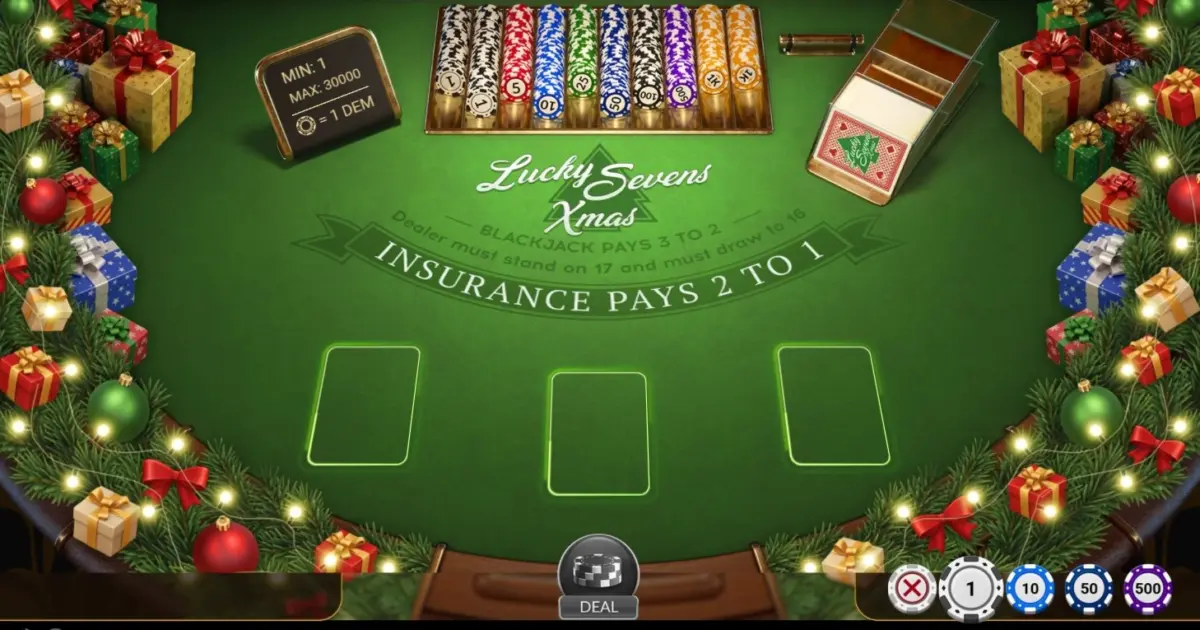
If you want a low-edge blackjack table to play without money on the line, this one is worth your time. Evoplay publishes a return of 99.7% for Blackjack Lucky 7s Xmas, which is above the 99.41% average across the blackjack tables we index, and a free demo is available so you can work through hands at no cost. The catch is that Evoplay does not publish the detailed rule set here, so several of the figures that actually determine your return are things you will need to read off the in-game paytable yourself.
How Blackjack Lucky 7s Xmas plays
This is an RNG blackjack table from Evoplay, listed in our index under Black Jack with a festive presentation implied by the name. Beyond that, the structural detail is thin: Evoplay has not published the deck count, the dealer’s soft 17 rule, the blackjack payout, the double and split permissions, whether late surrender is offered, or the table limits. None of that is guesswork you should accept from a review. Open the rules screen inside the game and check each one before you put real money through it.
What we can say is that the demo exists and is free, which makes the missing information easy to resolve. Deal a few dozen hands and the answers surface quickly. Does the dealer take a hole card? Can you double after splitting? Does a natural pay three to two? Twenty minutes in the demo tells you more about this table than any amount of reading, and it costs nothing.
Evoplay is a comparatively small player in this specific category. We index two blackjack titles from the studio, averaging 99.6% published return between them. If you like the way this one handles, the other is Blackjack Lucky Sevens (Evoplay) at 99.5%, a near-identical proposition without the Christmas dressing.
| Provider | Evoplay |
|---|---|
| RTP | 99.7% |
| Free demo | Yes |
Lucky 7s rules and what the name tells you
The title gives you a theme, not a rule set. “Lucky 7s” and “Xmas” describe presentation and possibly a bonus or side-bet hook built around sevens, but neither term is a recognised blackjack rule family the way “European”, “Vegas Strip” or “Single Deck” are. So unlike those titles, the name here tells you almost nothing about the maths.
That matters because the rule variables carry real weight. A shift from a 3:2 blackjack payout to 6:5 costs a player roughly 1.4% — the single most damaging rule change in the game, and enough on its own to turn a 99.7% table into something closer to a slot. A dealer who hits soft 17 rather than standing costs you around 0.2%. Fewer decks help you; eight decks cost roughly 0.6% against a single deck. Double after split, re-splitting aces and late surrender each hand back a fraction to the player. European no-hole-card rules, where the dealer draws only after you act, cost you around 0.1% compared with a peeking dealer.
If the game offers a sevens-based side bet, treat it as a separate wager with its own, much worse maths rather than part of the base game. More on that below.
Reading the 99.7% return figure
A 99.7% RTP is the same statement as a 0.3% house edge, expressed from the other direction. Over a very large number of hands, the table expects to keep 30p of every £100 staked. That is a genuinely low figure for blackjack and sits 0.29 percentage points above the 99.41% corpus average.
The caveat is the one that catches most players out: that number assumes perfect basic strategy on every single hand. Not most hands. Every hand. Published RTP is calculated against optimal play, so it describes the ceiling of what the game offers, not what a casual player realises. Stand on a 16 against a dealer 7, split tens because they feel strong, decline a double on 11 because the bet feels large, and your effective return drops well below the advertised figure. Small deviations compound: a player making a handful of intuitive errors per shoe can easily be playing a 98-point-something game while looking at a 99.7% label.
The other caveat is horizon. RTP is a long-run average across enormous sample sizes. In a hundred hands, variance dominates completely and the published figure tells you very little about what you will see. And nothing that happens in the demo predicts what happens with real money at stake — the maths is identical, but a demo session is not a forecast.
Where the house edge actually comes from
The base-game edge in blackjack comes from one structural asymmetry: you act first. Bust before the dealer acts and you lose immediately, even if the dealer would have busted too. Everything else in the rule set either widens or narrows that gap.
Basic strategy is how you shrink it. It is not a system or a betting pattern — it is a solved chart, computed from the exact composition of the deck, that gives the mathematically correct action for every player hand against every dealer upcard. There is nothing to intuit and nothing left to discover. Learn it, follow it, and you are playing the game as well as it can be played. It still does not eliminate the edge; it takes you to the floor and stops there.
Side bets are where returns fall off sharply. Perfect Pairs, 21+3 and any sevens-based novelty wager typically carry house edges several times the base game — figures in the 2% to 7% range are common across the category. Insurance is the clearest case: at standard 2:1 odds it is a losing proposition, and you should decline it as a matter of routine. If this table offers side bets, they are optional, and skipping them is the correct default.
Does card counting work here?
No. This is an RNG table, and an RNG table reshuffles the virtual deck before every hand. Counting depends on depletion — cards leaving the shoe and not coming back, so that the remaining composition drifts in your favour and you can raise your bet when it does. Reshuffle after each round and there is no depletion to track. Every hand starts from a full, freshly randomised deck, and the count you were keeping is worthless before you can act on it.
The same reasoning kills every betting progression. Martingale, D’Alembert, doubling after a loss: all of them change the shape of your variance, concentrating outcomes into rarer large losses and more frequent small wins, and none of them touches expected value. A 0.3% edge applied to a larger bet is simply a larger expected loss. No hand is ever “due” — the deck has no memory, and on an RNG table it has no history either.
What does work is basic strategy, played consistently, with side bets declined. That is the whole toolkit.
Bankroll and unit sizing
Because Evoplay does not publish the table limits here, you cannot size a session properly until you have checked the minimum bet in the game itself. Once you know it, a common approach is to treat a session bankroll as a fixed number of betting units — 40 to 50 units is a reasonable frame — and hold the unit constant regardless of how the last few hands went. Flat betting will not improve your return, but it makes the length of your session predictable, which is the thing you can actually control.
Play only with money set aside for entertainment in advance, never money you need for anything else. Blackjack is 18+, treat it as a cost rather than a source of income, and decide your limit before you start rather than in the middle of a losing run. If it stops feeling like entertainment, stop.
The free demo is the honest place to build the habit. Run basic strategy through several hundred hands there, watch how far a fixed bankroll actually stretches, and you will make better decisions if you later play for money.
Verdict
The published number is strong. 99.7% is at the top end of what blackjack tables advertise and better than the category average, and free demo access means you can evaluate it properly before committing anything. Evoplay only has two blackjack titles in our index, but both sit high on return.
The reservation is disclosure. With no published deck count, soft 17 rule or blackjack payout, that 99.7% is a claim you cannot yet verify against a rule set. Check the paytable first — if the natural pays 6:5 rather than 3:2, the real figure is nowhere near the headline. For comparison against better-documented tables, American Blackjack at 99.5% and Classic Blackjack at 99.28% are both worth a look.
Frequently Asked Questions
Can I play Blackjack Lucky 7s Xmas free with no download?
Yes. A free demo of Blackjack Lucky 7s Xmas is available and runs in the browser with no download and no deposit. It is the practical way to check the rules Evoplay has not published, including the deck count, the soft 17 rule and the blackjack payout, before you stake anything real.
What is the Blackjack Lucky 7s Xmas RTP?
Evoplay publishes 99.7%, which is 0.29 percentage points above the 99.41% average across the blackjack tables we index. That figure assumes perfect basic strategy on every hand, so a player making occasional intuitive decisions rather than following the chart realises a materially lower return than the label suggests.
What is the house edge on this table?
The 99.7% return corresponds to a 0.3% house edge under optimal play. Because Evoplay does not publish the rule set, that edge is unverified. A 6:5 blackjack payout instead of 3:2 would cost roughly 1.4% on its own; dealer hitting soft 17 adds about 0.2%. Check the paytable.
Does card counting or a betting system work on Blackjack Lucky 7s Xmas?
No. This is an RNG table that reshuffles before every hand, so there is no card depletion to count and no advantage to accumulate. Betting progressions such as Martingale change the shape of your variance but never the expected value. Basic strategy, played consistently, is the only genuine tool.
Who makes Blackjack Lucky 7s Xmas and how does it compare to their other table?
Evoplay develops it. The studio has two blackjack titles in our index, averaging 99.6% published return. The alternative is Blackjack Lucky Sevens (Evoplay) at 99.5%, essentially the same proposition without the Christmas theme, so the Xmas version holds a 0.2 point advantage on paper.




