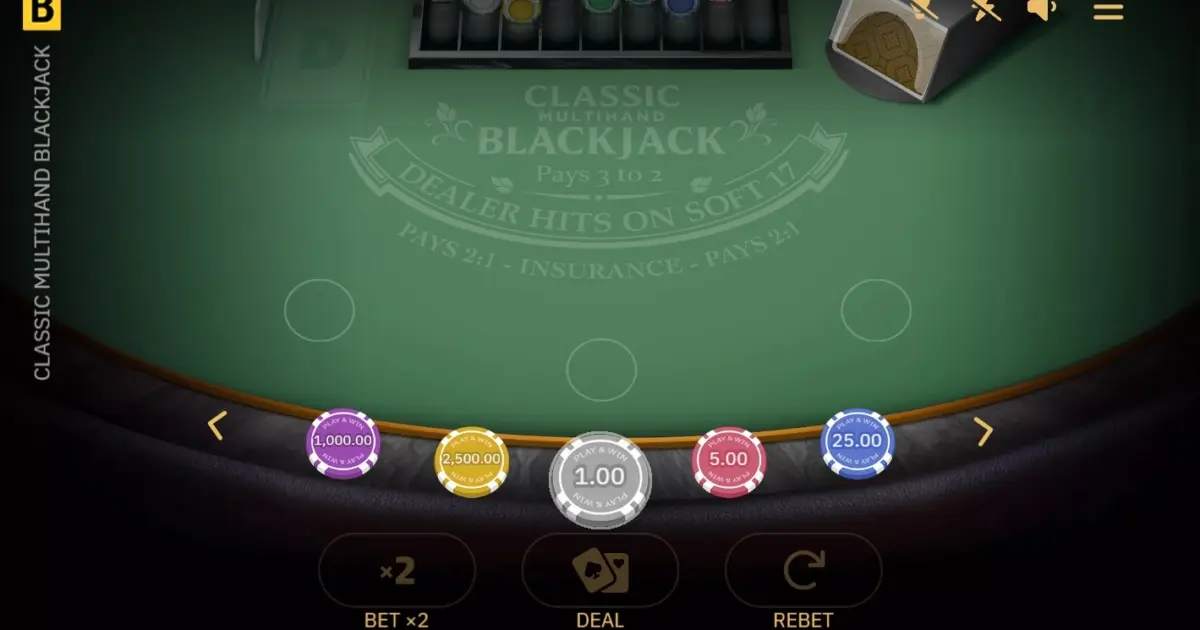
If you want a low-edge blackjack table you can practise on without spending anything, this one qualifies on the numbers. The published return of 99.38% is close to the best you will find in an RNG blackjack lobby, and a free demo is available so you can learn the interface before any money is involved. The catch is structural rather than mathematical: a multi-hand table lets you push far more money across the felt per hour than a single-hand table does, at exactly the same edge.
What kind of blackjack is Classic Multihand Blackjack?
This is a BGaming RNG table, not a live-dealer stream. Every card comes from a random number generator, and the name points at two things worth understanding before you sit down.
The word “Multihand” indicates you can play several hands per round against a single dealer hand. That normally means three or five betting boxes, though the exact number is not published in the data available here, so check the table before you commit a bet. The important consequence is not strategic but financial: three hands at one unit each is three units at risk per round, and the house edge applies to every one of them. Your expected hourly loss scales with total money wagered, so a multi-hand table burns through a bankroll several times faster than a single-hand version of the same game.
“Classic” indicates a baseline rule set — the kind of table standard basic strategy charts are written for, without exotic payout twists or bonus wagers layered on top. Again, treat that as a strong hint from the title rather than a confirmed rule list. Neither the deck count nor the specific dealer and doubling rules are published for this table, so the paytable and rules screen inside the game are your only reliable source. Open them first; it takes thirty seconds and it determines which strategy chart is correct.
| Provider | BGaming |
|---|---|
| RTP | 99.38% |
| Free demo | Yes |
Return to player: 99.38%
An RTP of 99.38% is the same figure stated another way as a house edge of 0.62%. Over a very long run, the model expects the table to keep 62 cents of every hundred dollars wagered. That is a strong number for RNG blackjack. It sits exactly on BGaming’s average across its six blackjack titles, and only marginally below the 99.41% average across the wider corpus of tables — a difference of 0.03%, which is noise at any realistic session length.
The caveat matters more than the figure. Every published blackjack RTP assumes perfect basic strategy on every single hand. That number is not what a casual player gets. It is what a player gets who hits the correct decision on soft 18 against a nine, splits the right pairs, doubles the right totals and never takes insurance. Deviate a handful of times per shoe and the realised return drops materially — a habitually loose player can give back a full percentage point or more, which turns a 0.62% edge into something closer to a mid-tier slot.
Note also that RTP is a long-run average across millions of hands. Across a hundred hands, variance dominates completely. The edge is real but it is slow; the swings are fast.
Deck count, dealer rules and the payout that matters most
The single most damaging rule change in blackjack is the blackjack payout. A natural paying 3:2 is standard. A natural paying 6:5 costs the player roughly 1.4% — more than double the entire house edge of this table. If a blackjack game advertises a 99.38% return, that figure almost certainly assumes 3:2, because 6:5 alone would push the edge past 2%. Confirm the payout on the felt or in the paytable before your first real-money hand. It is the one rule worth walking away over.
After that, the rules that move the edge are, roughly in order of size: whether the dealer stands or hits on soft 17 (standing is worth about 0.2% to you), the number of decks (single deck is best, eight is worst, with a total spread around 0.5%), doubling after a split, re-splitting aces, late surrender, and whether the dealer peeks for blackjack or the table runs European no-hole-card rules. Each of the smaller ones is worth a few hundredths to about a tenth of a percent.
BGaming does not publish the deck count or the dealer’s soft-17 rule for this table in the data available, so you cannot derive the edge yourself from first principles. What you can do is read it off the rules screen and pick the matching strategy chart. If you want a table where the surrender rule is stated in the title itself, Surrender Multihand Blackjack publishes a 99.48% return and names the rule up front.
Playing your first ten hands
Use the free demo for these ten hands. The goal is not to win anything; it is to find out how many boxes the table gives you, where the double and split buttons sit, and whether the dealer peeks.
Then load a basic strategy chart alongside it. Basic strategy is not a system or a betting pattern — it is a solved chart. For every combination of your total and the dealer’s up-card, there is one mathematically optimal action, and it was calculated decades ago. Following it minimises the house edge to the published figure. It never eliminates it, and no amount of correct play flips the sign.
Two habits to build immediately. First, decline insurance every time. At the standard 2:1 offer it is a losing bet against any shoe you cannot count, and it is the most common way players volunteer extra edge to the house. Second, play one box while you learn. Multi-hand tables punish inattention: three simultaneous decisions per round means three chances to misplay, and the errors compound rather than average out.
Card counting is worth addressing here because the multi-hand format tempts people into it. It does not work on an RNG table. The deck is reshuffled every hand, so there is no depletion to track and no count to carry forward. Every round is independent. No hand is ever “due”.
Side bets: the maths behind the temptation
The data available does not list which side bets, if any, this table offers, so check the betting layout in the game itself. The general maths applies regardless of which ones appear.
Side bets carry a dramatically higher house edge than the base game. Where this table’s main wager runs at 0.62%, typical Perfect Pairs implementations sit somewhere around 4% to 11% depending on deck count, and 21+3 commonly lands in the 3% to 8% range. Those are five to fifteen times worse per dollar wagered. They exist because they pay big multiples occasionally, and that feels different from grinding a base-game edge, but the arithmetic is not ambiguous.
Insurance deserves separate mention because it is offered mid-hand rather than pre-deal. At the standard 2:1 payout, insurance is a losing proposition on average — the dealer does not complete a blackjack often enough to justify the price. Taking it “to protect a good hand” is not protection; it is a second, worse bet placed on top of a good one.
If you want to keep every dollar on the lowest-edge wager available, ignore the side betting circles entirely. On a 0.62% base game, a single side bet can easily double or triple your effective cost per round.
Session limits and bankroll
Multi-hand play changes bankroll maths more than most players expect. If you normally stake one unit per round, playing three boxes at the same unit size triples your exposure per round without changing the edge. Either divide your unit by the number of boxes or accept that your session will resolve roughly three times faster in both directions.
A practical approach: decide your total session budget first, then size a unit at somewhere between 1% and 2% of it across all boxes combined, so a normal losing streak does not end the session in ten rounds. Variance on a 0.62% edge is wide — losing sessions are routine and prove nothing about the table.
Betting progressions do not fix this. Martingale, D’Alembert and any “double after a loss” pattern reshape the distribution of outcomes, making small wins more frequent and large losses rarer but far more severe. They do not alter expected value by a single cent, because the edge on each individual hand is unchanged.
Blackjack is for players aged 18 and over. Set a budget before you open the table, treat the money as the cost of entertainment rather than a source of income, and stop when you reach the limit you set rather than the one you feel like setting mid-session. Demo results tell you nothing about how real-money play will go.
Verdict on Classic Multihand Blackjack
The headline number is good. A 99.38% return puts this among the stronger RNG blackjack options, matching BGaming’s own average and sitting within 0.03% of the wider market. A free demo is available, which makes it a reasonable place to drill basic strategy at zero cost.
What holds it back is disclosure. The deck count, the dealer’s soft-17 rule, the doubling and splitting permissions and the side bet menu are all absent from the published data, so you cannot verify the rule set before loading the game. That is not unusual for RNG tables, but it does mean the paytable screen is mandatory reading rather than optional. If you want to compare figures within BGaming’s range, Multihand Blackjack Pro 2 posts the identical 99.38%, while Blackjack MH (BGaming) comes in slightly lower at 99.33%.
Worth your time if you play the chart properly and size your unit for the number of boxes you open. Less suited to anyone planning to play three hands on instinct, because a multi-hand table converts small strategy errors into money three times as quickly.
Frequently Asked Questions
Can I play Classic Multihand Blackjack for free?
Yes, a free demo is available for this BGaming table, so you can deal hands with no deposit and no download. It is the sensible way to check how many betting boxes the table gives you and to drill basic strategy decisions before any real money is at stake. Demo outcomes do not predict real-money results.
What is the Classic Multihand Blackjack RTP?
The published return is 99.38%, equivalent to a 0.62% house edge. That figure assumes perfect basic strategy on every hand — correct hits, stands, doubles and splits without exception. A player making occasional errors realises a materially lower return, potentially a full percentage point worse, so the chart matters as much as the table choice.
Which rules change the house edge on this table?
The blackjack payout dominates everything else: 6:5 instead of 3:2 costs roughly 1.4%, more than double this table's entire 0.62% edge. After that, dealer standing on soft 17 is worth about 0.2%, deck count spans roughly 0.5%, and double-after-split, re-splitting aces and surrender contribute smaller amounts. BGaming does not publish these specifics here.
Does card counting work on Classic Multihand Blackjack?
No. This is an RNG table that reshuffles the deck every hand, so there is no card depletion to track and no running count to carry between rounds. Each hand is statistically independent of the last. Betting progressions like Martingale change the shape of your variance but leave expected value exactly where it was.
Who makes this game and how does it compare to their other tables?
BGaming develops it, and the studio publishes six blackjack titles averaging 99.38% — the same figure as this table. Multihand Blackjack Pro 2 matches it at 99.38%, Blackjack MH (BGaming) sits slightly lower at 99.33%, and Surrender Multihand Blackjack leads the range at 99.48% with the surrender rule named in the title.




