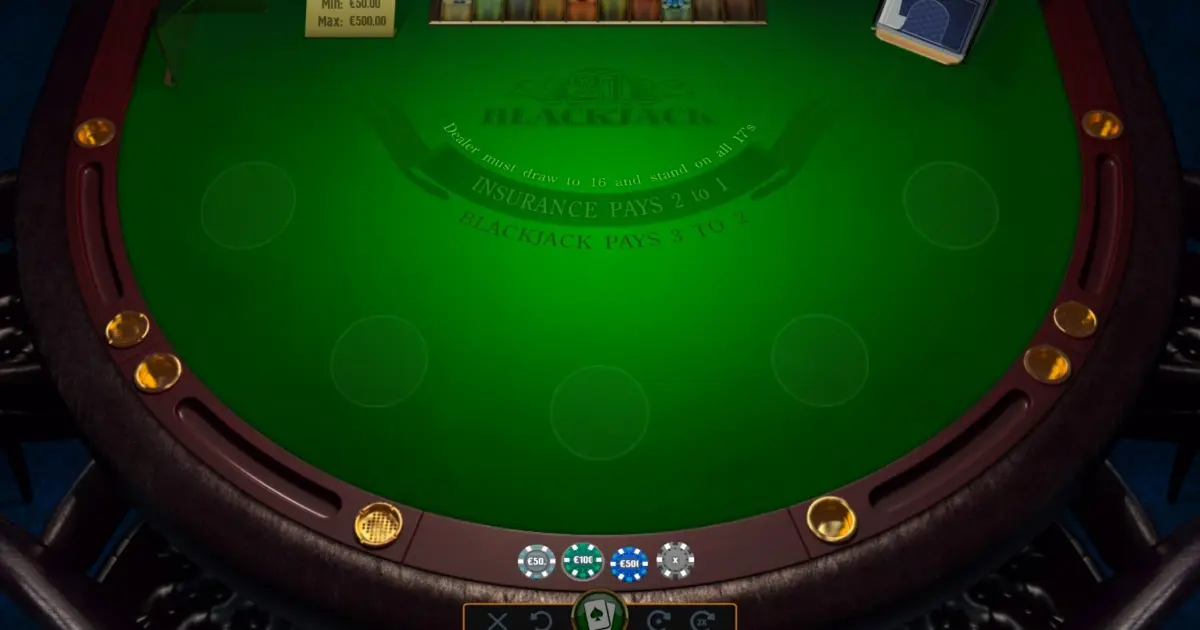
Blackjack (Playson) is worth your time if you want a virtual table with a headline RTP of 99.5% — a figure that sits right at the top of what online blackjack offers. But that number is conditional, not a promise: it assumes you play perfect basic strategy on every single hand, and the moment you deviate, the house edge climbs. For a maths-literate player, this is a solid, high-return option worth a look; for a casual player, it is still blackjack, still beatable in the short run by variance, and still a game where the house always has the edge over the long run.
Blackjack (Playson) in one minute
Blackjack (Playson) is a virtual blackjack table from Playson, sitting in the Black Jack subcategory on this site with a rank of 81 and a popularity percentile of 39.8 — a mid-pack table that is not the most played but holds its own. The single most important number here is the RTP of 99.5%, which translates to a house edge of just 0.5% if you play perfect basic strategy on every hand. That makes it one of the most favourable published figures on the site, and it is the reason this table stands out.
Playson does not publish the full rule set for this table in its public materials, so you cannot confirm the deck count, whether the dealer hits soft 17, the blackjack payout, or which side bets are offered from the listing alone. The name indicates a standard virtual blackjack, which normally means a multi-deck shoe and a 3:2 payout, but you should verify those rules in the game’s own paytable before playing for real money. The difference between 3:2 and 6:5 alone is worth roughly 1.4% of the edge — bigger than the entire house edge this table claims.
House edge versus RTP: the numbers explained
RTP and house edge are two sides of the same coin. If the RTP is 99.5%, the house edge is 0.5% — the casino’s theoretical long-run take on every wager, assuming perfect basic strategy on every hand. That is the critical caveat: no player plays perfectly, and a casual player who hits when they should stand, splits when they should not, or takes insurance will realise a materially lower return than the published figure. The 99.5% is a ceiling, not an average.
How the rules move that edge matters more than the headline number. A 3:2 blackjack payout versus 6:5 is the single most damaging rule change in the game — 6:5 costs the player roughly 1.4%, which is nearly three times the entire house edge on this table. The dealer standing versus hitting on soft 17 changes the edge by a few tenths of a percent. The number of decks, whether you can double after a split, whether you can re-split aces, and whether late surrender is offered all move the edge by hundredths or tenths of a percent. Dealer peek versus European no-hole-card changes how you play a blackjack against a dealer ace.
Here is the table of the figures we do know for Blackjack (Playson):
| Metric | Value |
|---|---|
| Provider | Playson |
| RTP | 99.5% |
| House edge (assuming perfect basic strategy) | 0.5% |
| Subcategory | Black Jack |
| Rank | 81 |
| Popularity percentile | 39.8 |
| Free demo | Yes |
Playson does not publish the deck count for this table. That matters because deck count changes the edge by a few hundredths of a percent — small, but not zero — so check the in-game rules screen before you put money down.
How this table compares to other online blackjack
The corpus average RTP across online blackjack tables on this site is 99.41%, and Blackjack (Playson) sits above that at 99.5% — a difference of 0.09 percentage points. That is not a huge gap, but in a game where the entire house edge is half a percent, a ninth of it is a real, if modest, improvement over the field. It is also exactly in line with Playson’s own average RTP of 99.5% across its two blackjack games, so this is not an outlier within the provider’s catalogue; it is their standard.
If you want to compare directly, Blackjack Low is the other Playson blackjack table and posts the same 99.5% RTP — so the choice between them comes down to rules and feel, not headline number. For a different flavour at the same return, American Blackjack also sits at 99.5%, while Classic Blackjack comes in at 99.28%, a touch below the corpus average. None of these numbers mean anything without the rule set behind them, so the practical advice is the same across all of them: check the in-game rules before you play for money.
Basic strategy in practice
Basic strategy is a solved chart, not a system. It is the mathematically optimal decision for every possible hand against every possible dealer up-card, worked out by exhaustive computation decades ago and verified ever since. It tells you when to hit, stand, double, split, and surrender to minimise the house edge — and it is the only thing standing between you and the full published RTP. Without it, you are giving the house far more than the 0.5% this table claims.
In practice, basic strategy is a fixed set of rules you can memorise or keep on a card next to you. For example: always stand on hard 17 or higher, always hit on hard 11 or lower, double on 11 against a dealer 2 through 10, never take insurance, and split aces and eights every time. The chart varies slightly depending on the table’s rules — whether the dealer hits soft 17, whether double after split is allowed, whether surrender is offered — so the chart that applies to Blackjack (Playson) depends on rules Playson has not published. Use the standard multi-deck chart as your baseline, and adjust if the in-game rules screen tells you otherwise.
The honest truth is that basic strategy minimises the house edge without ever eliminating it. Even a perfect player loses 0.5% over the long run on this table. What basic strategy does is ensure you lose as little as possible, and it converts blackjack from a game where the casino crushes the uninformed into one where the edge is thin enough that short-term variance can easily swing your way. That is the entire game.
Betting systems and why they do not change the odds
Martingale, D’Alembert, “double after a loss” — every betting progression you have heard of shares one property: it changes the shape of your variance, not the expected value. A progression reshuffles when you win and lose in bigger or smaller chunks, but the long-run expected loss per hand is identical to flat betting at the same average stake. The house edge applies to every hand independently, and no sequence of bets alters that.
Worse, progressions are dangerous in a specific way: the Martingale, where you double after every loss, requires an ever-larger bankroll to survive a losing streak, and table limits exist precisely to break that strategy. A run of six or seven losses — entirely normal in blackjack variance — can wipe out a bankroll that survived dozens of flat-bet sessions. The progression does not make you more likely to win; it makes your losses bigger when they come, and they always come eventually.
Card counting does not work against this table either. Blackjack (Playson) is an RNG table that reshuffles the shoe every single hand, which destroys the entire premise of counting — that the composition of the remaining deck shifts as cards are dealt. With a fresh random deck each hand, there is no information to track, and any counting system is pure superstition. The only edge available is the thin one from playing perfect basic strategy, and that is the whole toolkit.
The free demo
Blackjack (Playson) has a free demo available, and there is no good reason not to use it. The demo lets you play with virtual credits, test the table’s feel, timing, and interface, and — most importantly — practise basic strategy without risking a cent. This is the single best use of a demo for a blackjack player: the maths is identical to the real-money game, so every hand you play in the demo is practice you can carry straight into a cash session.
One thing the demo cannot do is predict real-money results. The RNG works the same, the rules are the same, but short-term variance is the same too — a winning demo session proves nothing about how you will do with real money, and a losing one proves nothing either. Use the demo to build and verify your basic strategy, not to test your luck.
When you do move to real money, keep the basics in mind: 18+, set a budget before you start, and treat the game as entertainment, not income. The house edge is real and unavoidable over the long run, and the only responsible way to play is with money you can afford to lose, in amounts you have decided in advance.
Verdict
Blackjack (Playson) is a strong table on the numbers: a 99.5% RTP, a 0.5% house edge under perfect play, and a free demo to practise on. It sits above the corpus average, matches the best of the related tables on this site, and comes from a provider whose blackjack standard is clearly this same figure. The mid-pack popularity is not a mark against it — it is simply less hyped than the big-name tables.
The two things to hold against it are the missing rule details and the basic-strategy caveat. Playson does not publish the deck count, blackjack payout, or surrender rules, and those details can shift the real edge by more than the entire 0.5% headline figure if you are not careful. And that 99.5% is a ceiling, not a guarantee — it assumes perfect play on every hand, and casual play will return less. If you play basic strategy and verify the rules in-game, this is genuinely one of the better-value virtual blackjack tables you can find.
Frequently Asked Questions
Can I play Blackjack (Playson) free?
Yes, a free demo is available for Blackjack (Playson). You can play with virtual credits to learn the table and practise basic strategy without risking real money. The demo uses the same RNG and rules as the real-money game, so it is a good training ground — though it cannot predict real-money results.
What is the RTP of Blackjack (Playson)?
The RTP is 99.5%, which means a house edge of 0.5% — but only if you play perfect basic strategy on every hand. That figure is a ceiling, not an average; a casual player who makes mistakes realises a materially lower return than the published number.
How does the house edge on Blackjack (Playson) compare to other tables?
At 99.5%, it sits 0.09 percentage points above the site's corpus average RTP of 99.41%. It matches Blackjack Low and American Blackjack at 99.5%, and beats Classic Blackjack's 99.28%. The real edge depends on rules Playson does not publish, so check the in-game rules screen.
Does card counting or a betting system work on Blackjack (Playson)?
No. This is an RNG table that reshuffles every hand, which makes card counting useless — there is no changing deck composition to track. Betting progressions like Martingale change the shape of variance, not the expected value; the house edge applies to every hand independently.
Who makes Blackjack (Playson)?
The provider is Playson, which publishes an average RTP of 99.5% across its two blackjack games. The other one, Blackjack Low, posts the same 99.5% figure. Playson does not publish the full rule set for this table, so verify deck count and blackjack payout in the game's paytable.




