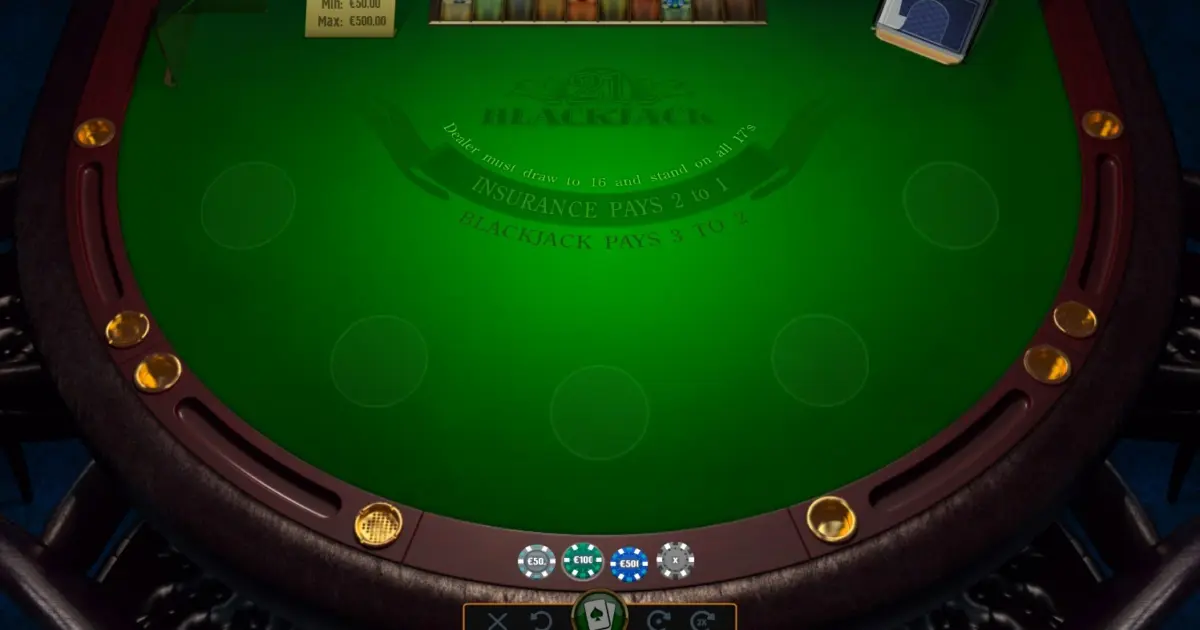
If you want a low-stakes blackjack table with a competitive published return, this one is worth a session in demo mode. Playson lists Blackjack Low at a 99.5% RTP, which is marginally above the 99.41% average across the blackjack tables in our database. The catch, as always, is that the figure describes a player making the mathematically correct decision on every single hand.
What Playson does not publish here is the detail: no deck count, no soft-17 rule, no blackjack payout, no side bet list, no table limits. That matters, and this review is honest about where the gaps are rather than filling them with plausible-sounding numbers.
How Blackjack Low plays
The structure is the standard one for the format. You place a bet, receive two cards, the dealer receives their hand, and you choose whether to hit, stand, double or split according to the two visible cards. The dealer then plays out a fixed, non-discretionary rule set, and hands are compared. Nothing about a digital table changes that core loop.
What Playson has not disclosed publicly is the specific rule configuration. That includes the number of decks in the shoe, whether the dealer stands or hits on soft 17, whether the blackjack payout is 3:2 or 6:5, whether double-after-split and re-splitting are permitted, whether late surrender is available, and which side bets sit alongside the main wager. Each of those moves the edge, and the blackjack payout in particular moves it a lot.
So the practical route is straightforward: open the free demo, open the in-game rules or paytable screen, and read the rule list there before you commit anything. The demo costs nothing and the rules screen is the authoritative source for this table. Playson currently lists two blackjack titles, and the sibling table Blackjack (Playson) carries the same 99.5% published return, so it is worth comparing the two rule screens side by side to see where the “Low” designation actually changes things.
| Provider | Playson |
|---|---|
| RTP | 99.5% |
| Free demo | Yes |
Low-stakes rules and what the name tells you
The word “Low” in the title almost certainly refers to the betting range rather than a rule variation. In most provider catalogues, a “Low” table is the same game engine as the standard version with a reduced minimum and maximum bet, aimed at players who want longer sessions from a smaller bankroll. That is a reasonable reading of the name, but it is a reading, not a confirmed fact, and Playson does not publish the limits.
This is worth being careful about, because table naming is not standardised across the industry. Some providers use a suffix to signal a genuine rule family: “European” normally means a two-deck or multi-deck game with no dealer hole card, “Single Deck” normally means one deck with a payout adjustment to compensate, “American” normally means the dealer peeks for blackjack. “Low” carries no such rule implication that we can rely on.
The safe assumption is that the rules match Playson’s standard blackjack build and only the stakes differ, and the safe action is to verify that in the paytable. If you find the minimum bet is higher than you expected, or that a rule you rely on is absent, you will know before your money is on the felt rather than after.
Reading the 99.5% return figure
RTP and house edge are two ways of stating the same number. A 99.5% RTP means a house edge of 0.5%: over a very large number of hands, the table is modelled to return 99.50 units for every 100 wagered. That is a good figure for blackjack and it sits 0.09 percentage points above the corpus average of 99.41%.
The caveat is the one that catches most players out. Published blackjack RTP assumes perfect basic strategy on every hand, with no exceptions for hunches, no standing on a 16 against a 7 because it feels safer, and no taking insurance. Basic strategy is a solved chart, not a system: for every combination of your hand and the dealer’s up card there is one decision with the highest expected value, and the chart lists it.
Deviate from that chart and your realised return drops below 99.5%. A casual player who plays by instinct typically gives up one to two percentage points, which turns a 0.5% edge into something two to four times worse. The 99.5% figure is available to you, but it is not automatic — it is the reward for playing the chart properly.
It also describes a long-run average, not a session. Blackjack variance means a hundred hands can land well above or well below the modelled return, and demo results tell you nothing predictive about a real-money session.
Where the house edge actually comes from
The 0.5% edge is a net figure produced by the interaction of the rules. As general rules of thumb, and not as claims about this specific table:
- The blackjack payout is the single biggest lever. Moving from 3:2 to 6:5 costs the player roughly 1.4% — enough on its own to turn a good table into a poor one.
- A dealer who hits soft 17 costs you around 0.2% versus one who stands.
- Fewer decks favour the player, though the effect is small once you are past two decks — a few hundredths of a percent per deck at the margin.
- Double-after-split, re-splitting aces and late surrender each return a small amount of edge to you, in the region of 0.1% to 0.15% apiece.
- A no-hole-card dealer costs you a little when you double or split into a dealer blackjack.
Side bets sit outside all of this. Perfect Pairs, 21+3 and similar wagers typically run house edges of 2% to 7% or worse, far above the base game. Insurance is a losing bet at standard 2:1 odds unless you are counting cards, which brings us to the next section. Whether any side bets appear on this table is not published, so check the paytable.
Does card counting work here?
No. Card counting works by tracking how the composition of a shoe drifts as cards are removed, which only creates an advantage when the shoe is dealt down over multiple rounds. An RNG blackjack table reshuffles a full virtual shoe before every hand, so every round starts from the same fresh distribution and there is no history to count. Your count is reset to zero before you can act on it.
The same logic disposes of insurance as anything other than a losing bet here. Insurance is only profitable when you know the remaining deck is rich in tens, and on a reshuffled table you never know that. Decline it.
Betting progressions do not help either. Martingale, D’Alembert and “double after a loss” schemes change the shape of your variance — more small wins, occasional very large losses — but they do not touch the expected value of a single hand, and expected value is what the house edge measures. No hand is ever “due”. If you want to compare how a different rule set feels, American Blackjack also publishes 99.5% and gives you a second reference point.
Bankroll and unit sizing
Because this is billed as a low-stakes table, the sensible approach is to treat the minimum bet as your unit and size your session bankroll as a multiple of it. Something in the range of 40 to 100 units gives you room to absorb a normal losing run without being forced to stop mid-session or raise your stake to chase back. Keep the unit flat. Blackjack’s edge is thin enough that bet-sizing gymnastics only add variance.
Doubling and splitting mean a hand can cost two or more units, so your bankroll needs to be measured against the largest amount a single hand can absorb, not the base bet. Budget for that before you sit down.
Blackjack Low is for players aged 18 or over. Set a budget in advance, treat it as the price of entertainment rather than a source of income, and stop when it is spent. If the amount you are betting has stopped feeling like entertainment, that is the point to walk away and use the free demo instead.
Verdict
On the number Playson does publish, this is a solid table: 99.5% RTP, slightly above the blackjack average in our database, and a free demo you can use to learn the interface at no cost. It ranks in the 36.8th popularity percentile, so it is not a headline title, but popularity and mathematics are different things.
The reservation is disclosure. Without a published deck count, soft-17 rule, blackjack payout or side bet list, you cannot verify the 99.5% figure against the rules yourself before opening the game. That is fixable in thirty seconds on the rules screen, and you should do it. If the paytable shows 6:5 blackjacks, the published return does not describe what you would actually be playing. If you want a table with more of its rules on the record, Classic Blackjack at 99.28% is worth a look for comparison.
Frequently Asked Questions
Can I play Blackjack Low for free?
Yes. A free demo of Blackjack Low is available, so you can learn the interface and read the in-game rules screen without staking anything. Use it to confirm the deck count, blackjack payout and soft-17 rule, none of which Playson publishes externally. Demo results do not predict real-money outcomes.
What is the RTP of Blackjack Low?
Playson lists a 99.5% RTP, equal to a 0.5% house edge. That figure assumes perfect basic strategy on every hand with no exceptions and no insurance. Play by instinct instead and your realised return typically falls one to two percentage points lower, which multiplies the effective edge against you several times over.
Which rules affect the house edge most on a blackjack table?
The blackjack payout dominates. Dropping from 3:2 to 6:5 costs a player roughly 1.4%, more than every other common rule combined. Dealer hitting soft 17 costs about 0.2%, and double-after-split, re-splitting aces and late surrender each return roughly 0.1% to 0.15%. Playson does not publish these for this table.
Does card counting or a betting system work on Blackjack Low?
No. This is an RNG table, so the virtual shoe reshuffles before every hand and there is no card history to count. Insurance is a losing bet for the same reason. Progressions like Martingale reshape your variance without changing expected value, and no hand is ever due to win.
Who makes Blackjack Low?
Playson develops it. The studio has a small blackjack catalogue of two titles, both published at 99.5% RTP, the other being Blackjack (Playson). The "Low" in the name most likely signals reduced betting limits rather than a rule variation, but Playson does not publish the limits, so verify them in the game.




