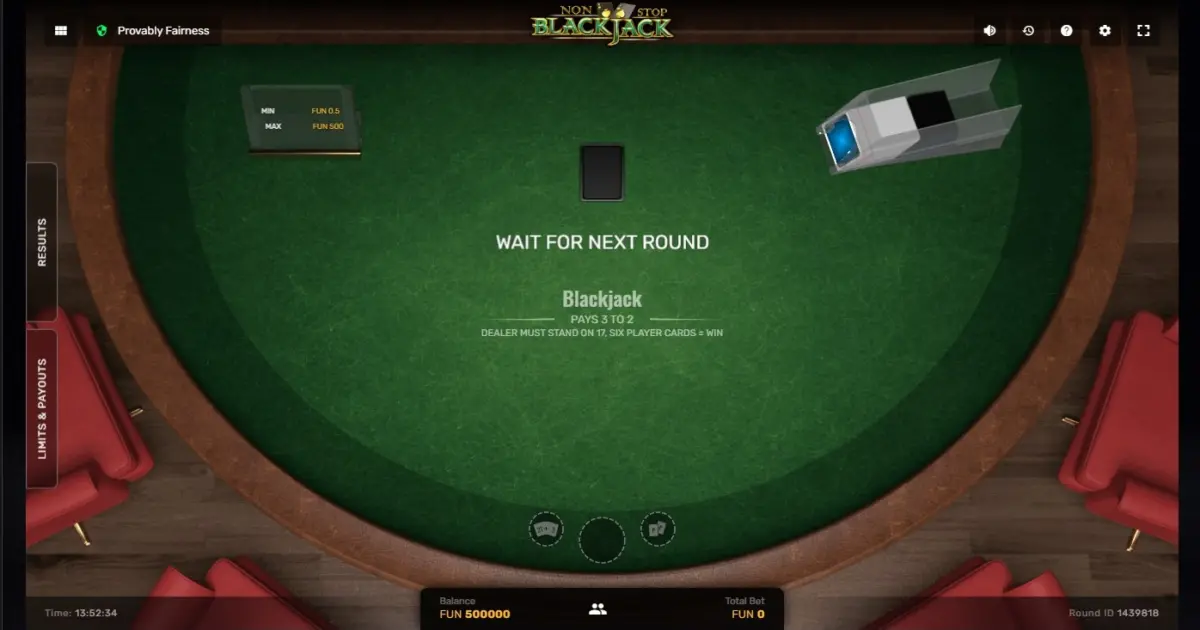
If you want a straightforward RNG blackjack table with a competitive published return, non-stop blackjack is worth a look: Pascal Gaming lists a return-to-player of 99.47%, which sits just above the 99.41% average across the blackjack tables in our catalogue. A free demo is available, so you can learn the interface without staking anything.
The caveat matters more than the headline. That 99.47% assumes flawless basic strategy on every hand, and Pascal Gaming does not publish the detailed rule set for this table in the data available here — so the paytable and rules screen inside the game are your real reference before you play for money.
How Non-Stop Blackjack plays
This is a software-driven, random-number-generated blackjack table rather than a live-dealer stream. You are dealt against a virtual dealer, the shoe is handled by the RNG, and there is no other player at the table to slow the pace. The name suggests a design built around uninterrupted hand-after-hand play, which is the main practical difference you will notice compared with a live table where you wait on other seats.
Beyond that, the specifics are not published in the information available. The deck count, the dealer’s soft 17 rule, whether double-after-split and re-splits are permitted, whether late surrender exists, the blackjack payout, table limits and the available side bets are all absent from Pascal Gaming’s published data for this table. Every one of those affects your expected return, and several affect it substantially, so treat the in-game rules screen as mandatory reading rather than optional.
Pascal Gaming is a comparatively small presence in this space — we catalogue two blackjack titles from the studio, both at a listed 99.47%. The other is Turbo Blackjack, which shares the same headline figure and is worth comparing directly if you like the studio’s approach.
| Provider | Pascal Gaming |
|---|---|
| RTP | 99.47% |
| Free demo | Yes |
RNG blackjack rules and what the name tells you
The title does not name a rule family. It does not say “European”, “Single Deck”, “Atlantic City” or “Vegas Strip”, which means you cannot infer the deck count or the dealer’s hole-card behaviour from the name the way you sometimes can. That is genuinely useful information: it means you have to check rather than assume.
The rules that move the needle most, in rough order of impact, are these. A 6:5 blackjack payout instead of 3:2 costs the player roughly 1.4% and is the single most damaging common rule change — it alone would make a 99.47% claim impossible to sustain in practice. A dealer who hits soft 17 rather than standing costs you around 0.2%. Fewer decks favour you; eight decks cost roughly 0.05% against a single deck. Double-after-split, re-splitting aces and late surrender each return a small amount of edge to the player, in the range of 0.05% to 0.15% apiece. European no-hole-card rules, where the dealer takes no second card until players have acted, cost around 0.1% compared with a peeking dealer.
A published 99.47% is consistent with a liberal, player-friendly rule set, but the figure alone does not tell you which rules produce it. Verify before you stake.
Reading the 99.47% return figure
RTP is simply the inverse of the house edge. A 99.47% return means a house edge of 0.53% — over a long run of correctly played hands, the table expects to keep about 53 cents of every 100 units wagered. That is a good number for blackjack and considerably better than most other casino games.
The condition attached to it is the part casual players miss. Every published blackjack RTP assumes perfect basic strategy on every single hand, with no deviations for hunches, no standing on 16 against a 10 because it feels safer, and no taking insurance. Play approximately instead of exactly and your realised return drops materially — common play mistakes routinely cost a percentage point or more, which is to say they can double or triple the effective house edge.
The figure is also a long-run average, not a session forecast. Across a few hundred hands your actual result will scatter widely either side of it, and no amount of correct play changes that. For context, American Blackjack lists 99.5% and Classic Blackjack lists 99.28%, so the gaps between well-regarded tables are measured in fractions of a percent — small enough that your own accuracy matters far more than your choice of table.
Where the house edge actually comes from
The dealer’s structural advantage comes from one thing: you act first. If you bust, you lose immediately, regardless of what the dealer would have done afterwards. That single asymmetry is the whole edge, and blackjack’s 3:2 bonus payout plus your right to double and split are the concessions that claw most of it back.
Basic strategy is the solved answer to that problem. It is a chart, not a system — a complete table of the mathematically best action for every combination of your hand and the dealer’s up card, derived from probability rather than observation. Learn it and you compress the edge to the published minimum. It does not eliminate the edge, and nothing does.
Side bets work in the opposite direction. Perfect Pairs, 21+3 and similar wagers typically carry house edges in the 2% to 7% range, an order of magnitude worse than the base game. Insurance is a losing bet at the standard 2:1 payout for anyone not tracking the composition of the shoe, and on an RNG table nobody is. Whether this table offers any of these is not published, so check — and if they are there, the correct basic-strategy answer is to skip them.
Does card counting work here?
No. Card counting works by tracking which cards have left the shoe so you can raise your bet when the remaining cards favour you. An RNG blackjack table that reshuffles between hands destroys that information every time it deals, so there is nothing to count. The composition of the next hand is independent of the last one.
The same logic disposes of betting progressions. Martingale, D’Alembert and “double after a loss” all change the shape of your variance — bigger swings, more frequent small wins, occasional catastrophic sessions — without changing expected value by a single decimal place. No sequence of bet sizes can convert a negative-expectation game into a positive one. And no hand is ever “due”; the RNG has no memory of what it dealt you.
What does work is accuracy. Correct basic strategy on every hand, no insurance, no side bets. That is the entire edge-reduction toolkit available on an RNG table, and it gets you to the published figure.
Bankroll and unit sizing
Because the house edge is small, blackjack sessions are dominated by variance rather than by the edge. A common approach is to size your base bet so your session bankroll covers 40 to 50 units, which gives you enough hands to ride out a normal run of bad ones without being forced out. Increase stakes only by revising that whole calculation, never mid-session to chase a loss.
Blackjack is 18+ only. Set a budget before you open the table, treat it as the cost of entertainment rather than a source of income, and stop when it is spent regardless of how the session is going. If gambling stops feeling like a choice, seek support from a recognised problem-gambling service.
Demo play is genuinely useful for drilling basic strategy without cost, but it predicts nothing about your real-money results. Use it to build accuracy, not expectations.
Verdict
A listed 99.47% return puts this table among the better-value blackjack options in our catalogue, narrowly ahead of the 99.41% corpus average. The free demo means you can drill basic strategy at no cost, and Pascal Gaming’s consistency across both its blackjack titles is a mild point in its favour.
The reservation is transparency. Without published deck count, soft 17 rule, blackjack payout or side-bet details, you are trusting a headline figure you cannot yet reconcile against a rule set. Open the rules screen first, confirm the blackjack payout is 3:2, and only then decide whether the number is real for you.
Frequently Asked Questions
Can I play Non-Stop Blackjack for free?
Yes, a free demo of Non-Stop Blackjack is available, so you can play with virtual credits and no download or deposit. It is the sensible way to learn the interface and drill basic strategy. Bear in mind that demo results tell you nothing about how a real-money session will go.
What is the Non-Stop Blackjack RTP?
Pascal Gaming lists 99.47%, slightly above the 99.41% average across the blackjack tables we catalogue. That figure assumes perfect basic strategy on every hand, with no insurance and no side bets. Play approximately instead of exactly and your realised return will be materially lower.
What is the house edge and which rules change it?
A 99.47% return equals a 0.53% house edge. Rules move that figure: a 6:5 blackjack payout instead of 3:2 costs roughly 1.4%, a dealer hitting soft 17 around 0.2%, and more decks a further fraction. Pascal Gaming does not publish these details, so check in-game.
Does card counting or a betting system work on this table?
No. This is an RNG table that reshuffles between hands, so there is no shoe composition to track and nothing to count. Betting progressions like Martingale alter the shape of your variance without changing expected value. Correct basic strategy is the only genuine edge-reduction tool available.
Who makes Non-Stop Blackjack and what else do they offer?
Pascal Gaming develops it. The studio has a small blackjack range — two titles in our catalogue, both listed at 99.47%. The other is Turbo Blackjack, which shares the same headline return, so it is the natural comparison if you like this table's pace and presentation.




