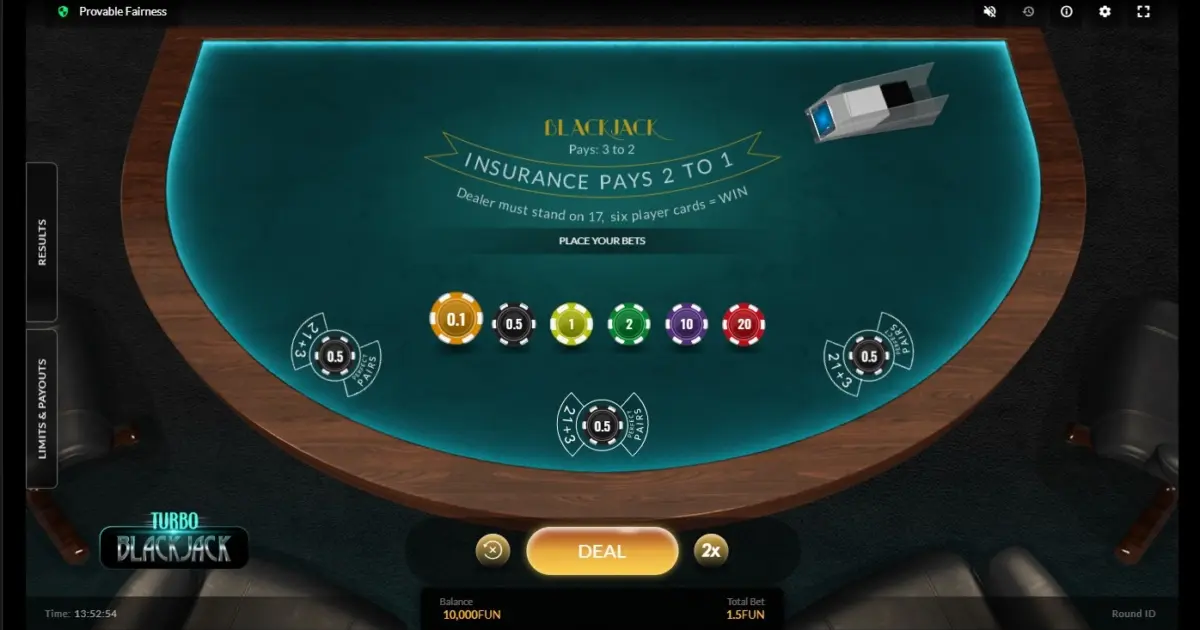
If you want a low-edge blackjack table and you are willing to play accurately, turbo blackjack is worth a look: Pascal Gaming publishes an RTP of 99.47%, which sits just above the 99.41% average across the blackjack tables we list. It is also playable as a free demo, so you can check the rules screen and get comfortable with the pace before any money is involved. The catch is the same as at every table — that return figure is earned, not given.
Turbo Blackjack at a glance
Pascal Gaming is a small studio in this category, with two blackjack tables in our database, and both are quoted at the same 99.47% return. Turbo Blackjack ranks 114th by popularity here, putting it in roughly the 15th percentile — a niche table rather than a headline release.
| Field | Detail |
|---|---|
| Game | Turbo Blackjack |
| Provider | Pascal Gaming |
| Category | Blackjack |
| Published RTP | 99.47% |
| Average RTP across our blackjack list | 99.41% |
| Popularity rank | 114th (15th percentile) |
| Free demo | Yes |
Pascal Gaming does not publish the table rules alongside that RTP figure — no deck count, no soft 17 rule, no blackjack payout, no confirmed side bet list. Those details are what actually produce the 99.47%, so read the in-game rules screen before you commit real stakes. If you want a directly comparable table from the same studio, Non-Stop Blackjack is quoted at the same 99.47%.
What a 99.47% RTP means at a blackjack table
RTP is the mirror image of the house edge: 100% − 99.47% leaves a house edge of 0.53%. Over a long run of hands, the table keeps about 53 cents of every $100 wagered. That is a tight number by casino standards, and better than most non-blackjack products you will find.
Here is the part that matters most, and it is not marketing small print. That 99.47% assumes perfect basic strategy on every single hand. Every published blackjack RTP is calculated that way. It presumes you hit, stand, split and double exactly as the optimal chart says, with no exceptions, no hunches and no deviations because the last three hands went badly.
A casual player realises a materially lower return. Standing on soft 18 against a 9, declining a split you should take, or doubling when you should not adds fractions of a percent back to the house each time, and those fractions compound across a session. Depending on how loose the play is, a real return can drift from 99.47% down towards the high 97s or worse. The figure is a ceiling, not a promise.
The rules that move the house edge
Since the specific rule set here is not published, it helps to know which rules do the heavy lifting so you can read a paytable properly. As general rules of thumb:
- Blackjack paying 6:5 instead of 3:2 costs the player around 1.4% — by far the most damaging single rule change, and enough to turn a good table into a poor one on its own.
- A dealer who hits soft 17 rather than standing costs roughly 0.2%.
- Fewer decks favour the player. Single deck is worth a few tenths of a percent against a six or eight deck shoe.
- Double after split helps the player by roughly 0.15%; being allowed to re-split aces adds a smaller amount again.
- Late surrender is worth around 0.07% when used correctly.
- A dealer peek for blackjack is better for you than the European no-hole-card rule, which costs about 0.11% because you can lose doubled and split bets to a dealer blackjack.
The title gives no reliable clue about which of these apply, so treat nothing as settled until you have opened the rules screen. Comparing quoted numbers across tables is a reasonable shortcut: American Blackjack is listed at 99.5%, slightly ahead of this one, while Classic Blackjack sits at 99.28%.
Basic strategy, and what it can and cannot do
Basic strategy is not a system. It is a solved chart: for every combination of your hand and the dealer’s up card, one action has the highest expected value, and the chart tells you which. It was derived mathematically decades ago and is not up for debate.
What it does is bring your realised return up towards the published figure. What it cannot do is remove the house edge. Play flawlessly for a thousand hands and the maths still favours the dealer by that 0.53%; basic strategy just stops you handing over more than you have to.
Charts vary slightly with the rules, so once you know the deck count and the soft 17 rule from the game screen, use the chart that matches. No betting progression changes any of this. Martingale, D’Alembert and any “double after a loss” pattern reshape the distribution of your results — bigger swings, different bust risk — while leaving expected value untouched. And no hand is ever “due”; each deal is independent of the last.
Side bets and insurance
Pascal Gaming does not publish which side bets, if any, this table offers, so check before you assume Perfect Pairs or 21+3 are available. What is universal is the maths behind them. Side bets typically carry house edges of several percent — often 5% to 10% or more — against the 0.53% you are facing on the base game. Wagering a unit on a side bet is many times more expensive per hand than the same unit on your main hand.
Insurance deserves its own note because it is offered as protection and functions as a bet. At standard 2:1 odds, insurance loses money over time whenever you cannot track the composition of the remaining cards. In a game that reshuffles, that is always. Basic strategy declines insurance, full stop, including when you hold a blackjack yourself.
Card counting also has no application here. Counting depends on information carrying over from hand to hand as a shoe depletes. An RNG table that reshuffles every hand resets that information to zero each deal, so there is nothing to count and no system built on counting will work.
Playing the Turbo Blackjack demo
A Turbo Blackjack free demo is available, and it is the sensible starting point. Use it to read the rules screen, confirm the payout on a natural, learn the interface and practise running a basic strategy chart until the decisions come without hesitation. Practising accuracy for free costs nothing but time, and inaccuracy is the main reason players fall short of a published RTP.
Be clear about what demo play does not tell you. Results in a free session do not predict real-money outcomes; short runs are dominated by variance in either direction. If you do move to stakes, think in units — a fixed bet size small enough that a normal losing streak does not end your session — and expect swings even with correct play.
Blackjack is for players aged 18 or over. Set a budget before you open the table, treat it as entertainment spending rather than a source of income, and stop when you reach the limit you set rather than the one the session suggests.
Verdict: who should sit at this table
The 99.47% figure is genuinely competitive, a shade above the average for the blackjack tables we list, and the free demo removes any reason to learn the interface with real money on the line. That is a solid combination for a player who already runs basic strategy properly.
The reservation is transparency. With no published deck count, soft 17 rule or blackjack payout, you are trusting the quoted RTP without seeing the rules that produce it. That is manageable — the rules screen answers it in a minute — but it means a little homework before your first real hand. If you want a comparable table with a marginally higher quoted return, American Blackjack at 99.5% is the alternative. If you simply want the same maths from the same studio, Non-Stop Blackjack matches this one exactly.
Frequently Asked Questions
Can I play Turbo Blackjack for free?
Yes, a free demo of Turbo Blackjack is available, so you can play with no download and no deposit. Use it to read the in-game rules screen, confirm the blackjack payout and practise basic strategy decisions. Bear in mind that results in a demo session do not predict real-money outcomes.
What is the Turbo Blackjack RTP?
Pascal Gaming publishes an RTP of 99.47%, which is a house edge of 0.53%. That figure assumes perfect basic strategy on every hand, with no deviations. A player who guesses on close decisions realises a materially lower return, so the 99.47% is a ceiling rather than an expectation.
Which rules affect the house edge most at this table?
The blackjack payout matters most: 6:5 instead of 3:2 costs a player roughly 1.4%. After that come the dealer's soft 17 rule, deck count, double after split, re-splitting aces and surrender. Pascal Gaming does not publish these for Turbo Blackjack, so check the rules screen.
Does card counting work on Turbo Blackjack?
No. Counting relies on information carrying over as a shoe depletes, and an RNG table that reshuffles every hand erases that information each deal. No betting progression helps either — Martingale and similar patterns change the shape of your variance, not the 0.53% expected loss per wager.
Who makes Turbo Blackjack, and how does it compare to other tables?
Pascal Gaming, a small studio with two blackjack titles in our database. Its other table, Non-Stop Blackjack, is quoted at the same 99.47%. Among wider options, American Blackjack is listed slightly higher at 99.5%, while Classic Blackjack sits lower at 99.28%.




