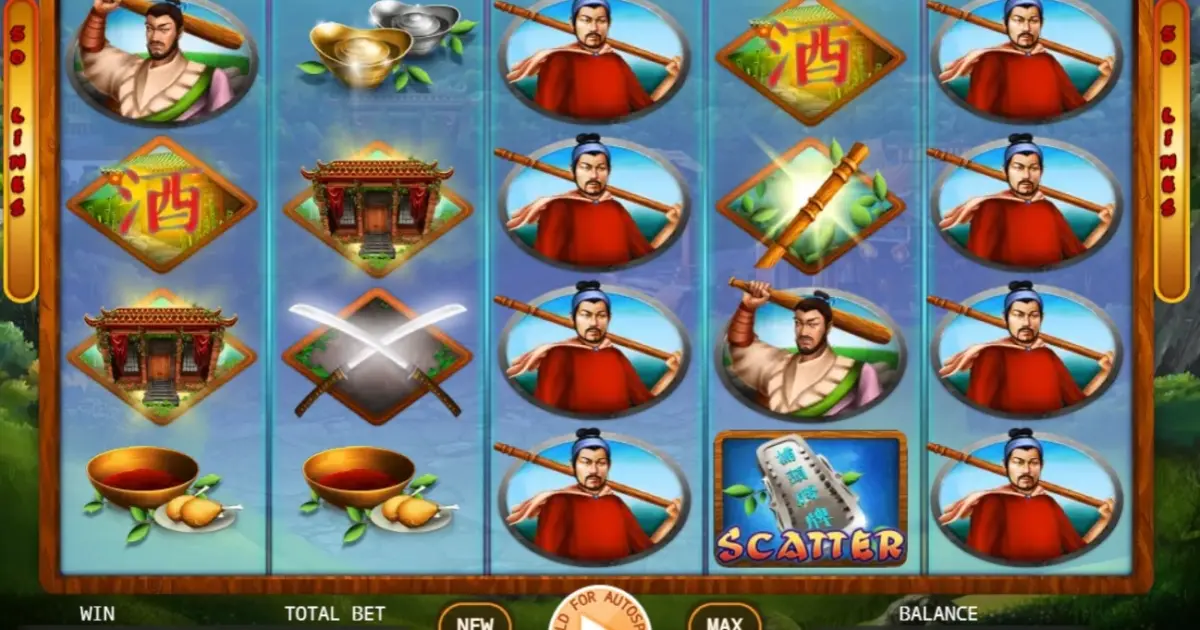
Ka Gaming has not published a return-to-player percentage for this five-reel release, and that single gap should shape how you approach the wu song slot. A free demo is available, so you can watch the reels behave without staking anything, which is the sensible first step with any game whose headline maths are unlisted. Everything below separates what is genuinely known from what is only asserted elsewhere on the internet.
Is Wu Song worth playing?
It is worth a look in demo form, and harder to recommend with real money until a return figure is published. The reason is simple: without an RTP number you cannot compare this game against anything else on a like-for-like basis, and comparison is the only tool a player actually has.
What is on the record is modest but useful. It is a five-reel game listed under the Slot Machine subcategory, built by Ka Gaming, and tagged to an Asian theme. It sits at rank 2,835 in the wider catalogue, which places it in roughly the 85.8th popularity percentile — more played than most titles, well short of the games that dominate lobbies.
For context on the studio, the average published RTP across Ka Gaming titles is 94.47%, against a corpus-wide average of 95.71%. That is a studio-level observation, not a claim about this specific game, and it should not be read as a prediction of what this one returns. It does tell you the neighbourhood you are shopping in.
| Provider | Ka Gaming |
|---|---|
| Reels | 5 |
| Theme | Asian |
| Free demo | Yes |
| Site-wide average RTP | 95.71% |
What a missing RTP figure means for the Wu Song slot over 1,000 spins
RTP is a long-run average of money returned to players across an enormous number of spins, not a promise about your session. A game at 96% returns roughly £96 per £100 wagered measured over millions of spins; the house edge is the remaining £4. Over 1,000 spins at £0.20 a spin — £200 staked — a 96% figure implies around £192 returned on average, but the distribution around that average is wide enough that individual results routinely land far above or far below it.
Because no RTP is published for this title, none of that arithmetic can be applied to it directly. You cannot calculate an expected return, and you cannot rank it against the games you already play. Treat any specific percentage quoted for this game on another site as unverified unless the studio or the operator states it in the game’s own information panel.
One thing worth knowing: some studios ship games in multiple RTP configurations, and the operator chooses which one to run. Where that happens, the paytable screen inside the game is the only authority. Check it every time.
How volatile is Wu Song?
No volatility rating is published for this game either, so the honest answer is that it is unclassified. What you can do is understand the two profiles you might be dealing with, then watch the demo closely enough to form your own impression.
Low-volatility maths pays small amounts often. Balances drift rather than lurch, sessions last longer on the same money, and the biggest results are usually a modest multiple of the stake. High-volatility maths does the opposite: long stretches return little, and the mathematical return is concentrated into rare outcomes. Same theoretical RTP, completely different experience — and a bankroll that comfortably survives one can be wiped out quickly by the other.
In a demo, the tells are behavioural. Count how often a spin returns anything at all across a hundred or so spins, and note how large the better results are relative to your stake. Frequent small returns point low; long dry stretches broken by occasional larger ones point high. Two caveats. A hundred spins is a small sample, and every spin is independent of the last, so nothing you observe makes a future outcome more or less likely.
What the Asian theme brings to the game
The Asian tag places this among the largest thematic groups in the catalogue, with 1,455 titles carrying it. That scale matters more than it first appears: it means you have enormous choice within the same visual territory, and no reason to settle for a game whose numbers you cannot see.
What the theme label supports is limited and worth stating plainly. It tells you the game draws on Asian settings and iconography. It does not tell you which symbols appear, what the soundtrack does, or how the reels are animated — so this review will not pretend to know. The five-reel structure is confirmed, which is the most common layout in modern slots and the format most players will find immediately familiar.
Paylines or ways are not listed in the available data. That is a meaningful omission, because line count determines how much of your stake covers each spin and how results are counted. Many slots use anything from 10 fixed lines to several thousand ways; which one applies here is something you will have to read off the in-game information screen rather than take from any review.
Stakes, session length and bankroll
No minimum or maximum stake is published for this title, so plan your session around your own budget instead of the game’s limits, then check the actual range in the demo before you switch to real money.
The arithmetic that matters is the same for every slot. Divide the money you are willing to lose by your stake, and you get the number of spins you can cover in the worst case. £50 at £0.50 a spin covers 100 spins before any returns; the same £50 at £0.10 covers 500. Returns along the way extend that, but the worst case is what your budget has to survive.
Spin speed compounds this. A slot can comfortably process several hundred spins an hour, which means hourly turnover is far higher than most players estimate. At £0.20 a spin and 500 spins an hour, you have wagered £100 in sixty minutes regardless of where the balance finishes.
No stake pattern changes any of this. Raising stakes after a loss, or lowering them after a win, alters the size of your swings and nothing about expected value. Results are independent.
Alternatives if Wu Song is not for you
If the missing RTP is the sticking point, the fix is to pick something with published figures. Wong Choy is the strongest comparison on numbers alone: it shares the Asian theme and carries a listed 96.74% RTP, comfortably above the 95.71% catalogue average. Mystic Fortune Deluxe sits close behind at 96.71%, so either gives you maths you can actually plan around.
For a middle option, The Book of Amaterasu publishes 95.0% — below the other two, but still a stated figure you can weigh rather than guess at. The 1.7-point gap between it and Wong Choy is worth about £1.70 per £100 wagered over a very large sample.
If you specifically want more from this studio, Ka Gaming slots number 602 titles in total, including Monkey Heist, Miss Tiger and The Primeval Rainforest. None of those three has a published RTP in the available data either, so they leave you in the same position as this game. Where a figure exists, use it.
Final take
A five-reel Asian-themed game from a studio with 602 titles to its name, sitting in the 85.8th popularity percentile, with no published RTP, no volatility rating and no stated stake range. The free demo is the redeeming feature: it costs nothing and shows you the game’s actual information screen, which is where the numbers this review cannot supply will be listed if they exist anywhere.
Play it free first. If the in-game paytable confirms a return figure you are happy with, fine. If it does not, there are Asian-themed alternatives above with published percentages, and no good reason to stake money on maths you cannot see.
Slots are 18+ and paid entertainment, not income. Decide what the session is worth to you before you start, stake only that, and stop when it is gone. Demo results are not a forecast of real-money outcomes.
More from Ka Gaming
- Poseidon’s Treasure
- Alice In MegaLand — 96.0% RTP
- Monkey Heist
Frequently Asked Questions
Can you play Wu Song for free?
A free demo is available for this title, so you can spin it without staking money or creating a deposit. That matters more than usual here, because Ka Gaming has not published an RTP figure for the game — the demo lets you read the in-game information panel and judge the reels yourself before committing anything.
What is the RTP of Wu Song?
No return-to-player figure is published for this game in the available data, so treat any percentage quoted elsewhere as unverified. For context, Ka Gaming's titles average 94.47% RTP against a catalogue-wide 95.71%. That is a studio-level average, not a figure for this specific slot. Check the in-game paytable.
Is Wu Song high or low volatility?
The volatility is unclassified — no rating is published. In practice, low-volatility maths pays small amounts frequently and stretches a bankroll, while high-volatility maths concentrates returns into rare outcomes and demands a larger budget. Watching a hundred or so demo spins gives you a rough impression, though every spin remains independent.
Who is Ka Gaming and what else do they make?
Ka Gaming is the studio behind this five-reel release and has 602 titles in the catalogue, among them Monkey Heist, Miss Tiger and The Primeval Rainforest. Their published RTPs average 94.47%, slightly below the 95.71% corpus average. None of those three related titles has a listed RTP in the available data.
How does Wu Song compare to Wong Choy?
Wong Choy is the better-documented option: it shares the Asian theme and publishes a 96.74% RTP, above the 95.71% catalogue average, while this title publishes no figure at all. On numbers you can actually verify, Wong Choy wins. Both are five-reel Asian-themed games, so the visual territory overlaps.