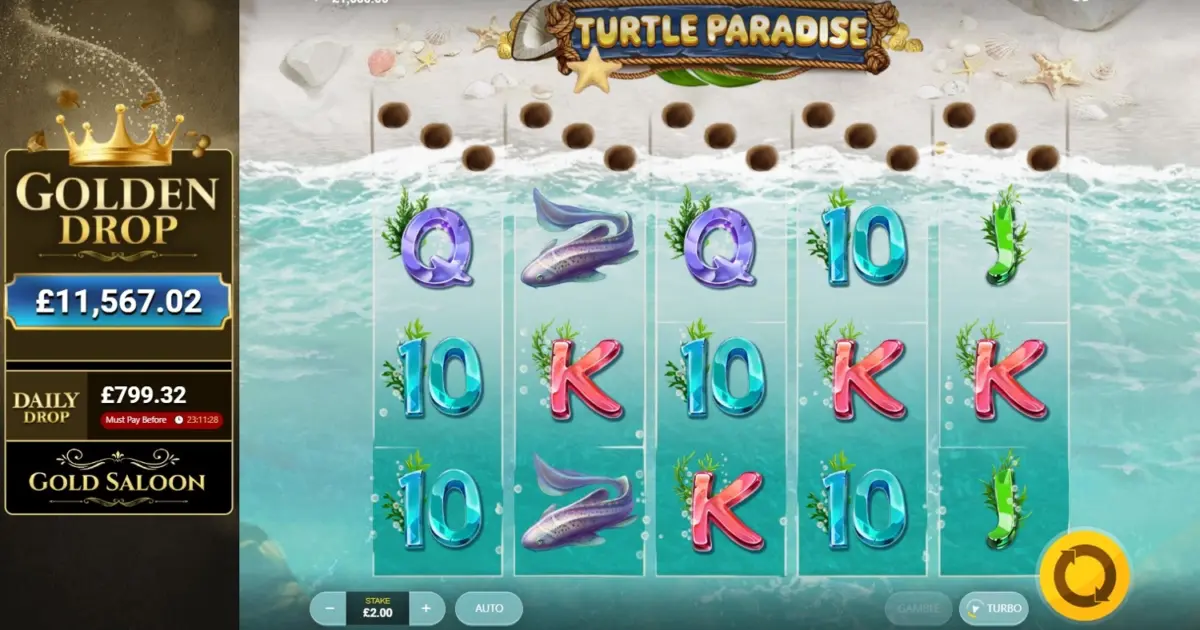
The single most useful number here is the return figure: the Turtle Paradise slot runs at 96.12% RTP, slightly above the average of the games we track. It comes from Red Tiger Gaming, sits on five reels, and is playable as a free demo. What is not available is a published volatility rating, a max win figure or a paytable breakdown, so anyone telling you how swingy this game is has gone beyond the facts.
Turtle Paradise versus the average slot
Against the corpus of games in our database, this one sits 0.41 percentage points ahead on return. The average RTP across that corpus is 95.71%; this title posts 96.12%. Small as it looks, that gap is real money over volume. Wager £2,000 across a long session history at 95.71% and the theoretical return is £1,914.20. At 96.12% it is £1,922.40. Roughly £8 of difference per £2,000 staked.
That is the honest scale of an RTP edge: it matters, but it is a slow effect measured across tens of thousands of spins, not something you will feel in an hour. It also tells you nothing about how any single session will go. Two games with identical RTP can produce completely different experiences depending on how the return is distributed between frequent small payouts and rare large ones. Since no distribution data has been published for this title, the 0.41-point advantage is the only comparative claim that can be made with confidence.
| Provider | Red Tiger Gaming |
|---|---|
| RTP | 96.12% |
| Reels | 5 |
| Theme | Ocean and sea |
| Free demo | Yes |
| Site-wide average RTP | 95.71% |
RTP breakdown: 96.12% in context
RTP is a long-run theoretical average built into the game’s maths, not a promise about your session. At 96.12%, the model returns £96.12 for every £100 wagered across a sample large enough for variance to flatten out. That sample is enormous, typically millions of spins, which is why short sessions land nowhere near the figure.
Put numbers on it. Spin 500 times at £0.50, and you have staked £250. The theoretical return is £240.30, a modelled cost of £9.70. Your actual result might be £40 up or £150 down, because each spin is an independent event with its own outcome and no memory of what came before. Nothing you do between spins changes the expected value. Bet sizing changes how fast the maths plays out, not the percentage.
The 3.88% house edge is where the operator’s margin lives. It is applied continuously, spin by spin, which means total wagered matters more than any individual bet. Two hundred spins at £1 exposes the same amount to the edge as four hundred at £0.50.
Volatility profile
Red Tiger Gaming has not published a volatility rating for this game, and no hit frequency data is available either. That absence is worth stating plainly rather than papering over, because volatility is arguably more decision-relevant than RTP for a single session.
Here is why it matters. Low-volatility slots pay small amounts often; your balance drifts down gently, sessions last longer on a given budget, and big results are rare. High-volatility slots do the opposite, absorbing long stretches of nothing in exchange for occasional large payouts, which means they demand a much larger bankroll to survive the dry spells. Medium sits between the two. Crucially, all three can share the same RTP. The return is simply packaged differently.
Without a rating, the practical answer is to find out empirically. Run a few hundred demo spins and watch the shape of the balance graph: frequent small returns suggest the lower end of the scale, long flat stretches broken by spikes suggest the higher end. That observation is the closest thing to reliable volatility information available for this title.
Red Tiger Gaming as a studio
Red Tiger Gaming has 335 titles in our database, with an average RTP of 95.62% across that catalogue. This game sits half a point above the studio’s own average, which makes it one of the better-returning options in the range rather than a typical one. A studio average that size is a useful benchmark when you are scanning Red Tiger Gaming slots: anything below 95.62% is below the house standard.
For comparison within the same catalogue, Epic Journey posts 96.00%, a shade under this one, while Savannah Pride returns 95.75% and sits closer to the studio mean. If return is your primary filter, this title edges both. One caution on catalogue averages: they are pulled across hundreds of games of differing ages, and some older titles were built to different return conventions, so treat 95.62% as a rough centre of gravity rather than a precise house policy.
Three Ocean and sea alternatives worth comparing
The ocean and sea category is crowded, with 527 games carrying the theme in our database. Three of them make direct sense as comparisons on the numbers.
- Big Bass Bonanza returns 96.71%, a full 0.59 points higher. Over £2,000 wagered that is roughly £12 of theoretical difference.
- Pearls of Aphrodite is the highest of the group at 96.81%, and pairs the sea theme with mythological source material.
- Bigger Bass Bonanza also posts 96.71%, matching its stablemate.
Note what this comparison does and does not tell you. It ranks four games on one variable. It says nothing about which is more enjoyable, how often each pays, or what a session on any of them feels like, because volatility figures are not available for this title to compare against. If return is the only criterion, the alternatives above are ahead. If you like this game’s five-reel setup and fishing theme, a 0.59-point gap is a modest price for playing what you actually want to play.
Getting the most out of the free demo
A Turtle Paradise free demo is available, and it is the sensible first stop. Demo mode runs the same maths model with play-money credits, so you can learn the mechanics, see how often the reels return something, and decide whether the pace suits you before any of your own money is exposed to the 3.88% edge.
Two honest limits. Demo results do not predict real-money results, because both are sequences of independent random outcomes; a good demo run is not a signal of anything. And playing for fun money removes the emotional weight that changes how people behave with real stakes.
This game is for adults 18 and over. Decide what the session is worth to you before you start, treat that figure as the price of entertainment rather than an investment, and stop when it is gone. There is no stake pattern, timing or progression that improves your expected return, and no such thing as a game being due.
Should you play the Turtle Paradise slot?
Worth a look if you want an ocean theme from Red Tiger Gaming and care about return. At 96.12% it beats both the studio average of 95.62% and the wider corpus average of 95.71%, and it has clearly found an audience, ranking 2,606th overall and placing in the 86.9th percentile for popularity.
The reasons to hesitate are informational rather than mechanical. With no published volatility rating and no max win figure, you cannot judge the risk profile before you play, which matters if you budget carefully. Several ocean alternatives return more. The reasonable approach: spend a few hundred demo spins working out the rhythm yourself, then decide whether the 0.41-point RTP edge over the average justifies picking this over a higher-returning rival.
More from Red Tiger Gaming
- Savannah Pride — 95.75% RTP
- Primate King Megaways — 95.67% RTP
Frequently Asked Questions
Can you play Turtle Paradise for free?
A free demo is available for this title, running on play-money credits with the same underlying maths as the paid version. It is the practical way to learn the five-reel layout and judge the pace before staking anything. Bear in mind that demo outcomes cannot predict real-money results, since every spin is independent.
What is the RTP of Turtle Paradise?
The published RTP is 96.12%, meaning the model theoretically returns £96.12 per £100 wagered across a very large sample of spins. That leaves a house edge of 3.88%. It is 0.41 points above the 95.71% average across the games in our database and half a point above Red Tiger Gaming's own 95.62% catalogue average.
Is Turtle Paradise high or low volatility?
No volatility rating has been published for this game, so treat any figure quoted elsewhere with caution. Low volatility means frequent small returns and longer sessions on a fixed budget; high volatility means long dry stretches and rarer large payouts. Running a few hundred demo spins and watching the balance pattern is your best available guide.
Who makes Turtle Paradise?
Red Tiger Gaming developed it. The studio has 335 titles in our database with an average RTP of 95.62%, so this game sits above its own house standard. Other Red Tiger Gaming slots include Epic Journey at 96.00%, Savannah Pride at 95.75%, and Primate King Megaways, for which no RTP figure is published.
How does Turtle Paradise compare to Big Bass Bonanza?
Big Bass Bonanza returns 96.71% against 96.12% here, a 0.59-point advantage that works out to roughly £12 per £2,000 wagered in theoretical terms. That comparison covers return only. Volatility data is not available for this title, so there is no honest way to say which delivers the steadier session.