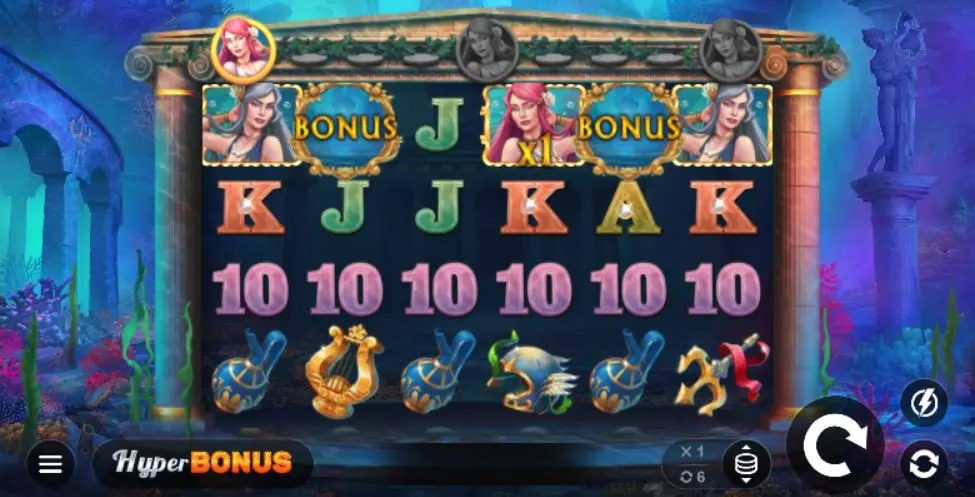
The Pearls of Aphrodite slot ranks 69th overall and sits in the 99.7th percentile by popularity, meaning it attracts more play than virtually every other title in our index. Kalamba Games has paired a 96.81% RTP with 6 reels and an ocean theme, producing a game that looks mathematically competitive on paper. The question is whether the experience behind those numbers matches the attention it commands.
Is Pearls of Aphrodite worth playing?
If you filter for RTP above 96% and prefer 6-reel layouts, this is a legitimate candidate. The 96.81% return sits above both Kalamba’s own portfolio average (95.92%) and the broader corpus average (95.71%), placing it in roughly the top quarter of the provider’s 165 titles on pure theoretical return alone.
The 99.7th-percentile popularity rank tells you that other players have already voted with their bankrolls. Whether that interest is driven by aesthetics, marketing, or genuine engagement depth is impossible to separate from raw data. What the numbers do confirm: this is not a low-return game sitting in an obscurity corner. It is a headline title with above-average mathematics behind it.
The caveats are significant though. No published volatility rating, no max win figure, and no stake range from the provider means you cannot fully calibrate expectations before you spin. The free demo exists, so at least you can test the pace without financial risk.
What 96.81% RTP means over 1,000 spins
RTP is a long-run statistical average calculated across millions — often billions — of spins. It is not a prediction for any individual session. That said, the arithmetic of 96.81% is straightforward and useful as a planning benchmark.
| Figure | Value |
|---|---|
| Provider | Kalamba Games |
| RTP | 96.81% |
| Reels | 6 |
| Popularity rank | 69 |
| Popularity percentile | 99.7% |
| Free demo | Yes |
At a stake of £1 per spin, 1,000 spins cost £1,000. The theoretical return is £968.10, leaving a theoretical house edge of £31.90. At £2 per spin, the figures double: £2,000 staked, £1,936.20 returned in theory, £63.80 lost in theory. These numbers represent the statistical centre of a distribution, not a guaranteed outcome. Your actual session will land somewhere around that point, and “around” can span from complete loss to a substantial win over any sample of 1,000 spins.
The 3.19% house edge is the lowest you will encounter at Kalamba Games in this comparison set. Their portfolio average of 95.92% implies a 4.08% edge — roughly 28% more theoretical loss per pound staked over the same session length. For a player choosing among Kalamba titles, that difference compounds meaningfully across thousands of spins.
How volatile is the Pearls of Aphrodite slot?
Kalamba Games has not published a volatility rating for this title. This is a genuine gap, not an oversight you can fill through inference from other fields. Reel count, RTP, and theme tell you nothing reliable about how wins are distributed within a session.
Volatility determines whether the 96.81% RTP arrives as frequent small returns or as rare large payouts punctuated by long dry spells. Two games can share identical RTP figures and deliver entirely different experiences. A low-volatility game with 96.81% RTP might return 30-40% of spins as wins averaging well below the stake. A high-volatility game with the same RTP might pay winning combinations on fewer than 20% of spins but with larger average payouts when they land.
Without a volatility figure or hit frequency from the provider, your only tool is the free demo. Play it at your intended real-money stake and track how many spins pass between wins. Note the size of each win relative to your stake. Twenty minutes of demo play will not give you statistical certainty, but it will show you whether the pacing suits your bankroll and temperament. Every spin is independent regardless of what preceded it, so the demo reveals the game’s rhythm rather than predicting future results.
What the Ocean and Sea theme brings to the game
“Pearls of Aphrodite” positions the game within Kalamba’s ocean-themed catalogue, one of 527 titles in the broader ocean and sea category across all providers we review. The title references classical mythology through the goddess connection, while the theme label confirms underwater imagery as the dominant visual language.
What a theme actually affects is presentation — symbol design, background artwork, and audio. It does not alter mathematics. Two identical games with different themes would play the same way. The practical value of thematic consistency is in engagement: if you find ocean settings relaxing or absorbing, you will likely play longer sessions at comfortable stakes, which improves your experience even though it does not improve your expected return.
The 6-reel format is worth noting here. Compared to the traditional 5-reel layout found in most slots, a 6-reel grid typically supports either a larger number of paylines or ways-based mechanics. The exact configuration for this title has not been specified, so you will discover it in the paytable during demo play. A 6-reel game generally means more positions for symbols to land on, which can increase the frequency of partial cluster formations even if the total number of winning combinations depends on the specific mechanic Kalamba employed.
Stakes, session length and bankroll
Kalamba Games has not published a minimum or maximum stake range for Pearls of Aphrodite in the data available to us. This means you will need to check the stake selector directly in-game or at your chosen casino to determine the floor and ceiling.
Without knowing the minimum stake, the following framework still applies. A typical 1-hour session at moderate speed runs 400-600 spins. At £0.50 per spin, that is £200-£300 in total turnover. At £1, the figure doubles to £400-£600. These are amounts wagered, not necessarily amounts lost — the theoretical return of 96.81% means you should expect roughly 3-4% net loss across the session, so a £300 turnover might leave you approximately £10 lighter on average.
The relationship between your total bankroll and your per-spin stake determines whether you can survive the variance the game throws at you. Since volatility is unpublished, a conservative approach means allocating more bankroll than you would for a confirmed low-variance game. If your total budget is £100, keep your stake at £0.20-£0.50 to ensure you get 200-500 spins before depletion in a worst-case losing run. This gives you enough sample size to assess whether the game suits your preferences.
Alternatives if Pearls of Aphrodite is not for you
The ocean theme category is vast — 527 titles in our index alone — so you have substantial choice. Big Bass Bonanza carries a 96.71% RTP across a similar sea-and-fishing setting, though it comes from a different provider entirely. If you want to compare the presentation style without leaving the theme, it is a natural next step.
Within Kalamba Games specifically, Agent 51 offers a 96.73% RTP — only 0.08 points below Pearls of Aphrodite but in a completely different thematic setting. If your preference runs toward the provider’s mechanics but the underwater presentation does not hold you, Agent 51 keeps the math nearly identical while shifting the visual context.
For a third option within the provider, Fire Eagle runs at 96.01% RTP. That is a full 0.8 percentage points lower than Pearls of Aphrodite, which over 5,000 spins at £1 per spin means roughly £40 more in theoretical loss. If Fire Eagle’s mechanics and theme appeal more strongly to you, that trade-off is worth calculating before you commit. A 0.8% RTP gap compounds slowly but consistently across extended play.
Final take
Pearls of Aphrodite earns its popularity ranking on genuine mathematics. The 96.81% RTP is well above Kalamba’s portfolio average and above the broader market, placing it among the stronger offerings from this 165-game provider. The 6-reel ocean setting provides a visual framework that stands out enough within its theme category to justify the attention it receives.
The missing volatility data is the one significant gap. Without it, you cannot determine whether this game suits your bankroll tolerance or session-length preference before you play. The free demo closes that gap practically — use it deliberately rather than casually, tracking win frequency and payout sizes relative to stake.
Play responsibly. Set a budget before you open any slot and treat the entire session as paid entertainment at the rate the theoretical house edge implies. Never chase losses or adjust stakes to recover them. If gambling stops being a leisure activity, contact the National Council on Problem Gambling at 1-800-522-4700 or visit ncpgambling.org.
Frequently Asked Questions
Is Pearls of Aphrodite available to play for free?
Yes. Kalamba Games provides a free demo version of Pearls of Aphrodite, allowing you to test the game mechanics, pacing, and visual design without wagering real money. The demo uses virtual credits and does not affect any real-money balance.
What is the RTP of Pearls of Aphrodite and how does it compare?
Pearls of Aphrodite has a 96.81% RTP, placing it above both Kalamba Games' portfolio average of 95.92% and the overall market average of 95.71%. Over 1,000 spins at £1, the theoretical return is £968.10 with a house edge of approximately £31.90.
What volatility level should I expect from this slot?
Kalamba Games has not published a volatility rating for Pearls of Aphrodite. Without this figure or a hit frequency, you cannot determine from data alone whether wins arrive frequently in small amounts or rarely in larger payouts. The free demo is your practical tool for assessing the game's pace.
Who makes Pearls of Aphrodite and what else do they offer?
Kalamba Games produces Pearls of Aphrodite as one of 165 titles in their portfolio. Their average RTP across all games sits at 95.92%, making Pearls of Aphrodite one of their stronger mathematical performers. Related titles include Agent 51 and Fire Eagle.
How does Pearls of Aphrodite compare to other ocean-themed slots?
With 527 ocean and sea themed slots in our index, Pearls of Aphrodite ranks at the 99.7th percentile by popularity. Big Bass Bonanza, another sea-themed game, runs at 96.71% RTP — ten basis points lower — while Splash Cash drops to 93.54%, a significantly weaker theoretical return.