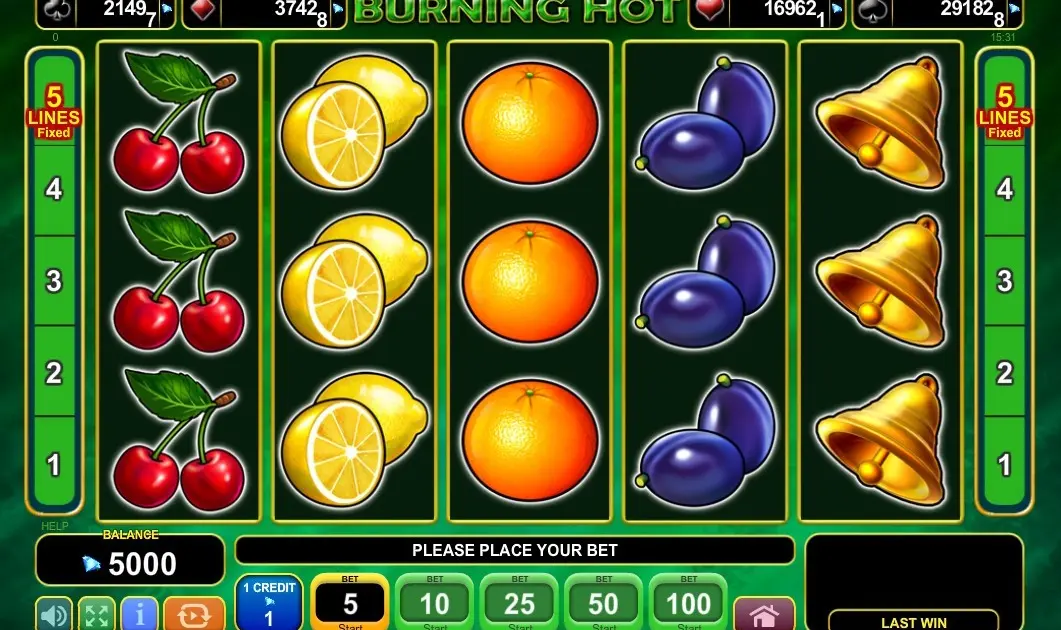
Burning Hot is a straightforward five-reel fruit slot that does two things well: it returns 96.45% to players over the long run, and it keeps the swings small enough that your bankroll lasts. If you want a low-drama session with no feature bloat, it fits. If you chase big multipliers or layered bonus rounds, look elsewhere.
Amusnet (formerly EGT Interactive) built this as part of their 199-game catalogue, and the studio’s average RTP sits at 95.99%. Burning Hot beats that by nearly half a percentage point, and it ranks in the 99.7th percentile for popularity—57th overall across the corpus—which suggests players have found the balance between RTP, volatility and session cost appealing.
| Metric | Value |
|---|---|
| RTP | 96.45% |
| Volatility | Low |
| Reels | 5 |
| Stake range | £0.05–£10.00 |
| Provider | Amusnet |
| Theme | Fruits |
| Popularity rank | 57 |
Is Burning Hot worth playing?
Yes, if your priority is session length over headline wins. The 96.45% RTP sits 0.74 percentage points above the 95.71% corpus average, and the low volatility profile means you’ll see frequent small pays rather than long droughts punctuated by rare big hits. That combination suits players who want their bankroll to stretch across hundreds of spins without needing to top up constantly.
The downside is predictability. Low volatility flattens the emotional arc of a session—you won’t get the adrenaline spike of a sudden 500× win, but you also won’t blow through your budget in twenty spins. If you treat slots as paid entertainment and measure value in time at the screen rather than jackpot potential, Burning Hot delivers exactly what its numbers promise.
The game sits in the top 0.3% of slots by popularity, which is rare for a low-volatility fruit machine. That rank reflects consistent performance rather than marketing hype: players return because the maths works in their favour over repeated sessions, not because the theme is innovative.
What 96.45% RTP means over 1,000 spins
RTP is a long-run statistical average, not a session guarantee. Over an infinite number of spins, Burning Hot returns £96.45 for every £100 wagered. Over 1,000 spins—a realistic evening session—variance still dominates, and you can finish above or below that figure by a wide margin.
To put it in cash terms: if you spin 1,000 times at £0.10 per spin, you wager £100 total. The RTP predicts you’ll have £96.45 left on average, so your expected cost for that session is £3.55. In practice, low volatility tightens the spread of outcomes around that average. You’re less likely to finish with £150 or £40 than you would be on a high-volatility slot with the same RTP, but you’re more likely to land within a few pounds of the predicted return.
The 96.45% figure becomes reliable only across tens of thousands of spins. If you play 10,000 rounds, your actual return will converge much closer to 96.45%. If you play 100 rounds, the RTP is nearly meaningless—variance overwhelms the average. Treat the RTP as a quality filter when choosing between games, not as a predictor of tonight’s result.
Compared to Amusnet’s portfolio average of 95.99%, Burning Hot gives back an extra £0.46 per £100 wagered. That difference sounds trivial, but compounded across thousands of spins it becomes the difference between a game that bleeds your bankroll slowly and one that bleeds it quickly.
How volatile is Burning Hot?
Low volatility means the game pays out frequently, but the individual wins are small relative to your stake. You’ll hit winning combinations often enough to keep your balance moving, but you won’t see many pays worth more than 10–20 times your bet. The upside is that your session lasts longer; the downside is that you’re very unlikely to turn £10 into £500 in a single sitting.
Low-volatility slots suit two types of player: those with small bankrolls who want to maximise playtime, and those who find the constant small wins more engaging than long waits for a big hit. If you’re gambling with money you can afford to lose and you want that money to buy you an hour or two of entertainment, low volatility is the correct choice. If you’re hunting a balance-changing win, you need high volatility and you should accept that most sessions will end quickly and badly.
Bankroll requirements scale with volatility. A high-volatility slot might demand 200–300 times your base bet to survive the dry spells; a low-volatility game like Burning Hot can run comfortably on 50–100 times your stake. That means a £10 bankroll supports £0.10–£0.20 spins with a reasonable chance of lasting the session, whereas the same £10 on a high-variance game at £0.20 per spin could vanish in under fifty rounds.
What the Fruits theme brings to the game
The Fruits theme is the oldest and most utilitarian category in slots, descended directly from the original mechanical machines. It signals simplicity: you’re here for the maths, not for narrative or visual spectacle. Burning Hot sits within a corpus of 2,560 fruit-themed games, so the theme itself offers no competitive advantage—it’s a default choice, not a creative one.
What the theme does do is set expectations. Fruit slots rarely include multi-stage bonus games, character progression, or cinematic interludes. The reels spin, symbols land, wins pay. If that sounds boring, it’s supposed to—boring means low cognitive load, which suits players who want to zone out rather than manage cascading features or decision trees.
The “Burning” modifier in the title is common shorthand in fruit slots for a mild visual treatment—flames, glowing edges, slightly more saturated colours—but it doesn’t imply any mechanical feature. Treat it as branding, not as a promise of gameplay innovation.
Stakes, session length and bankroll
The stake range runs from £0.05 to £10.00 per spin, which covers casual players and mid-stakes grinders but excludes true penny slots and high-roller territory. At £0.05, a £5 bankroll buys you 100 spins before RTP erosion; add the low volatility, and you can expect small wins to stretch that to 150–200 spins in practice. At £1 per spin, you’d want at least £50–£75 behind you to avoid an unlucky early exit.
Session length depends on how you pace your stake. If you start at £0.10 per spin and maintain that through the entire session, a £20 bankroll should last 200 base spins, and the 96.45% RTP combined with low volatility should extend that to somewhere between 250 and 350 spins depending on luck. That’s 20–30 minutes of continuous play. If you chase losses by raising your stake mid-session, all bets are off—you’ve abandoned the maths and you’ll run out faster.
The £10 maximum stake is low by modern standards, which makes Burning Hot a poor fit for players who want to bet big and finish quickly. If you’re used to £20–£50 spins, you’ll find the pacing frustratingly slow. If you normally play at £0.20–£1, the cap won’t bother you.
Alternatives if Burning Hot is not for you
If you want to stay with Amusnet but prefer slightly higher volatility, 20 Power Hot Dice offers 96.44% RTP—effectively identical—while introducing a dice mechanic that adds a layer of decision-making absent from Burning Hot. If you’re chasing a higher return within the same fruit category, Hot Hot Fruit pushes RTP to 96.84%, a meaningful 0.39 percentage points above Burning Hot, though you’ll need to check its volatility profile to ensure it still fits your session budget.
For players who want more visual polish but similar low-volatility maths, many modern fruit slots from NetEnt, Play’n GO and Pragmatic Play sit in the 96–97% RTP range and offer smoother animation and sound design, though they rarely match Amusnet’s lean, no-nonsense approach. The tradeoff is that feature-heavy games often bury their RTP inside complex bonus mechanics, making it harder to predict session cost.
If Burning Hot feels too flat and you’re willing to accept higher variance, move up to medium-volatility fruit slots in the 96–96.5% RTP band. You’ll sacrifice some session length, but you’ll see occasional wins large enough to feel like progress rather than treading water.
Final take
Burning Hot is a workmanlike low-volatility fruit slot that does exactly what its RTP and variance numbers predict. The 96.45% return sits comfortably above both the provider and market averages, the stake range covers casual and mid-stakes players, and the lack of feature complexity means your session cost is transparent. It won’t surprise you, which is either its greatest strength or its fatal flaw depending on what you want from a slot.
The 99.7th percentile popularity rank suggests that a large cohort of players values reliability over novelty, and Burning Hot delivers reliability. If you’re new to slots, this is a safe place to learn how RTP and volatility interact. If you’re experienced and you want a low-stress session where your bankroll lasts, it’s a rational choice. If you’re hunting a story to tell or a balance-changing win, pick something else.
Set a budget before you start, treat that money as the cost of entertainment rather than an investment, and stop when it’s gone. Burning Hot is designed for players aged 18 and over. If you find yourself chasing losses or playing beyond your limit, take a break and seek support at BeGambleAware or your local responsible gambling service.
Frequently Asked Questions
Can I play Burning Hot slot for free?
Yes, free demo play is available. The demo uses the same RTP and volatility as the real-money version, so it's a useful way to see how the low-variance maths affects session length and win frequency before you commit your own funds. Demo wins have no cash value and cannot be withdrawn.
What does 96.45% RTP mean for my session?
Over an infinite number of spins, Burning Hot returns £96.45 per £100 wagered. In a single session of 500 or 1,000 spins, variance still dominates—you can finish well above or below that figure. The RTP becomes predictive only across tens of thousands of spins, but the 96.45% figure is high enough that you're starting with better odds than most slots offer.
How risky is Burning Hot compared to other slots?
Burning Hot is low volatility, which means frequent small wins and rare large ones. Your bankroll will drain slowly rather than swinging wildly, so you can play longer on the same budget. That's ideal for casual players who want time at the screen, but frustrating for anyone chasing a big multiplier win in a short session.
Who is Amusnet and what else do they make?
Amusnet (formerly EGT Interactive) is an established provider with 199 games in their catalogue. Their portfolio average RTP is 95.99%, so Burning Hot sits near the top of their range. If you like the maths here, their other "Hot" titles such as 20 Power Hot Dice and Flaming Hot follow similar design principles, though RTP and volatility vary.
Is Burning Hot better than Hot Hot Fruit?
Hot Hot Fruit offers 96.84% RTP, which is 0.39 percentage points higher than Burning Hot's 96.45%. Over 10,000 spins at £1 each, that difference amounts to an extra £39 returned to you on average. If both games suit your volatility preference, the higher RTP makes Hot Hot Fruit the mathematically superior choice for session length and long-run cost.




