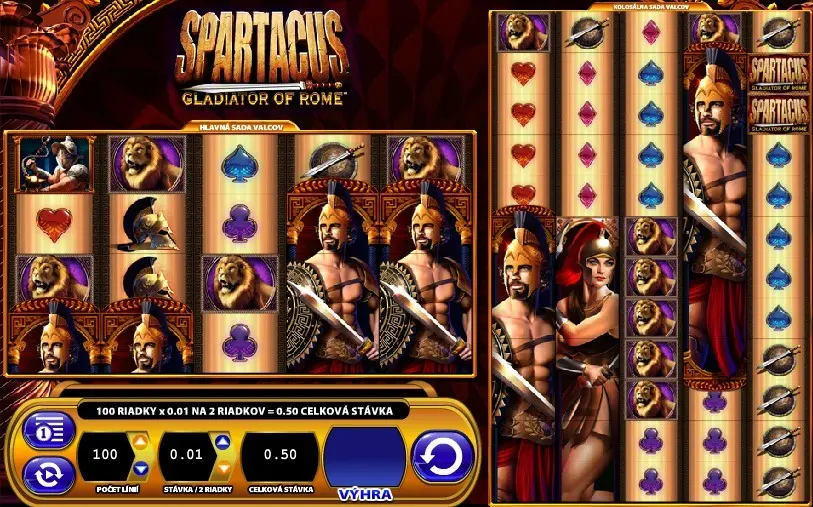
The numbers here are ordinary in the most literal sense: the spartacus gladiator of rome slot returns 95.98% over a very long sample, which is almost exactly the middle of the pack. It sits at rank 2402 for popularity, putting it inside the top 12% of titles by traffic, and a free demo exists so you can look before you spend. What WMS has not published is a volatility rating or a maximum win figure, and that gap matters more than the RTP does.
Spartacus Gladiator of Rome versus the average slot
Measured against the average RTP across the games catalogued here, 95.98%, this title is ahead by 0.27 percentage points. That is a real edge, but a small one. In cash terms it means that across a very large number of spins, a theoretical £100 staked returns about £95.98 here against roughly £95.71 on an average machine — a difference of 27 pence per £100 wagered.
Put that in session terms. If you stake £0.50 a spin and play 400 spins, you have wagered £200. The expected difference between this game and the library average over that £200 is about 54 pence. It is not something you will notice. What you will notice is variance: the gap between your actual result and the theoretical one will dwarf that 54p in either direction, every single session, and no amount of RTP shopping changes that. RTP is a tiebreaker, not a strategy.
| Provider | WMS |
|---|---|
| RTP | 95.98% |
| Reels | 5 |
| Theme | Medieval |
| Free demo | Yes |
| Site-wide average RTP | 95.71% |
RTP breakdown: 95.98% in context
An RTP figure is a long-run average calculated across millions of simulated spins, not a promise about your afternoon. At 95.98%, the theoretical house margin is 4.02%. On £1 spins, that is about 4p of expected cost per spin — so 500 spins carries an expected cost of roughly £20, with the actual outcome landing anywhere from a total loss of the £500 staked to something well above it.
Three reference points make the figure readable. The library average is 95.71%. The WMS average across their 55 games listed here is 96.01%. This game sits between them, 0.03 points under its own studio’s mean. So it is a fractionally below-par WMS release and a fractionally above-par release overall.
Every spin is independent and the RTP does not adjust to your history — a long losing run does not build up a corresponding return, and a good run does not borrow against a future one. Nothing about the sequence of spins you have already played tells you anything about the next one.
Volatility profile
There is no published volatility or variance rating for this game in the data available, and no hit-frequency figure either. That absence is worth stating plainly rather than guessing around: if you see a confident “high volatility” claim for this title elsewhere, ask what it is based on.
What you can do is work out the answer yourself in the demo, because volatility is the one trait free play reveals honestly. Low-volatility slots pay small amounts often, so your balance drifts down in a fairly smooth line. High-volatility slots pay rarely and larger, so the same balance moves in long flat stretches punctuated by sharp jumps. Play 200 demo spins at a fixed stake and watch the shape of the line rather than the end number.
The practical consequence is bankroll sizing. A game that pays in chunks needs more spins’ worth of budget to survive its dry stretches at the same stake. If your demo run shows long gaps between paying spins, either lower your stake or accept shorter sessions.
WMS as a studio
WMS is a land-based cabinet manufacturer whose catalogue moved onto online platforms, which is why so many of its titles feel like floor machines rather than mobile-first designs. There are 55 WMS games in this library, averaging 96.01% RTP — a tight, consistent band rather than a mix of generous and stingy outliers, and slightly above the 95.71% overall average.
That consistency means switching between WMS slots rarely costs you much in theoretical return. The closest comparison is Spartacus Call to Arms, another WMS release with the same naming lineage and a marginally higher 96.05% RTP, so if you like the framing and want the better published figure, that is the one to open next.
Two other WMS titles sit in the same narrow range: Zeus at 95.97% and Invaders from the Planet Moolah at 96.00%. The spread across all four is seven hundredths of a percentage point. Choose between them on how they play, not on the decimals, because the decimals are effectively identical.
Three Medieval alternatives worth comparing
This is a five-reel machine filed under Medieval, a category with 232 games in this library, so you have real choice if the theme is what brought you here. Three are worth putting side by side with this one.
Centurio covers similar Roman ground at 96.08%, a tenth of a point ahead. Two Tribes is the outlier of the group at 96.91% — nearly a full percentage point above this game, which over a £500 turnover is about £4.65 in expected difference. If published RTP is your deciding factor among Medieval slots, that is the strongest number on this list by a clear margin.
In the other direction, Da Vinci Diamonds runs at 94.94%, more than a point below this title. It remains widely played, which is a useful reminder that popularity and RTP are unrelated: players choose games for how they feel, and the return figure is often the last thing anyone checks.
Getting the most out of the free demo
Free play is available, and it costs nothing but time. Use it for the two things it is genuinely good at: confirming the game runs properly on your device, and reading the rhythm of the paytable so you know what you are looking at before money is involved.
Be clear about what the demo cannot tell you. A demo session’s results have no predictive value for a real-money session — the sample is far too small, the outcomes are independent, and a strong demo run is coincidence rather than a signal. Treat the balance on screen as a way to count spins, not as a forecast.
If you do move to real stakes, slots are 18+ and are paid entertainment, not a way to make money. Decide the amount you are content to spend before you start, the same way you would for a cinema ticket, and stop when it is gone. If the amount you set no longer feels comfortable, that is the signal to close the tab.
Should you play Spartacus Gladiator of Rome slot?
It is a reasonable, unremarkable choice. The 95.98% return beats the library average by 0.27 points and trails the WMS house average by 0.03, which places it squarely in the acceptable middle. Nothing about the maths argues against playing it, and nothing about the maths argues strongly for it either.
The honest reservation is the missing information. With no published volatility rating, no hit frequency and no stated maximum win, you cannot judge in advance whether your bankroll suits the way this game distributes its returns. That is answerable in the demo, but it takes you 15 minutes of spinning to find out what a data sheet should have told you in a line.
So: worth a demo run if the Roman framing appeals, and a fair pick once you have confirmed the pace suits you. If you are optimising purely on published return, Two Tribes at 96.91% is the better number and Spartacus Call to Arms at 96.05% is the closer swap.
Frequently Asked Questions
Can I play Spartacus Gladiator of Rome for free?
Free play is available for this WMS title, so you can spin it with no deposit and no download. Use the demo to check how the game runs on your device and to read the paytable at your own pace. Bear in mind that demo results are not a forecast of real-money outcomes.
What is the RTP of Spartacus Gladiator of Rome?
The published RTP is 95.98%, meaning roughly £95.98 returns per £100 wagered across a very large sample. That is 0.27 percentage points above the 95.71% average across this library and 0.03 points below the 96.01% WMS average. It is a long-run figure, not a session expectation.
How volatile is Spartacus Gladiator of Rome?
No volatility or variance rating has been published for this game, so any confident claim about it elsewhere is worth questioning. You can gauge it yourself: play a couple of hundred demo spins at a fixed stake and watch whether your balance drifts smoothly or moves in sharp, infrequent jumps.
Who makes Spartacus Gladiator of Rome and what else do they produce?
WMS developed it, a studio with roots in land-based slot cabinets. There are 55 WMS games in this library, averaging 96.01% RTP — a notably consistent band. Other titles include Zeus at 95.97%, Invaders from the Planet Moolah at 96.00% and Spartacus Call to Arms at 96.05%.
How does it compare with Centurio?
Centurio publishes a 96.08% RTP against 95.98% here, a gap of a tenth of a percentage point — about 10p per £100 wagered over a very large sample. Both are five-reel Medieval-themed machines. The practical difference is negligible, so pick on how each one plays rather than on the decimal.