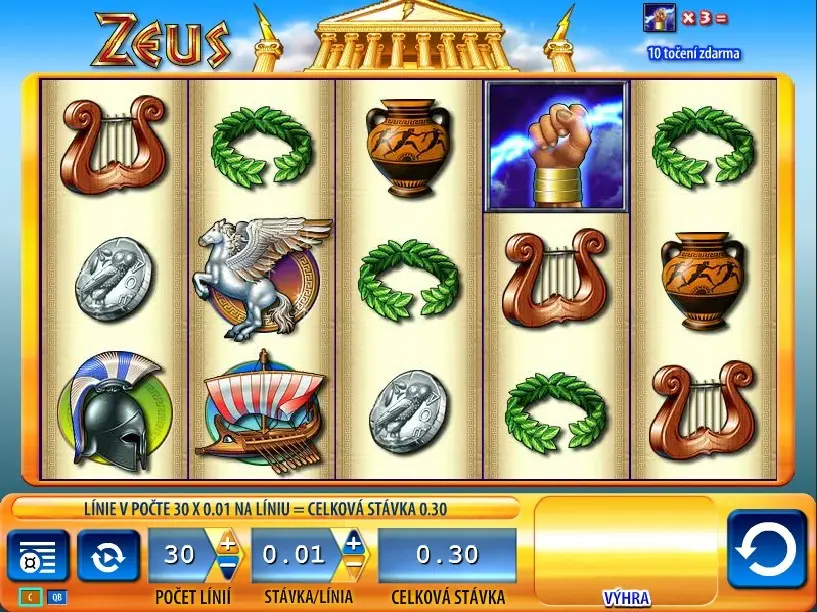
Zeus earns a cautious recommendation based on its statistics: the 95.97% RTP places it above the average slot in this catalogue, and its 98.5th-percentile popularity confirms that a large number of players return to it session after session. The problem is that WMS has not published a volatility rating for this zeus slot, which means you cannot assess whether its payout rhythm suits your bankroll without extended demo play. A slot with 95.97% RTP and high volatility produces long dry stretches followed by irregular bursts, while the same RTP at low volatility delivers small, frequent returns that keep your balance ticking over. Without a volatility figure, you are working with half the picture.
| Statistic | Value |
|---|---|
| RTP | 95.97% |
| Provider average RTP | 96.01% |
| Corpus average RTP | 95.71% |
| Reels | 5 |
| Popularity rank | 297 (98.5th percentile) |
| Volatility | Not published |
| Stake range | Not published |
The table above tells you where Zeus sits statistically, but it does not tell you how it will feel to play. The rank of 297 out of thousands of titles, combined with the 98.5th-percentile score, suggests that engagement factors clearly compensate for whatever the raw numbers leave unexplained.
What 95.97% RTP means over 1,000 spins
RTP describes the theoretical return a slot pays back across an enormously large number of spins — millions, not thousands. At 95.97%, the mathematics predicts that for every £100 wagered, £95.97 returns to players in wins, and £4.03 is retained as house edge. Over 1,000 spins at a £1 stake, you wager £1,000 total and the expected return across a very large population of such sessions is approximately £959.70.
Zeus is 0.26 percentage points above the corpus average of 95.71%. In practical terms, that difference means you would expect to retain roughly £2.60 more over 1,000 spins at £1 each compared to a slot at the catalogue average. Over 100 spins, the difference shrinks to pence. It is a real advantage, but a small one that will not rescue a losing session or accelerate a winning one.
Against WMS’s own portfolio average of 96.01%, Zeus actually sits slightly below — by 0.04 percentage points. So while the game outperforms the broader catalogue, it does not outperform its own provider’s typical return. If you are choosing within WMS titles specifically, the RTP difference between Zeus and games like Spartacus Call to Arms (96.05%) is marginal enough that volatility and theme preference matter more.
Remember: a single 1,000-spin session will deviate wildly from the theoretical return. You might finish with £1,200 or £800. The number describes where the distribution centres, not where any individual session lands.
How volatile is Zeus?
WMS has not published a volatility rating for Zeus, and no independent figure appears in the available data. This is a meaningful gap. Volatility determines the shape of your session: whether wins arrive in small, frequent clusters that sustain your balance, or whether long droughts punctuated by occasional larger payouts define the experience. Two slots with identical RTP can produce entirely different session profiles depending on volatility.
Without this information, you cannot set a realistic bankroll target. High-volatility slots typically require 200-400 times your minimum stake to have a reasonable chance of reaching a meaningful bonus round. Low-volatility slots can sustain a session on 100-150 times minimum stake. The gap between those two planning figures is enormous.
The 98.5th-percentile popularity score offers indirect evidence: players return to Zeus repeatedly, which could suggest the payout rhythm feels satisfying even if it is not formally rated. That is weak inference, but it is the best available signal. Your most reliable approach is extended demo play — observe the gap between wins, note how often the balance dips before recovering, and build your own picture of the game’s rhythm before risking real money.
What the Mythology theme brings to the game
Zeus draws on Greek mythology, taking its name from the king of the Olympian gods. The theme label also lists “Medieval,” an unusual pairing that suggests the visual design may blend classical mythological imagery with medieval or gothic aesthetic touches. Without describing specific graphics, the thematic combination places the game in a recognisable visual space that appeals to players who engage with ancient-Greek subject matter.
The mythology category contains 801 titles in this catalogue, making it a crowded segment. Zeus ranks 297th overall by play frequency, which means it holds its own in a saturated market — the popularity percentile of 98.5 confirms that engagement extends well beyond casual browsing.
If mythology themes specifically interest you, consider that Gates of Olympus carries an RTP of 96.5% — a full 0.53 percentage points higher than Zeus — while exploring the same Greek pantheon territory. The difference compounds over long sessions. Theme preference should not override numerical comparison when the gap is half a percentage point or more.
A theme label has no mechanical effect on RTP or volatility. It exists to sustain interest during the long stretches between significant returns, which is genuinely valuable when you are the one sitting in front of the screen for an hour.
Stakes, session length and bankroll
WMS has not published a stake range for Zeus in the available data. This means you cannot calculate how many spins your bankroll will support at minimum or maximum bet without checking the game interface directly. Every demo session should begin with noting the minimum and maximum stake clearly displayed.
General bankroll principles apply regardless of the specific numbers: divide your total session budget by the minimum stake to find your maximum theoretical spin count. If you bring £100 to a game with a £0.25 minimum bet, you have 400 spins before the balance is exhausted with zero returns. At 95.97% RTP, the expected loss per spin at £0.25 is £0.010075 — roughly one penny per spin as house edge, before variance.
Session length is primarily governed by your spin rate and your loss tolerance. A player clicking steadily might manage 60 spins per minute, meaning 400 spins exhaust a £100 budget in under seven minutes at the mathematical average rate of loss — though variance will stretch or compress that in any individual session.
Without a published volatility figure, you cannot calculate a recommended bankroll multiple. Set a hard stop-loss amount before you begin and treat the stake range as a planning variable you determine in the demo environment.
Alternatives if Zeus slot is not for you
If Zeus feels like a good fit on paper but you want to compare before committing, WMS has published RTP figures for several related titles worth examining. Spartacus Call to Arms carries a 96.05% RTP — 0.08 percentage points above Zeus, a marginal difference but a genuinely higher number from the same provider, which removes any doubt about portfolio-level RTP variance.
For players specifically interested in the mythology theme, Gates of Olympus offers 96.5% RTP — a 0.53 percentage point advantage over Zeus. That difference is large enough to matter over extended play. If you are comparing within the mythology category and Zeus does not feel like the right engagement level, the higher RTP and different feature structure of Gates of Olympus deserve a look.
Within WMS’s own library, Bier Haus sits at exactly 96.0% RTP — essentially the same return as Zeus but built around a completely different theme and visual identity. If the mythology presentation is not holding your attention, a theme switch at the same statistical return is worth exploring.
All three alternatives have confirmed RTP figures. None should be preferred on RTP alone without considering the full picture, but when volatility data is unavailable for your primary choice, a well-documented alternative reduces uncertainty.
Final take
Zeus presents a specific challenge: the RTP of 95.97% is genuinely above average for this catalogue, and the popularity data confirms that players find the experience compelling enough to return repeatedly. But the absence of published volatility and stake-range information means you are making a partially informed decision. You can verify the RTP claim; you cannot verify the session profile without spending meaningful time in demo mode.
If you decide to play, treat it as paid entertainment with a defined budget. Set your session limit before you spin, stop when you reach it regardless of how the game is performing, and remember that each spin is independent of the last — no sequence of outcomes changes what comes next. Every slot in this catalogue, including Zeus, has a house edge baked into its maths, and that edge does not care about your mood, your timing, or your recent results.
The free demo is the most useful tool available for this specific game precisely because the published data has gaps. Use it to build the volatility picture yourself.
Frequently Asked Questions
Can I play Zeus slot for free without an account?
Yes, the demo is available on this review site without registration. You play with simulated credits, which means no financial risk and no real-money payouts. The free demo uses the same mathematical parameters as the real version, so the RTP of 95.97% applies to both, but results in demo play tell you nothing about what will happen when real money is staked.
What does 95.97% RTP mean in practice for a Zeus slot session?
Over an extremely large number of spins across all players, 95.97% of total wagered money is returned as wins, with 4.03% retained as house edge. This figure is 0.26 percentage points above the corpus average of 95.71% and 0.04 below WMS's own portfolio average of 96.01%. A single session of 500 or 1,000 spins will deviate significantly from this theoretical value — RTP describes population-level outcomes, not individual results.
Is Zeus slot high volatility or low volatility?
WMS has not published a volatility rating for Zeus, and no verified independent figure appears in available game data. This means you cannot determine the game's risk profile from published sources alone. The best approach is extended demo play, where you observe the gap between wins and how the balance behaves over hundreds of spins, though remember that demo patterns do not predict real-money outcomes.
Who makes Zeus slot and what else does WMS publish?
Zeus is developed by WMS, a provider with 55 titles in this catalogue and an average RTP of 96.01% across their portfolio. WMS's other available games include Spartacus Call to Arms at 96.05% RTP, Bier Haus at 96.0%, and Invaders from the Planet Moolah also at 96.0%. Zeus sits slightly below the provider's own average, which is uncommon among its higher-ranked siblings.
How does Zeus compare to Gates of Olympus in the mythology category?
Gates of Olympus carries an RTP of 96.5%, a full 0.53 percentage points above Zeus at 95.97%. Both draw on Greek mythology themes within a catalogue of 801 mythology titles. That RTP gap means you would expect to retain approximately £5.30 more per £1,000 wagered on Gates of Olympus over the long run, though individual sessions will vary widely around that expectation.