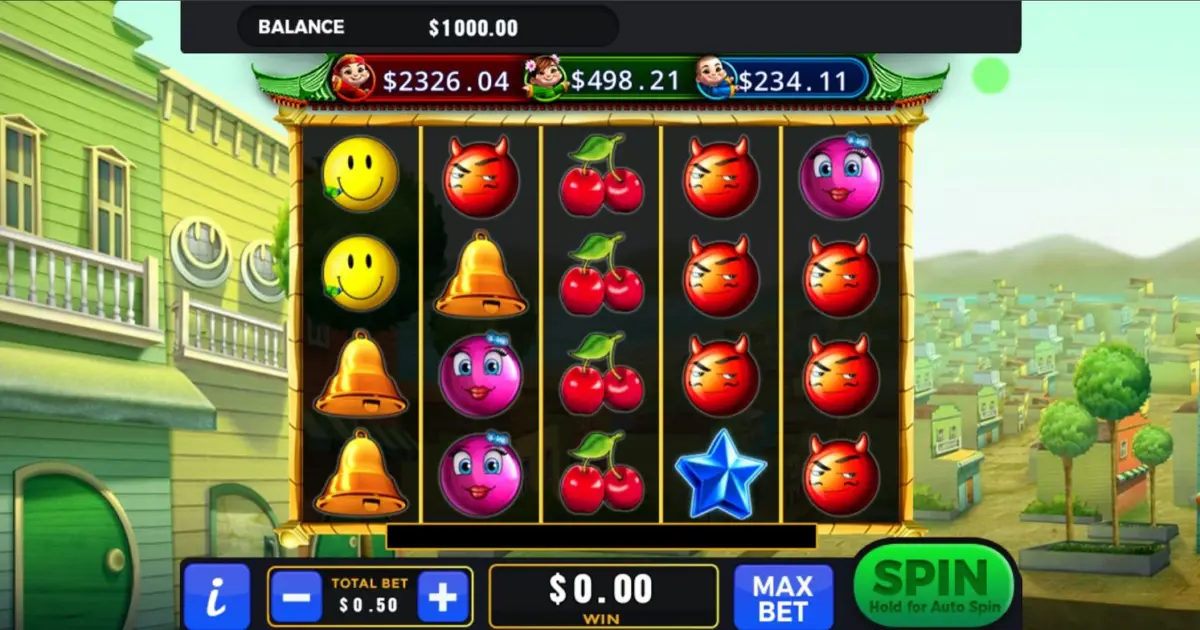
Smile Ville is worth a spin if you want a 5-reel slot from GMW (Game Media Works) that sits close to the market standard on return. The 95.61% RTP is a shade under the 95.71% corpus average, and the free demo means you can test it without staking real money. Below are the numbers and what they mean for your session.
Smile Ville at a glance
The key figures are straightforward. Smile Ville is a 5-reel slot with a 95.61% RTP, and it ranks at 1626 with a 91.9% popularity percentile — meaning it is being played more than most of the site’s catalogue. GMW (Game Media Works) has 152 slot titles to its name, with an average RTP of 95.61% across that library, so this game sits exactly on its own provider’s average.
The game suits players who want a mainstream, middle-of-the-road return profile rather than an outlier. If you prefer a slightly higher RTP, compare it to Sugar Bang, also from GMW, which lists 95.0% — actually a touch lower. The popularity rank suggests it is getting attention, but popularity is not the same as payout rate.
| Provider | GMW (Game Media Works) |
|---|---|
| Reels | 5 |
| Free demo | Yes |
What a 95.61% RTP actually returns
RTP is a long-run statistical average, not a per-session promise. A 95.61% figure means that across a very large number of spins, the game returns £95.61 for every £100 wagered. The house edge is 4.39%.
Run that through a concrete example. At a £0.20 minimum stake, 1,000 spins means £200 in total wagers. On average, you would expect about £191.20 back — but that is the average over many, many sessions. In any single 1,000-spin run, your actual result can land well above or below that number. Short-term variance dominates; the RTP only becomes visible over tens of thousands of spins.
Compared to the 95.71% corpus average, Smile Ville is 0.10 percentage points behind. That difference is negligible in practice — roughly £0.10 per £100 wagered. It is not a reason to avoid the game, but it is also not a reason to pick it over a higher-RTP alternative.
Volatility and what your session will feel like
GMW has not published a volatility rating for Smile Ville in the available data, so treat any label you see elsewhere with caution. What you can reason about is the structure: a 5-reel slot with a 95.61% RTP and no stated volatility figure gives you no reliable way to predict swing size before you play.
In general terms, low volatility slots pay smaller amounts more often, which stretches a bankroll across longer sessions. High volatility slots pay less frequently but in bigger chunks when they land — you need a larger bankroll to survive the dry stretches. Medium volatility sits in between. Without a published figure for Smile Ville, the honest answer is that you should not assume anything about hit frequency or swing size; play the demo to get a feel for it yourself.
Every spin is independent, so no pattern of losses makes a win “due.” Your session is a sequence of unrelated events, and the RTP only asserts itself over a very large sample.
The 5-reel layout and how wins are counted
Smile Ville uses a 5-reel layout, which is the most common configuration in modern slots. Five reels give the game room for a standard payline structure, though the exact number of paylines or whether it uses a “ways” mechanic is not stated in the available data.
In general terms, a fixed-payline slot pays when matching symbols land on an active line from the leftmost reel. A “ways” system instead pays for matching symbols on adjacent reels regardless of position, which typically produces more winning combinations. Without confirmation from the provider, you should not assume which system Smile Ville uses.
What the 5-reel frame does tell you is that the game is conventional in scope. It is not a high-complexity layout, and the maths behind it should be readable in the paytable before you commit real money.
Stake range and sizing a bankroll
The available data does not list a minimum or maximum stake for Smile Ville. That absence matters for planning: without a published range, you cannot work out a precise bankroll figure from the game’s own limits.
You can still plan sensibly. Decide a session budget you are comfortable losing entirely, and divide it into a number of spins you can afford to play. A common approach is to size each stake so that your bankroll covers at least a few hundred spins — that gives you a realistic chance of experiencing the game’s normal range of outcomes rather than being wiped out in the first stretch.
Because the RTP is 95.61%, your long-run expectation is a slow bleed of 4.39% of turnover. That is the mathematical reality of every spin being independent: no stake size or progression changes the expected value, so pick a level that fits your budget and your tolerance for losing it.
Playing the Smile Ville demo before you commit
A free demo is available for Smile Ville, and it is the right first move. You can test the game with no download required and no stake at risk, which lets you judge the layout and pacing before you decide whether to wager real money. The demo runs on the same RTP maths, so the long-run return is the same — but demo play never pays out real money, and it does not predict what a real-money session will produce.
Use the demo to check whether the game holds your attention and whether its rhythm suits you. What it cannot do is tell you whether you will win. No short session, demo or real, reveals the true RTP.
18+. Set a budget and treat any money you spend as the cost of paid entertainment, not as an investment. If you are losing more than you planned, stop — the game is not “due” to pay back.
Verdict: who should play Smile Ville
Smile Ville is a solid, unremarkable choice for players who want a 5-reel slot near the market-average return. The 95.61% RTP is only marginally below the 95.71% corpus average, and the 91.9% popularity percentile shows it is getting real play. If you want a slightly different option from the same provider, Big 5 Baby 5 is another GMW title worth a look, though its RTP is not published.
Skip it if you are hunting for an above-average RTP — this game does not offer one. For everyone else, the free demo is the sensible way to decide. If the layout clicks and the pacing suits you, the maths is honest enough to justify a small real-money bankroll. If not, move on; there is no shortage of alternatives in the 95%+ RTP range.
One note on the missing fields: GMW has not published a max win figure, volatility rating, or stake range for this title. Treat any specific numbers you see quoted elsewhere as unverified until the provider confirms them.
Frequently Asked Questions
Can I play Smile Ville for free?
Yes. A free demo is available for Smile Ville, so you can play without staking real money and with no download required. The demo uses the same 95.61% RTP maths as the real-money game, but it never pays out actual winnings and does not predict real-money results.
What is the Smile Ville RTP and what does it mean?
Smile Ville has a 95.61% RTP, meaning it returns £95.61 per £100 wagered across a very large number of spins. That is 0.10 percentage points below the 95.71% corpus average, a difference of roughly £0.10 per £100 — negligible in practice.
Is Smile Ville a high or low volatility slot?
GMW has not published a volatility rating for Smile Ville in the available data, so the swing size and hit frequency are unconfirmed. Treat any volatility label you see elsewhere as unverified and use the free demo to get a feel for the game's pacing yourself.
Who makes Smile Ville and what else do they offer?
Smile Ville is made by GMW (Game Media Works), which has 152 slot titles with an average RTP of 95.61% across its library. A related GMW game is Sugar Bang, which lists a 95.0% RTP, slightly below Smile Ville's figure.
Can demo play on Smile Ville pay real money?
No. The Smile Ville demo uses the same 95.61% RTP maths as the real-money version, but it never pays out actual winnings. Demo play is for testing the game only and does not predict what a real-money session will produce.