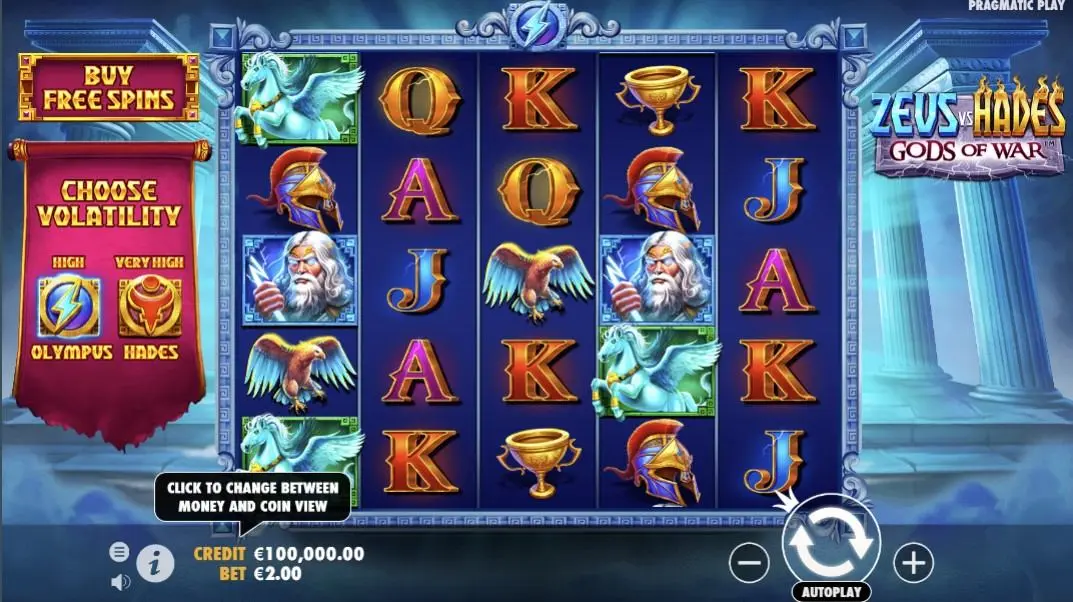
Pragmatic Play’s zeus vs hades: gods of war slot draws on mythology for its setting, runs a 5-reel grid with 15 paylines, and pays out at 96.07% RTP over a very large number of spins. If you want a mythological slot from a well-known provider and you are comfortable with some missing transparency data, this is a reasonable pick to shortlist. If you need a confirmed volatility rating or published maximum win before committing, you will have to look elsewhere.
Zeus vs Hades: Gods of War at a glance
The table below collects every game-specific number Pragmatic Play has published for this title. Read the empty rows as deliberately — a missing field is information about what you cannot verify.
| Field | Value |
|---|---|
| Provider | Pragmatic Play |
| RTP | 96.07% |
| Reels | 5 |
| Paylines | 15 |
| Minimum stake | $0.10 |
| Maximum stake | $100 |
| Volatility | Not published |
| Max win | Not published |
| Hit frequency | Not published |
| Free demo | Available |
With 739 titles in Pragmatic Play’s catalogue and an average RTP of 96.32%, this game sits 0.25 percentage points below that house mean. Against the broader corpus average of 95.71%, it still clears by 0.36 points, so it is not a bad RTP in isolation — just not the best Pragmatic Play has to offer numerically. Among the provider’s mythological output, Gates of Olympus posts 96.50%, a wider margin over the corpus. At rank 156 and 99.2nd popularity percentile, it is a heavily played title, so you will find it at most Pragmatic Play-licensed casinos without trouble.
What a 96.07% RTP actually returns
RTP is a long-run statistical average calculated across millions of simulated spins by the provider’s math team. It does not describe any single session. To see the arithmetic, take 1,000 spins at the $0.10 minimum stake: total wagered is $100.00, expected return is $96.07, expected net result is −$3.93. Now take 500 spins at the $1.00 mid-range: total wagered is $500.00, expected return is $480.35, expected net result is −$19.65.
Compare this to the corpus average of 95.71%. Over the same $500 bankroll, the corpus mean would return $478.55 — a difference of only $1.80 per $500 wagered. That gap is real but small, meaning this title’s RTP edge over average is thin enough that other factors — volatility behaviour, feature design, personal enjoyment — should carry more weight in your decision than 0.36 percentage points.
The number that matters more to your session feel is the shortfall relative to Pragmatic Play’s own 96.32% average. You are giving up 0.25 points to play a game that sits below its maker’s portfolio mean. That does not make it a bad game; it makes it a below-average entry in a strong catalogue. If RTP is your single filtering criterion, Sweet Bonanza at 96.51% is a closer match to the house standard.
Volatility not published: what that means for you
Pragmatic Play has not assigned a volatility rating to this title in the data available for review. This is a meaningful gap. Volatility determines how your $100 bankroll behaves over a typical session — whether you experience frequent small returns that bleed slowly, or long dry stretches punctuated by large single wins that create steep swings.
Without a published rating, you cannot plan stake sizes to match risk appetite the way you could with a game rated high or low. Many slots in the 96% RTP range with mythology themes run medium-to-high volatility based on general industry patterns, but I cannot confirm that for this specific game. Treat any volatility claim you see on third-party sites with caution unless it cites an official source.
One indirect signal: the $100 maximum stake relative to the $0.10 minimum suggests the provider expects some players to run extended sessions where variance is moderate enough to sustain a long play period. That is inference, not fact, and it should not substitute for a confirmed rating.
The 5-reel layout and how wins are counted
The game uses a standard 5-reel grid with 15 fixed paylines. A fixed layout means you cannot choose how many lines to activate — every spin bets on all 15 simultaneously, and the total stake is divided across them. At $0.10 per spin, each line carries $0.0067 of your wager; at $100, each line carries $6.67.
With 15 lines on 5 reels, the game sits at the lower end of line counts in the modern online slot space. Games with 20, 25, or ways-based mechanics offer more opportunities for matching symbols on any given spin, which typically produces higher hit frequency. With fewer lines, you may experience more spins that land no win at all, though individual winning combinations can pay more because the stake is spread over fewer paths. Pragmatic Play has not published hit frequency for this title, so I cannot quantify that trade-off with numbers. The 801 mythology-themed games in this corpus include a wide range of layouts — some use ways or cluster pays instead of fixed lines, which changes how often symbols connect. 9 Arrows of Odysseus offers a different structural approach if you want to compare mechanics within the same theme.
Stake range and sizing a bankroll
The stake range runs from $0.10 to $100 per spin. That is a 1,000:1 ratio between minimum and maximum, which is wide and accommodates both cautious and aggressive players within a single game.
For a player budgeting $50 as entertainment cost, the minimum stake of $0.10 gives you 500 spins before the money is gone if every single spin loses. At $1.00 per spin, that same budget covers 50 spins — enough to sample the game’s rhythm without significant risk. At the maximum $100, you have one spin. That is the math; volatility determines whether you survive those sessions or deplete them faster.
A useful planning method: divide your total session budget by 200, and use that as a per-spin ceiling. A $200 budget gives you $1.00 per spin, roughly 200 spins of exposure. This works regardless of what the game’s actual volatility turns out to be, because it limits downside to the amount you have already decided to spend. There is no betting pattern or stake progression that changes the 96.07% RTP — every spin is independent.
Playing the zeus vs hades: gods of war slot demo before you commit
A free demo is available for this game, which is the single most useful pre-commitment tool you have. Demo play runs on the same math model as the real-money version but uses simulated credits. It lets you confirm whether the reel behaviour feels enjoyable to you personally, whether the pacing holds your interest over 100 or 200 spins, and whether the feature cadence suits your temperament.
Demo play cannot predict your real-money results. Variance is the same engine, but a demo session of 500 spins is a tiny sample relative to the millions used to calculate RTP. You may see a wildly different return profile in a demo than you do when real money is at stake, and neither is “the truth” — both are random draws from the same distribution.
Set a budget before any real-money session and treat the cost as entertainment spending, the same as a concert ticket. If you are 18 or older and gambling as entertainment, the demo is the zero-risk way to decide whether this specific game earns its share of that budget.
Verdict: who should play this game
This slot suits a player who wants a mythology-themed Pragmatic Play title with above-average RTP, a clean 5-reel 15-line structure, and who is comfortable making that choice despite the missing volatility and max-win data. The 96.07% return is respectable against the corpus, and the popularity percentile confirms a large player base — you will not struggle to find it or see others discuss their experience.
Skip this title if a published volatility rating is essential to your bankroll planning, or if you need a confirmed maximum win multiplier before risking real money. In that case, Pragmatic Play’s Gates of Olympus publishes more complete metadata and edges this game by 0.43 percentage points on RTP. If you are simply browsing the mythology theme for something new with solid structure and no red flags in the numbers that are published, Zeus vs Hades is a legitimate option worth a demo session.
Frequently Asked Questions
Is there a free demo of Zeus vs Hades: Gods of War Slot?
Yes, a free demo version is available through Pragmatic Play-licensed operators. The demo uses simulated credits but runs on the same 96.07% RTP math model as the real-money game. You can test the 5-reel, 15-payline layout and see how the feature cadence feels without risking funds, though no real-money payout is possible from demo spins.
What does the 96.07% RTP mean for my actual sessions?
The 96.07% RTP is a long-run average calculated across millions of spins, not a session guarantee. Over 1,000 spins at $0.10 each, the expected return is $96.07 per $100 wagered, meaning $3.93 expected net loss. Individual sessions of any length can vary far above or below that figure because every spin is independent.
What volatility rating does Zeus vs Hades: Gods of War have?
Pragmatic Play has not published an official volatility rating for this title in available data. This means you cannot plan stake sizes or session length to match a confirmed risk profile the way you could with a rated game. Treat any third-party volatility claim as unverified unless it cites an official Pragmatic Play source.
How does this slot compare to Gates of Olympus from the same provider?
Gates of Olympus returns 96.50% RTP compared to Zeus vs Hades at 96.07%, a 0.43-point difference in the mythological theme's favour. Both share the Pragmatic Play mythology setting and 5-reel layout, but Gates of Olympus uses a different payline or ways structure and publishes more complete metadata including volatility, making it easier to plan around numerically.
Can I play Zeus vs Hades: Gods of War for real money starting at low stakes?
The minimum stake is $0.10 per spin, so a $20 bankroll covers 200 spins at the lowest setting. The maximum is $100 per spin. Since no volatility rating is published, start at the minimum to observe the game's behaviour with limited exposure before deciding whether higher stakes suit your session budget and risk comfort.




