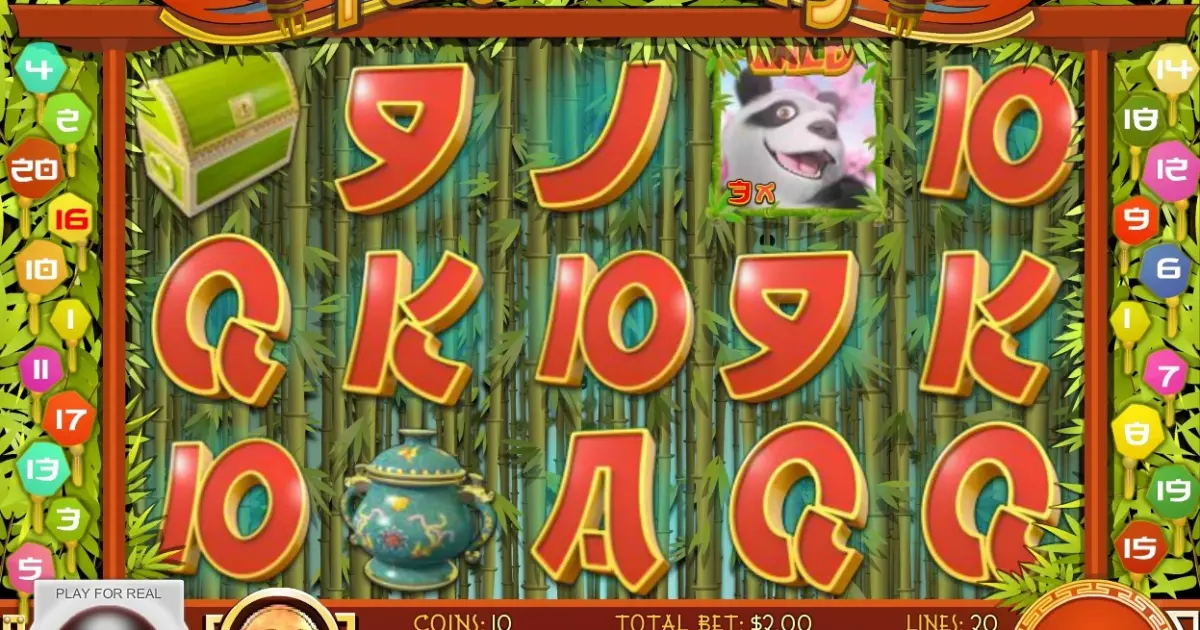
Panda Party is a 5-reel, Asian-themed slot from Rival that sits just under the average return seen across the site. If you are weighing up the panda party slot against other options, the headline figures — 95% RTP and a mid-pack popularity rank — tell you most of what you need to decide quickly, while the missing details matter just as much.
Panda Party at a glance
Panda Party is listed as a Slot Machine with 5 reels and themes tagged as 5-Reels and Asian, with Asian as the primary theme. Rival, the provider behind the game, has 152 titles in the current corpus and an average RTP across those titles of 94.67%, so this game’s 95% sits slightly above the provider’s own average. Across the whole site corpus the average RTP is 95.71%, which puts Panda Party 0.71 percentage points below that broader benchmark. Its popularity rank is 2928, which corresponds to the 85.3rd percentile — in other words, it is played less than the most prominent titles but still appears well within the catalog rather than at the very bottom.
That combination suits a player who wants a straightforward 5-reel structure without chasing the very highest-return numbers on the site. If you filter primarily by RTP, you will find higher options in both the Rival catalog and the Asian theme group, and the table below makes that comparison concrete. If you filter by theme first, Panda Party remains a representative example of Asian slots without asking you to learn an unusual mechanic.
| Figure | Value |
|---|---|
| Game | Panda Party Slot |
| Provider | Rival (152 games, avg RTP 94.67%) |
| RTP | 95.0% |
| Reels | 5 |
| Themes | Asian (primary), 5-Reels |
| Corpus average RTP | 95.71% (-0.71pp vs Panda Party) |
| Popularity rank | 2928 (85.3rd percentile) |
| Free demo | Available |
One gap to note early: no volatility rating, no published stake range, and no max win figure are supplied in the available facts. Missing data is not a flaw in the game itself, but it does change how you plan. You cannot size volatility risk precisely and you cannot calculate a bankroll floor from a stated minimum bet, so your planning needs to lean on the maths of RTP and on conservative session limits instead of on assumptions about swing size.
What a 95% RTP actually returns
95% RTP means that across a very large number of spins — millions, not hundreds — the game is designed to return £95 for every £100 wagered, keeping £5 as the house edge. It is a long-run statistical average, not a promise for any single session. Every spin is independent, and short-term results can sit far above or below that average.
To make that concrete, take an illustrative example because the facts do not include a published minimum stake for this title. If you imagine 1,000 spins at £1 per spin, you would have wagered £1,000 in total. At exactly 95% RTP the expected return across that sample would be £950, for a theoretical loss of £50. In practice you will not hit £950; you might finish significantly higher or lower, and the further you are from a huge sample, the larger that variance around the average can be.
Compared with the corpus average of 95.71%, the difference is modest but measurable over volume. A corpus-average game would be expected to return £957.10 on the same £1,000 wagered versus £950 for Panda Party, a gap of £7.10 per £1,000 staked. Against Rival’s own average of 94.67%, Panda Party is 0.33 percentage points higher, so it is slightly ahead of the typical Rival title even though it trails the site-wide figure. For context, Mystic Fortune Deluxe at 96.71% would be expected to return £967.10 on that £1,000, while The Book of Amaterasu at 95% matches Panda Party exactly on expected return.
Use RTP to set expectations, not to predict outcomes. A higher RTP improves expected value over time but never makes a session profitable by design, and a lower RTP does not make a game “tight” for your next 100 spins — it simply shifts the long-run average by a few pounds per thousand wagered.
Unpublished volatility and what your session will feel like
No volatility rating has been published for Panda Party in the facts available, so treat any description of it as low, medium or high elsewhere with caution. Volatility, where it is published, describes how results are distributed rather than how much is returned overall. Low volatility typically means more frequent but smaller swings around the average, which can stretch a flat-stake session. High volatility typically means longer quiet stretches punctuated by larger deviations, which demands a larger bankroll for the same number of spins and a higher tolerance for interim losses. Medium volatility sits between those two patterns.
Because the figure is missing here, you cannot know in advance which of those patterns Panda Party will follow, and you should not infer it from the theme, the reel count, or the RTP alone. Two games with the same 95% RTP can feel very different: one might keep you close to the starting balance for a long time, the other might move you away from it quickly in either direction, yet both converge toward 95% over millions of spins.
The practical response to an unpublished volatility is to plan conservatively. Assume swings could be material, keep stakes small relative to your total budget, and decide before you start how many spins you want to allow for and what loss limit ends the session. Many slots also include concepts such as wilds, scatters or free spins as ways to vary distribution, but the facts for this specific title do not confirm which, if any, of those concepts are present, so do not base a volatility guess on an assumed feature set.
If volatility is important to how you choose games, compare with titles where it is stated, or start with the free demo to observe the rhythm of wins and losses without financial risk — keeping in mind that demo play cannot predict real-money results and that short samples in either mode are not indicative of long-run behaviour.
The 5-reel layout and how wins are counted
Panda Party uses a 5 reels layout, the most common reel count for modern video slots. In general terms, the number of reels tells you how many vertical columns of symbols spin on each round, but it does not by itself tell you how wins are evaluated. Some 5-reel games use fixed paylines, where a win requires matching symbols to fall on a specific line, while others use “ways” mechanics where any matching symbols on adjacent reels from left to right count, and some combine paylines with additional counting rules.
The facts for Panda Party confirm the 5-reel structure but do not specify a payline count, a number of ways, or how wins are counted for this title. That absence is worth stating plainly: without a published payline or ways figure you cannot calculate a hit frequency, you cannot describe the shape of typical winning combinations, and you should be skeptical of any third-party site that quotes a precise line count for this game.
What you can take from the 5-reel tag is that the interface will feel familiar if you have played other 5-reel slots, and that comparisons within the same layout are more apples-to-apples than cross-layout comparisons. For example, Wong Choy is another Asian-themed title on 5 reels but carries a higher RTP of 96.74%, so a player who wants to stay within the theme while seeking a higher long-run return has a direct alternative to evaluate. Similarly, within Rival’s own catalog, Howl-O-Ween at 96.25% offers a higher RTP on a different theme but from the same provider, which can be useful if provider consistency matters to you.
When payline or ways data is missing, focus on what is verifiable: reel count, RTP, provider averages, and your own comfort with the format as observed in demo play.
Stake range and sizing a bankroll
No minimum or maximum stake is published for Panda Party in the available facts, so any exact bankroll math must remain illustrative rather than definitive. Stake range matters because it interacts directly with how long a budget lasts. A lower minimum stake lets you spread a fixed budget over more spins, which smooths some of the short-run variance without changing the expected value, while a higher minimum stake reduces the number of spins that same budget can cover.
To illustrate the relationship, consider a hypothetical £50 entertainment budget. At an illustrative £0.20 per spin, that budget would cover 250 spins before any returns; at £0.50 per spin it would cover 100 spins; at £1 per spin it would cover 50 spins. Those spin counts halve or double as you adjust stake, yet the RTP — 95% — still applies only as a long-run average and does not make any stake size more profitable than another on a per-pound basis. Every stake level carries the same house edge per pound wagered; only the number of opportunities and the size of each swing change.
Without a published range you should approach real-money play, if you choose it, by confirming the actual allowed stakes in the game interface before you set a budget, and by choosing a stake that leaves room for the session length you want even if early spins return less than average. Avoid any system that suggests raising stakes after losses or wins will change the expected value — it will not, because spins are independent. The most reliable control you have is deciding in advance how much you are willing to spend for the entertainment, and stopping when that amount is reached regardless of interim results.
Playing the panda party slot demo before you commit
A free demo is available for Panda Party, and it is the most useful way to answer personal fit questions that numbers alone cannot settle: whether the 5-reel presentation is comfortable to follow, whether the pace suits the session length you prefer, and whether the theme holds your attention. You can try the Panda Party free demo without committing funds, on a no-download basis where offered, and use that time to check practical details such as the actual stake options shown in the interface and how wins are displayed.
Treat demo play strictly as familiarisation. Demo credits have no cash value, and time spent in demo does not make future real-money spins more likely to win or to hit any particular pattern. Because every spin is independent, the sequence you see in 200 or 500 demo spins is just one small sample and cannot be extrapolated to long-run performance. The value of the demo is in learning the controls and confirming whether you enjoy the format, not in testing for profitability.
If you move from demo to real-money play, keep the following habits in place. You must be 18 or over to gamble in the UK. Set a budget before you start and treat it as the price of entertainment, not as an investment. Use deposit or loss limits where available, take regular breaks, and never chase losses or play with money you cannot afford to lose. If you feel you are spending more time or money than intended, use self-exclusion tools or seek support from independent organisations that offer confidential advice. Stopping is always an option, and stepping away does not affect the outcome of any future spin.
Verdict: who should play Panda Party
Panda Party will appeal most to players who want a familiar 5-reel, Asian-themed slot from an established provider and who are comfortable with a 95% RTP that sits a fraction below the site-wide average. It is not positioned as a highest-RTP choice within its theme or provider group — titles such as Wong Choy at 96.74%, Mystic Fortune Deluxe at 96.71%, and Howl-O-Ween at 96.25% all sit higher — but it does edge above Rival’s own average of 94.67%, which may matter if you prefer to stay within Rival slots for consistency.
The missing volatility rating and stake details mean this is a game to approach with a conservative plan rather than a precise mathematical model. If you like to size a bankroll from a stated variance level and a known minimum bet, the absence of those figures will feel like a gap; the available facts give you solid return-to-player context but not the distribution context that completes session planning. In that case, leaning on the demo to confirm presentation and to observe the interface’s actual stake options is more useful than relying on third-party claims.
Consider trying the demo first if you are theme-driven, if you already enjoy 5-reel games, or if you are comparing Asian slots side by side. If your primary filter is long-run return, note the 0.71-point shortfall versus the corpus average and weigh it against how much the theme matters to you. For entertainment budgets where every pound of expected value counts over many sessions, the higher-RTP alternatives noted above deserve a look; for shorter, casual sessions where familiarity and theme carry more weight, Panda Party remains a straightforward option provided you set a clear budget and treat any outcome as entertainment variance.
Frequently Asked Questions
Can I play Panda Party for free without risking real money?
Yes, a free demo is available for Panda Party. Demo play uses play credits with no cash value, so you can explore the 5-reel layout and check controls without staking funds. Remember that demo results do not predict real-money outcomes, because every spin is independent and short samples do not reflect long-run averages.
What is the RTP of Panda Party and what does it mean for my session?
Panda Party has a 95% RTP, meaning it is designed to return £95 for every £100 wagered across millions of spins. For an illustrative 1,000 spins at £1, that is £950 returned on £1,000 staked in theory, but actual sessions vary widely. The figure sits 0.71 points below the corpus average of 95.71%.
What volatility does Panda Party have and how will that affect swings?
No volatility rating has been published for Panda Party in the available facts, so its risk profile cannot be stated reliably. Volatility describes whether a game tends toward frequent small swings or rarer larger swings around the same RTP. Without that rating, plan conservatively with smaller stakes relative to your budget.
Who makes Panda Party and what else do they offer?
Panda Party is made by Rival, a provider with 152 games in the corpus and an average RTP of 94.67% across those titles. At 95%, Panda Party sits just above the provider average. Other Rival titles for comparison include Howl-O-Ween at 96.25% and Ocean Treasure at 96%.
What stake should I use for Panda Party to make my bankroll last?
No official minimum or maximum stake is published for Panda Party in the facts, so check the in-game interface for the actual range. As a guide, a £50 budget at £0.20 per spin allows 250 spins before returns, while £1 per spin allows 50. Choose a stake that funds your desired session length.