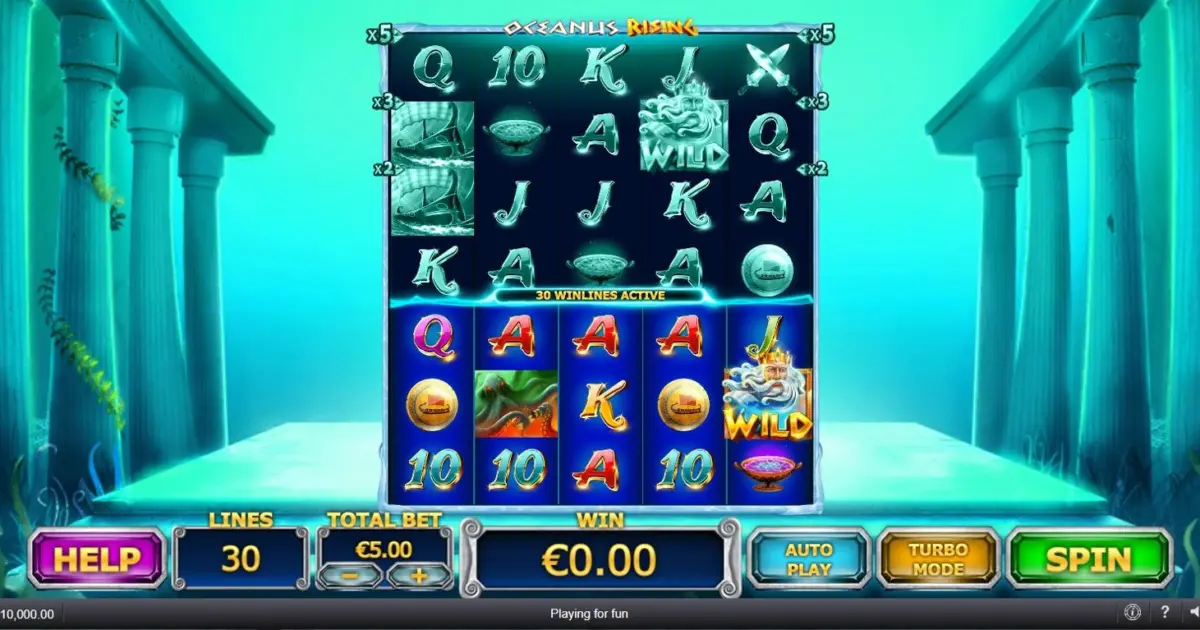
If you are comparing ocean-themed slots with a 95.05% RTP from a major studio, the oceanus rising slot deserves a look on paper — but the numbers below suggest it is not the strongest choice in its category. Playtech built a five-reel game with below-average theoretical returns and no published volatility figure, which means you are making a wager on a machine whose rhythm is only partially disclosed. Whether that matters depends on how much time you plan to spend at it.
Oceanus Rising versus the average slot
The single most decision-relevant number here is the RTP gap. Oceanus Rising returns 95.05%, which is 0.66 percentage points below the corpus average of 95.71%. In practical terms, across a large sample of 100,000 spins at a one-unit stake, that gap represents 660 units less returned to the player pool than a game sitting at the corpus mean. It is not a catastrophic shortfall — the variance of any individual session dwarfs this figure — but it is a genuine structural drag that no strategy can overcome.
Against Playtech’s own portfolio, the game sits almost exactly at the house average of 95.22%, trailing it by 0.17 points. So Oceanus Rising is neither a standout nor an outlier within its studio; it is a middle-of-the-road RTP from a middle-of-the-road provider.
| Provider | Playtech |
|---|---|
| RTP | 95.05% |
| Reels | 5 |
| Theme | Ocean and sea |
| Free demo | Yes |
RTP breakdown: 95.05% in context
RTP is a long-run statistical average calculated over millions of simulated spins. It tells you the theoretical house edge over an infinite session — 4.95% in this case — and nothing about what happens in your next hundred spins. A 95.05% game can pay back 120% in one short session and 60% in another. The number only becomes reliable at very large sample sizes, and no human session is large enough to guarantee convergence.
That said, the 0.66-point deficit versus the corpus average is a fixed, known cost per spin. If you are splitting time between this title and higher-RTP alternatives, you are choosing to accept a measurably worse long-run deal. The math does not care about theme preference or session nostalgia; over thousands of spins, each 0.66-point difference accumulates predictably.
Volatility profile
Playtech has not published a volatility rating for Oceanus Rising. This is a meaningful gap. Without a stated variance class — low, medium, or high — you cannot predict whether the game will pay frequent small wins or rare large ones, and you cannot calibrate your stake size or bankroll expectations accordingly.
In general terms, low-volatility games produce smaller swings and suit players with modest bankrolls who want extended play. High-volatility games swing harder and require deeper funding to ride out dry stretches. Medium volatility splits the difference. When a provider omits the rating entirely, treat it as a flag: the game may not fit cleanly into one category, or the studio may be relying on its brand reputation rather than data to drive player confidence. You are entitled to know what rhythm to expect before you deposit.
Playtech as a studio
Playtech operates one of the largest online casino portfolios in the industry, with 162 titles in our tracked corpus. Their average game returns 95.22% RTP, which is slightly below the broader market average but consistent across their output. Oceanus Rising, at 95.05%, sits marginally below even that studio norm.
If you are exploring Playtech’s wider catalogue, Drinks on the Beach runs at 94.85% — another below-average title. By contrast, Ji Xiang 8 returns 95.99%, a full 0.94 points better than Oceanus Rising, while The X Files at 95.12% is essentially equivalent. The spread within a single provider is small; if you want a materially better deal, you will need to look beyond Playtech.
Three ocean-themed alternatives worth comparing
The ocean-and-sea category in our corpus contains 527 titles, giving you enormous choice. If the 95.05% RTP of Oceanus Rising is holding you back, consider what else is available under the same visual banner:
- Big Bass Bonanza — 96.71% RTP. That is 1.66 points above Oceanus Rising, a difference that translates into 1,660 additional units per 100,000 spins at a one-unit stake.
- Bigger Bass Bonanza — also 96.71%, the direct sequel sharing the same theoretical return.
- Pearls of Aphrodite — 96.81%, the strongest RTP in this three-game comparison.
Every one of these alternatives returns more than the corpus average. Oceanus Rising returns less than it. If raw maths drives your selection, the case for switching is straightforward.
Getting the most out of the free demo
A free demo is available for Oceanus Rising, and you should use it — but use it correctly. Demo play lets you observe the game’s visual layout, pace, and interface without financial risk. It does not let you learn anything about volatility, hit frequency, or bonus-round behaviour in a statistically meaningful way, because a few hundred demo spins cannot sample the rare events that shape long-run returns. The demo also does not predict what your real-money results will look like; the random number generator is indifferent to whether your credits are real or virtual.
What the demo can tell you is whether you find the game’s presentation enjoyable. If you do, play responsibly: set a budget before you start, treat the money you spend as the cost of entertainment rather than an investment, and stop when the budget is exhausted. This is adult recreation, and 18+ is the minimum threshold. No slot, regardless of theme or provider, is designed to produce consistent profits.
Should you play Oceanus Rising?
The honest answer is: there is no mathematical reason to prefer this game over the ocean-themed alternatives listed above. At 95.05%, Oceanus Rising trails Big Bass Bonanza by 1.66 points, Pearls of Aphrodite by 1.76, and the corpus average by 0.66. Playtech’s popularity ranking for this title sits at position 134 out of their portfolio, with a 99.3 percentile engagement score — meaning it attracts a large audience relative to other slots in our dataset. That popularity is the one argument in its favour: other players clearly enjoy the presentation, even if the maths does not reward them for it.
If you already like the theme and the five-reel format, the RTP gap is small enough that personal preference can legitimately outweigh it. If you are selecting purely on numbers, try a higher-return ocean title first.
Frequently Asked Questions
What is the RTP of Oceanus Rising?
Oceanus Rising has a published RTP of 95.05% from Playtech. This places it 0.66 percentage points below the corpus average of 95.71% and slightly below Playtech's own portfolio average of 95.22%. Over a very large number of spins, the game returns 95.05 units per 100 units wagered as a theoretical average.
Is there a free demo available for Oceanus Rising?
Yes, a free demo version of Oceanus Rising is available on this site. You can play it without depositing money or creating an account. Demo play lets you experience the game's visual design and interface at no cost, though it does not reveal statistically meaningful information about volatility or long-run returns.
Does Playtech make other slots with better RTPs than Oceanus Rising?
Yes. Playtech's catalogue includes 162 tracked titles with an average RTP of 95.22%. Ji Xiang 8, for example, returns 95.99%, which is 0.94 points better than Oceanus Rising. Drinks on the Beach at 94.85% is actually worse, showing that the spread within a single provider can favour or disprove a specific choice.
How does Oceanus Rising compare to Big Bass Bonanza?
Oceanus Rising returns 95.05% RTP compared to Big Bass Bonanza's 96.71%, a gap of 1.66 percentage points. Both are five-reel ocean-themed slots. Over 100,000 spins at a one-unit stake, that difference amounts to approximately 1,660 units returned to the player pool. Big Bass Bonanza is a measurably stronger mathematical choice.
What is the volatility of Oceanus Rising?
Playtech has not published a volatility rating for Oceanus Rising. This means players cannot determine whether the game produces frequent small payouts or rare large wins before playing. Without this information, bankroll planning and session-length expectations remain uncertain, which is a notable gap in the disclosed data for this title.