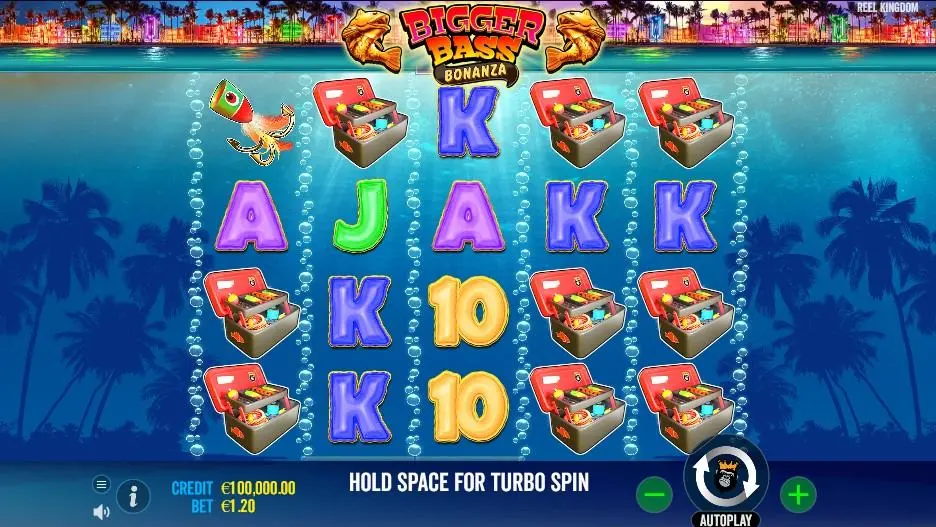
Bigger Bass Bonanza sits in the top 0.3% of slots by popularity and delivers an RTP a full point above corpus average, paired with high volatility and a maximum win capped at 4,000 times stake. If you want long statistical return and can tolerate session swings, the numbers justify a look. If you need frequent smaller hits to stretch a modest bankroll, they do not.
| Specification | Value |
|---|---|
| Provider | Pragmatic Play |
| RTP | 96.71% |
| Volatility | High |
| Reels × Paylines | 5 × 12 |
| Stake range | $/£/€0.12 – $/£/€240 |
| Maximum win | 4,000x |
| Themes | Ocean and sea, Animals, Fishing |
| Popularity rank | 55 of all slots tracked |
First look at Bigger Bass Bonanza
Pragmatic Play released Bigger Bass Bonanza as part of its ocean-and-fishing catalogue, building on the same reel structure and mathematical model that made Big Bass Bonanza a benchmark title. Both carry identical 96.71% RTP and high volatility, so this is a sequel in theme rather than a redesign in maths. The provider has published 739 games to date, averaging 96.32% RTP; this title runs 39 basis points above that house average and a full percentage point above the 95.71% corpus mean.
The ocean-and-sea theme category holds 527 games, so competition for attention is tight. Bigger Bass Bonanza holds rank 55 across all slots tracked—top 0.3 percentile—which tells you player preference has been sustained over time. Popularity does not change expected value, but it does confirm the game has found an audience willing to fund high-volatility sessions in exchange for that above-market RTP.
How a round plays out
You spin 5 reels arranged across 12 fixed paylines. Wins form when matching symbols land left to right on any of those twelve lines, and the paytable determines each combination’s multiplier against your stake per line. The 12-payline structure is narrow compared to the 243-way or 1,024-way mechanics common in modern video slots, which means fewer ways to connect a win on any given spin but a simpler pay structure to read.
Many slots in the fishing and ocean genre incorporate wild substitutions, scatter-triggered free spins, and accumulator mechanics that collect symbols or multipliers across a bonus round. Bigger Bass Bonanza follows this template in broad concept—fishing-themed slots typically do—but Pragmatic Play has not published granular feature detail such as free-spin counts, multiplier caps, or hit frequency for this title. Treat any specific numbers you see quoted on forum threads or aggregator sites with caution unless they cite primary source data.
The maximum win is capped at 4,000 times your total stake. At the £240 ceiling that translates to £960,000; at the £0.12 floor it is £480. The cap is mechanical: once the win reaches 4,000x on any spin or cascading sequence, the round ends and the balance is credited. This ceiling sits in the middle range for Pragmatic Play’s high-volatility catalogue—well above their low-volatility fruit slots but below the five-figure multiples on some of their tournament-focused titles.
Reading the 96.71% return figure
RTP is the percentage of all stakes the game is programmed to return as wins over a sample large enough for variance to flatten—think tens of millions of spins. 96.71% means that for every £100 wagered across that sample, the game returns £96.71 and retains £3.29 as house edge. Your personal session of 200 or 2,000 spins will not converge on that figure; volatility ensures you will finish meaningfully above it or below it almost every time.
Bigger Bass Bonanza’s RTP is 39 basis points above the Pragmatic Play average and a full point above the 95.71% corpus mean, which places it comfortably in the upper half of the market. For context, Sweet Bonanza runs 96.51%, Gates of Olympus sits at 96.5%, and Joker’s Jewels matches that figure. The difference between 96.5% and 96.71% is 21 pence per £100 staked over the infinite run—modest in absolute terms, but compounding across thousands of spins and meaningful when you compare titles of equal volatility.
RTP does not tell you how often you win or how large those wins are; it tells you the long-run cost of play. A 96.71% game with high volatility will deliver longer losing streaks and larger occasional wins than a 96.71% game with low volatility, even though both return the same fraction over time. Read RTP as the baseline tax on your entertainment budget, then use volatility to understand the ride.
Why high volatility changes your bankroll maths
Volatility describes the size and frequency distribution of wins. High volatility means longer gaps between winning spins, a higher proportion of dead spins, and bigger wins when they land. Your bankroll will swing more dramatically, and you will need a deeper reserve to survive the gaps between hits. Low volatility smooths the curve: smaller wins arrive more often, session length stretches further on the same budget, but the ceiling on any single win is lower.
Bigger Bass Bonanza’s high volatility pairs with a 4,000x maximum win and 96.71% RTP. The combination tells you this: expect to lose your stake more often than not on any given spin, expect a meaningful number of spins to return nothing, and expect the RTP to be delivered through infrequent larger pays rather than a steady trickle. If you start a session with twenty times your base stake—say £24 on a £1.20 spin—you can easily burn through that in under fifty spins without a bonus trigger. That is not a fault; it is the designed behaviour of a high-volatility model.
High volatility suits players who treat slots as high-risk entertainment and can afford to walk away from a losing session without chasing. It does not suit players who want to stretch a fixed budget across a longer session or who tilt when a dozen consecutive spins return nothing. The maths is neutral, but your tolerance for drawdown is not. If you know you will reload after a cold stretch, high volatility amplifies the cost of that reload.
Bet sizing from $/£/€0.12 upwards
The stake range runs from £0.12 per spin to £240 per spin, a 2,000:1 ratio that accommodates cautious penny play and high-roller session budgets. At the floor, a £50 bankroll funds 416 spins before depletion, enough to ride out the volatility curve if you define success as time on device rather than profit. At the ceiling, that same £50 buys a fifth of one spin, so the £240 maximum is reserved for players wagering four-figure session budgets and chasing the £960,000 maximum win.
Bet sizing does not change RTP or volatility; a £0.12 spin and a £240 spin face identical house edge and variance profile. What changes is absolute exposure. High volatility at high stakes compounds drawdown risk—losing fifteen consecutive spins at £240 costs £3,600, a session-ending sum for most players. The same fifteen-spin losing streak at £1.20 costs £18, uncomfortable but survivable within a typical recreational budget.
Choose your stake by dividing your total session budget by at least 100, ideally 200, to give yourself enough spins to see a bonus trigger or a cluster of line wins. If your budget is £50, that means £0.50 or £0.25 per spin. If your budget is £500, you can justify £2.50 to £5. Betting a larger fraction front-loads your entertainment into fewer spins and increases the probability you will finish the session in significant loss before variance has time to work.
Where Bigger Bass Bonanza sits among Ocean and sea slots
The ocean-and-sea category holds 527 games, spanning low-volatility fruit-and-shell slots at 94% RTP through to high-volatility deep-sea expedition titles above 97%. Bigger Bass Bonanza’s 96.71% RTP places it in the upper third of that distribution. Its sibling title Big Bass Bonanza shares the identical RTP and volatility profile, so your choice between them comes down to theme preference and feature variation rather than mathematical advantage. Pearls of Aphrodite edges ahead at 96.81% RTP if you want another ten basis points of long-run return within the same thematic family.
Pragmatic Play dominates the fishing subcategory by volume and visibility, and Bigger Bass Bonanza’s rank of 55th overall confirms the franchise has sustained player engagement beyond launch novelty. Popularity correlates with liquidity in tournament play and visibility in lobby filters, which matters if you value community leaderboards or prefer games with established session data. It does not change your expected value, but it does mean you are playing a known quantity rather than an orphaned back-catalogue title with sparse play history.
The honest verdict
Bigger Bass Bonanza delivers what its specification sheet promises: above-market RTP, high volatility, a four-figure maximum win multiplier, and a stake range that spans casual and committed play. The 96.71% return is one full point above corpus average and 39 basis points above Pragmatic Play’s house mean, which makes it a mathematically sound choice if you are comparing titles within the same volatility class. The 4,000x cap is modest next to the five-figure maximums on some competing high-variance slots, but it is proportional to the RTP and volatility model—this is not a lottery-ticket game.
High volatility means you need a disciplined bankroll plan and the temperament to tolerate long stretches of losing spins. If you cannot afford to lose your entire session budget or if you tilt when fifteen consecutive spins return nothing, this game will frustrate you regardless of its RTP. The maths works over millions of spins; your evening works over hundreds, and variance dominates that sample size. The 12-payline structure is narrow, which simplifies the pay logic but reduces the frequency of any win compared to 243-way or cluster-pays mechanics.
The game’s top-percentile popularity and sustained franchise presence confirm it has found its audience. Whether you are part of that audience depends on your volatility tolerance, your session budget, and whether you value incremental RTP improvement enough to accept the swings that come with it. The numbers are honest; make sure your expectations are, too.
Set a budget before you start, treat that budget as the cost of entertainment rather than an investment to grow, and stop when it is gone. Every spin is independent; no session is ever “due”. Bigger Bass Bonanza is designed for adults who can afford to lose what they stake. If you are chasing losses, borrowing to play, or gambling with money you need for something else, stop now. 18+.
Frequently Asked Questions
Can I play Bigger Bass Bonanza in demo mode without depositing?
Yes, a free demo version is available. Demo play uses virtual credits and cannot pay real money, but the RTP, volatility, reel layout, and feature triggers are identical to the real-money version, so you can test the session behaviour and pace before deciding whether to stake cash.
What does the 96.71% RTP mean for my session?
RTP is a statistical average calculated over tens of millions of spins. 96.71% means the game returns £96.71 per £100 wagered across that enormous sample. Your session of a few hundred spins will almost certainly finish above or below that figure—high volatility ensures large swings in both directions, and RTP only converges over a sample size no recreational player will ever reach.
How does high volatility affect how long my bankroll lasts?
High volatility produces longer losing streaks, more dead spins, and larger but less frequent wins. You need a deeper bankroll relative to your stake—ideally 100 to 200 times your per-spin bet—to survive the gaps between bonus triggers or line-win clusters. A £50 budget at £1 per spin can easily evaporate in under an hour; the same budget at £0.25 per spin gives you four times the runway.
Who is Pragmatic Play and what else do they publish?
Pragmatic Play is a Malta-based provider with 739 games published to date, averaging 96.32% RTP across the portfolio. Their catalogue includes Gates of Olympus, Sweet Bonanza, and the original Big Bass Bonanza. They focus on high-volatility video slots with bonus-buy options and cross-platform play, and they are a top-five provider by lobbies presence and tournament volume.
How does Bigger Bass Bonanza compare to the original Big Bass Bonanza?
Both carry identical 96.71% RTP, high volatility, 5 reels, 12 paylines, and the same stake range. The mathematical profile is the same, so your choice comes down to theme variation and feature preference rather than a difference in expected value or risk. If you want a marginally higher RTP within the ocean theme, Pearls of Aphrodite runs 96.81%.