The number that matters most here is 95.52%. That is the theoretical return-to-player figure published for this Blueprint Gaming release, and it sits 0.19 percentage points below the 95.71% average across the slots catalogued on this site. If you are choosing between a handful of Irish-themed games on a Friday night, that difference is not going to decide your session — but it is a real, measurable disadvantage, and there are Irish slots listed further down this page that return more.
What follows is what the published figures for the limerick lightning slot actually imply for your bankroll, and what has not been published at all. Blueprint has not disclosed a volatility rating, a max win multiplier, a hit frequency or a stake range for this title, so this review does not invent them.
Limerick Lightning versus the average slot
The headline comparison: this game runs 0.19 percentage points below the corpus average. In practical terms, that means the house edge here is 4.48% against an average of 4.29% across the wider set of games. Wager £1,000 across a very large number of spins and the modelled difference in expected loss between this title and a perfectly average one is around £1.90.
That is a small number, and anyone telling you it will define your evening is overselling it. Short-run variance dwarfs a fifth of a percentage point. Over 200 spins at £0.20 you might be up £40 or down £40, and the RTP figure will barely register in that outcome.
Where the gap does matter is repetition. If this becomes your regular game for months, the edge compounds against you in a way that a single session cannot show. Against the same studio’s own average of 95.35% the game actually looks marginally better than typical Blueprint output. Against the broader market it looks slightly worse. Both statements are true at once, which is exactly why a single RTP number should be read against a named benchmark rather than in isolation.
RTP breakdown: 95.52% in context
RTP is a long-run statistical average produced by the game’s mathematical model, not a promise about any session. At 95.52%, the modelled return is £95.52 for every £100 wagered — and the word “wagered” is doing heavy lifting. If you stake £0.40 per spin and play 500 spins, you have wagered £200, not £0.40. The model applies to that £200.
| Figure | Value |
|---|---|
| Game | Limerick Lightning |
| Provider | Blueprint Gaming |
| RTP | 95.52% |
| Reels | 5 |
| Theme | Irish |
| Type | Slot Machine |
| Provider average RTP | 95.35% across 201 games |
| Site-wide average RTP | 95.71% |
| Popularity rank | 1,988 (top 10%) |
| Free demo | Available |
Two things the figure does not tell you. It says nothing about the shape of the returns — a 95.52% game can pay in frequent small amounts or rare large ones, and those two experiences feel nothing alike. It also says nothing about your next spin. Each spin is independent of every spin before it, so no result is “owed” and no sequence is a signal.
Volatility profile
No volatility rating has been published for this game. That absence is worth stating plainly rather than papering over, because volatility usually tells you more about how a session will feel than RTP does.
The general mechanics are straightforward. Low-volatility slots pay small amounts often. Your balance drifts down gently, sessions last a long time on a modest budget, and the biggest single result is rarely dramatic. High-volatility slots invert that: long stretches of nothing, then occasional results large enough to reset the balance. Same RTP, entirely different ride. Medium sits between, which is where most modern 5-reel releases land.
Because you cannot look this figure up for this title, the demo is your measuring instrument. Play 200 or 300 spins at a fixed stake and pay attention to the pattern rather than the total: are small returns landing regularly, or are you watching the balance fall in a straight line punctuated by the occasional jump? That tells you roughly what bankroll the game wants. A high-variance game needs a bankroll of many hundreds of spins to survive its dry spells; a low-variance one is comfortable on far less.
One caveat that applies to every slot: demo results are a small sample. Two hundred spins can misrepresent a game’s volatility badly in either direction.
Blueprint Gaming as a studio
Blueprint Gaming has 201 games catalogued here, averaging 95.35% RTP. That is below the 95.71% site-wide average, so as a studio Blueprint tends to run slightly tighter than the market. This title’s 95.52% is above the studio’s own average, which makes it a comparatively better-returning Blueprint game rather than a comparatively better-returning slot.
The spread within their catalogue is wide, though, and worth knowing about. Rome Rise of the Empire is published at 96.94%, nearly a full 1.4 percentage points above the game reviewed here — a much more meaningful gap than the 0.19 discussed earlier. Fishin Frenzy Megaways sits at 96.1%, and King Kong Cash Even Bigger Bananas at 96.0%. If your only criterion is published return, all three beat this one from the same studio.
At rank 1,988 this game sits in the top 10% of titles by popularity here, so plenty of people are playing it despite the arithmetic. Familiarity, theme and feel drive that as much as numbers do, and there is nothing wrong with choosing a game you enjoy — just do it knowingly.
Three Irish alternatives worth comparing
The Irish theme is well populated: 391 games carry it in this catalogue, and several return considerably more. Leprechaun Wish is published at 97.2%, which is 1.68 percentage points above this title. On £1,000 of total wagering, that is roughly £16.80 of modelled difference in expected return — a gap large enough to be worth acting on if the theme is what you are after.
Gold Party comes in at 96.5%, and Pop O Gold at 96.0%. Both clear the site-wide average, which this game does not.
RTP is not the only axis, though. These games differ in mechanics, stake ranges and pacing, and none of those are captured by a single percentage. A 97.2% game with brutal variance can empty a small bankroll faster than a 95.52% game with gentle variance. The sensible move is to shortlist on published RTP, then use the free demos to work out which one you actually want to sit with.
Getting the most out of the free demo
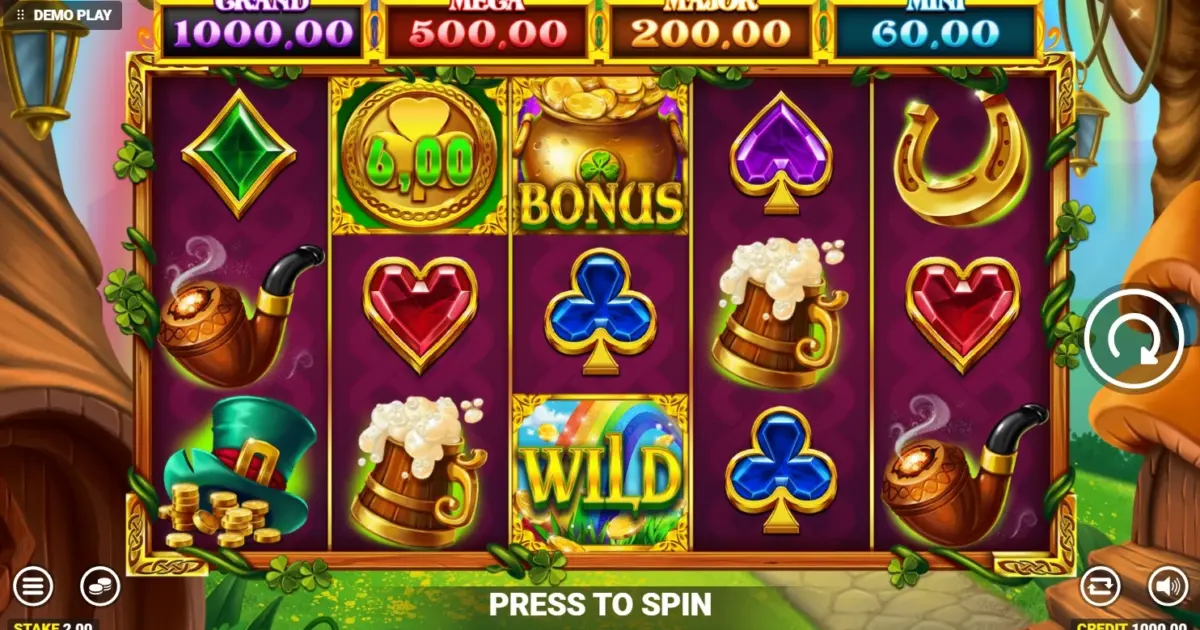
A free demo is available, so you can run this game with virtual credit before committing anything. Use it as a test, not entertainment filler. Fix a stake, run a few hundred spins, and note how often anything returns at all — that gives you a rough read on the volatility Blueprint has not published. Try the interface: stake controls, autoplay limits, how legible the paytable is. Read the in-game paytable carefully, since it is the authoritative source on this game’s features and this review will not guess at them.
Demo play does not predict real-money results, and it cannot pay real money. The virtual balance runs on the same maths but a different sample, and a lucky demo run means nothing about what happens next.
Slots are 18+ paid entertainment, not a way to make money. Set a budget you would spend on a night out and stop when it is gone. Never chase a loss, never stake money earmarked for something else, and if it stops being fun, close the tab. Every spin is independent, so no stake pattern, timing trick or progression system changes the 4.48% house edge.
Should you play Limerick Lightning?
If you want an Irish-themed 5-reel game from a studio with 201 titles behind it, and you like this one when you try the demo, it is a defensible choice. It returns more than the typical Blueprint release and it is popular enough to sit in the top 10% here.
If you are optimising for published return, it is hard to justify. Leprechaun Wish at 97.2% offers the same theme and 1.68 points more RTP. Rome Rise of the Empire offers 96.94% from the same studio. The missing volatility rating and undisclosed max win are further reasons to lean on the demo before deciding.
Verdict: play the demo, compare it against the higher-RTP alternatives above, and only bring real money to it if you prefer this game on its own merits rather than its numbers.
More from Blueprint Gaming
- Rome Rise of the Empire — 96.94% RTP
- King Kong Cash Even Bigger Bananas — 96.0% RTP
- Megaways of Rock — 95.5% RTP
Frequently Asked Questions
Can I play Limerick Lightning for free?
A free demo is available, so you can run the game with virtual credit and no download or deposit. That lets you test the stake controls, read the paytable and get a feel for how often the reels return anything. Bear in mind the demo runs on virtual balance only and cannot pay out real money.
What is the RTP of Limerick Lightning?
The published RTP is 95.52%, meaning a modelled return of £95.52 for every £100 wagered across a very large sample. That is 0.19 percentage points below the 95.71% site-wide average but above Blueprint Gaming's own 95.35% average. It describes long-run maths, not any individual session.
How volatile is Limerick Lightning?
No volatility rating has been published for this title, so treat any figure quoted elsewhere with caution. Low-volatility games pay small amounts often; high-volatility games pay rarely but larger, and need a much bigger bankroll to ride out dry spells. Running a few hundred demo spins is the practical way to gauge which pattern applies.
Who makes Limerick Lightning and what else do they make?
Blueprint Gaming develops it, with 201 games catalogued here at an average RTP of 95.35%. Their range includes Fishin Frenzy Megaways at 96.1%, King Kong Cash Even Bigger Bananas at 96.0% and Rome Rise of the Empire at 96.94% — all published above this title's 95.52%.
Is Leprechaun Wish a better option than Limerick Lightning?
On published return, yes it is: Leprechaun Wish carries a 97.2% RTP against 95.52% here, a gap of 1.68 percentage points on the same Irish theme. On £1,000 of total wagering that is roughly £16.80 of modelled difference. Mechanics and pacing differ though, so compare both demos before choosing.