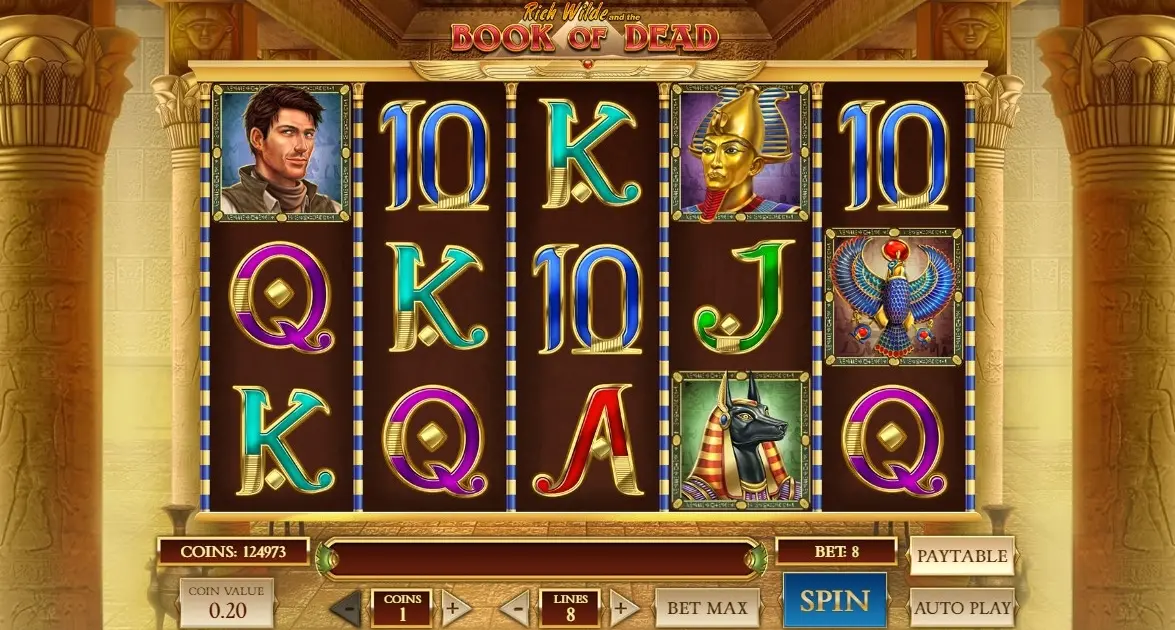
Book of Dead ranks as the 32nd most popular slot across the entire corpus—top 0.2%—yet its 94.25% RTP trails both the slot average and Play’n GO’s own portfolio mean by a material margin. If you’re drawn to the Egypt theme and high-variance play, understand what that RTP figure costs you before you commit your bankroll.
| Specification | Value |
|---|---|
| RTP | 94.25% |
| Volatility | High |
| Paylines | 10 |
| Reels | 5 |
| Stake range | $/£/€0.20–$/£/€50.00 |
| Provider | Play’n GO |
| Popularity rank | 32 (99.8th percentile) |
Book of Dead versus the average slot
The corpus average RTP is 95.71%. Book of Dead returns 94.25%, putting it 1.46 percentage points below the mean. That difference translates to £1.46 per £100 wagered over a sufficiently large sample—tens of thousands of spins. If you play 500 spins at £1 each, the house edge difference between this game and an average slot is roughly 73 pence in expected value. Over a single session that gap may feel invisible; over a month of regular play it compounds.
Play’n GO’s portfolio average is 95.8%, which means Book of Dead also underperforms the studio’s own benchmark by 1.55 points. Among 908 Egypt-themed slots in the corpus, plenty sit closer to 96%. Popularity does not erase the maths: a game can be widely played and still offer below-average long-run return.
RTP breakdown: 94.25% in context
RTP is the percentage of all wagers a slot is programmed to return to players across its lifetime. 94.25% means the game keeps £5.75 of every £100 wagered as the house edge, measured over millions of spins. Your personal session will swing wildly above or below that figure—RTP is a statistical average, not a session guarantee.
To illustrate: wager £1,000 across 1,000 spins at £1 each, and the long-run expectation is a return of £942.50, though actual results will cluster around that figure with substantial variance. Run the same experiment ten thousand times and the average converges on 94.25%. For a single player in a single evening, volatility dominates; for the operator’s ledger across all players, RTP is destiny.
Compare Book of Dead’s 94.25% to Legacy of Dead at 96.58% and you see a 2.33-point spread—£2.33 per £100 in expected value. That makes Legacy of Dead the mathematically superior choice within the same studio’s catalogue, assuming theme and mechanics suit you equally.
Volatility profile
High volatility means longer stretches without wins, punctuated by larger payouts when they land. Your bankroll will swing more violently than it would on a low-variance game with the same RTP. Budget for dry runs: twenty or thirty dead spins in a row sit well within normal distribution for a high-volatility slot.
The ten-payline structure concentrates outcomes. Fewer paylines mean fewer small wins and a higher proportion of zero-return spins. If you prefer frequent small hits that extend your session, high volatility is the wrong fit. If you accept the risk of burning through your stake quickly in exchange for the possibility of a large single payout, this profile matches that preference.
Practical implication: a £50 bankroll at £1 per spin gives you fifty attempts, but high volatility can consume that stake in under ten minutes if the variance runs cold. Size your bets to give yourself at least 100 spins of runway—ideally more—so you see enough of the game’s distribution to experience its designed behaviour rather than exiting on statistical noise.
Play’n GO as a studio
Play’n GO operates a 434-game portfolio with an average RTP of 95.8%. The studio releases slots across the volatility spectrum, from low-variance fruit machines to high-risk feature-heavy titles. Book of Dead sits at the lower end of the studio’s RTP range, which raises the question: why play this when Rich Wilde and the Tome of Madness offers 96.59% with comparable variance?
The studio’s reputation rests on polished execution and wide distribution—Play’n GO slots appear at hundreds of licensed operators. That ubiquity explains part of Book of Dead’s popularity, but it does not justify ignoring the RTP gap when alternatives exist within the same catalogue. Divine Divas returns 96.25%, a full two points higher, and remains a Play’n GO title with the same regulatory standing and availability.
If you hold loyalty to a specific provider, compare within the range rather than defaulting to the most marketed title. The studio’s average RTP tells you that Play’n GO can and does configure games above 96%; Book of Dead simply is not one of them.
Three Egypt alternatives worth comparing
The Egypt category holds 908 slots, and several deliver the same theme with better maths. Book of the Sun returns 96.23%, nearly two full points higher than Book of Dead. Over a £1,000 wagered sample, that difference is worth £19.80 in expected value. The theme and reel structure remain familiar; the RTP does not.
Crazy Mummy offers 96.0% RTP, still 1.75 points better than Book of Dead. If you want Egypt iconography without sacrificing mathematical efficiency, Crazy Mummy closes half the gap to the corpus average while keeping the high-volatility profile intact.
Wild Pharaoh sits at 94.63%, only marginally better than Book of Dead, which demonstrates that low RTP is not unique to this title within the theme. The Egypt category spans the full RTP spectrum, so filtering by return-to-player before you commit is the rational move. Popularity rank does not correlate with RTP—Book of Dead’s 32nd-place finish proves that widespread play and optimal configuration are independent variables.
Getting the most out of the free demo
The free demo uses the same RNG, reel strips, and paytable as the real-money version. It shows you the game’s volatility profile, hit frequency, and bonus triggering cadence without financial risk. Use it to confirm that the variance suits your temperament: if twenty scoreless spins feel intolerable, you have learned that high volatility is not your fit, and you have learned it for free.
Run at least 200 demo spins before forming a judgment. Fifty spins will show you almost nothing about a high-variance game’s true distribution. Track how often you see consecutive losing spins, how your balance moves, and whether the stake range at $/£/€0.20 to $/£/€50.00 aligns with your intended real-money budget. The demo cannot predict your real-money results—every spin is independent, and past outcomes exert zero influence on future ones—but it can surface whether the game’s rhythm matches your expectations.
If you move to real money, set a loss limit before you start and treat the stake as the price of entertainment, not as investment capital. You must be 18 or over, and the house edge guarantees that the average player loses over time. The demo’s job is to let you decide whether that entertainment is worth its cost, measured in both money and session enjoyment, before you pay for it.
Should you play Book of Dead?
Play Book of Dead if you want a specific gameplay experience that exists only in this title and you accept the RTP trade-off as the cost of that exclusivity. Do not play it if you judge slots purely on return-to-player and variance, because Play’n GO’s own catalogue and the broader Egypt category both offer mechanically similar games with two additional percentage points of RTP. That gap is not rounding error.
The game’s 99.8th-percentile popularity ranking reflects marketing reach, operator prominence, and possibly the appeal of its specific feature set—but those factors do not improve the maths. At 94.25%, you are paying 1.46 points below the slot average for the privilege of spinning this particular title. If theme and provider matter more to you than optimising long-run expected value, the demo will show you whether the trade-off feels acceptable. If RTP is your primary filter, start your comparison with Legacy of Dead or Book of the Sun and work outward from there.
Frequently Asked Questions
Can I play Book of Dead slot for free without depositing?
Yes, the free demo is available and uses the same RNG and paytable as the real-money version. It lets you test the high-volatility profile and ten-payline structure across as many spins as you want, with no registration or deposit required. Demo play cannot pay real money, but it shows you whether the game's variance suits your temperament before you risk your bankroll.
What does the 94.25% RTP mean for my session?
RTP is the percentage of all wagers returned to players over millions of spins, so 94.25% means the house keeps £5.75 per £100 wagered in the long run. Your individual session will swing wildly above or below that figure because of variance. Over 500 spins you might see anything from a 40% loss to a 30% gain; over fifty thousand spins your results converge toward the programmed 94.25%.
How does high volatility affect my bankroll?
High volatility produces longer losing streaks and larger but less frequent wins, so your balance swings more violently than on a low-variance slot. Budget for twenty to thirty consecutive dead spins as normal behaviour. To survive the variance and see the game's actual distribution, you need a bankroll that covers at least 100 spins at your chosen stake—preferably more. A £20 bankroll at £1 per spin will not last long enough to experience anything but noise.
How does Book of Dead compare to other Play'n GO slots?
Play'n GO's 434-game portfolio averages 95.8% RTP, which means Book of Dead sits 1.55 points below the studio's own mean. Legacy of Dead returns 96.58%, Rich Wilde and the Tome of Madness offers 96.59%, and Divine Divas pays 96.25%—all from the same provider, all with comparable or better maths. If you favour Play'n GO's execution, compare within the catalogue rather than defaulting to the most visible title.
Is Book of Dead better than other Egypt-themed slots?
Among 908 Egypt slots, Book of Dead's 94.25% RTP ranks below average. Book of the Sun returns 96.23%, Crazy Mummy pays 96.0%, and both deliver nearly two additional percentage points of long-run value with the same theme. Book of Dead's 32nd popularity rank shows it is widely played, but popularity does not correlate with RTP. Filter by return-to-player first, then compare features and volatility among the titles that meet your mathematical threshold.