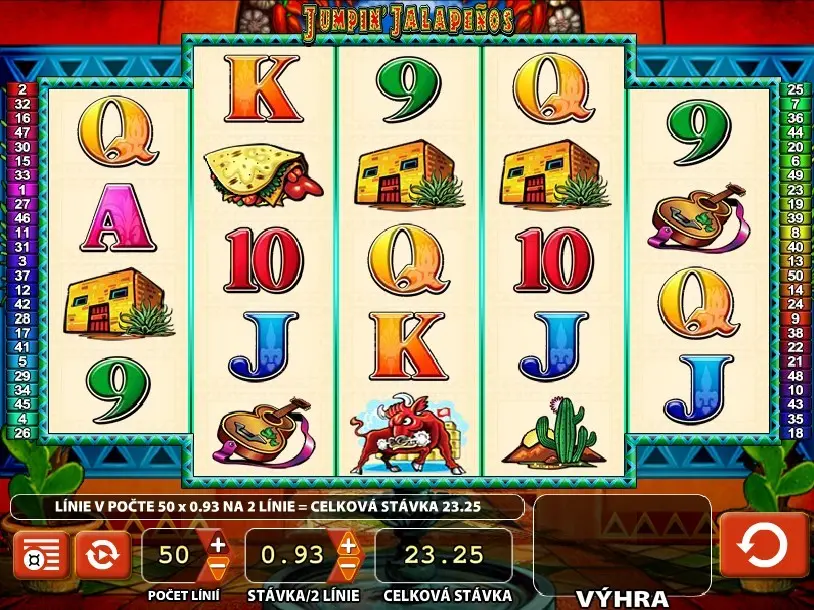
The one number worth knowing before you load this game is 96.03%. That is the published return-to-player figure for the jumpin jalapenos slot, and it sits marginally above both the WMS catalogue average of 96.01% and the 95.71% average across the games in this database. A free demo is available, which means you can test the feel of it without committing money.
What follows is what the published data supports and nothing more. WMS has not released volatility, hit frequency, max win, bonus mechanics or stake range for this title in the data available here, and rather than guess at those, this review tells you what each gap means for your decision.
Who makes Jumpin Jalapenos
WMS is the studio behind this game. Fifty-five WMS titles appear in this catalogue, which makes it a mid-sized presence rather than a two-game curiosity or a thousand-title content farm. That matters for one practical reason: a studio with a real back catalogue tends to reuse maths models across releases, so the average RTP across those 55 games is a meaningful reference point rather than a statistical accident.
That WMS average is 96.01%. Jumpin Jalapenos lands at 96.03%, effectively identical. The studio is not treating this title as a loss leader with a stripped-back return, nor is it a flagship with an unusually generous configuration. It is a standard-issue WMS return.
WMS as a brand originated in land-based cabinet manufacturing before its games appeared online, and many WMS slots you find in online lobbies are conversions of machines that ran on casino floors first. That heritage is worth knowing because cabinet-era games often carry design conventions from that era. What those conventions are in this specific game is not something the data here establishes, so treat any description you read elsewhere of its symbols, sounds or bonus structure as unverified unless it cites the provider.
| Provider | WMS |
|---|---|
| RTP | 96.03% |
| Reels | 5 |
| Free demo | Yes |
Where Jumpin Jalapenos sits in the WMS catalogue
Against its siblings, this game is squarely mid-pack on return. Spartacus Call to Arms is published at 96.05%, fractionally higher, and if you are picking purely on the RTP line then that is the marginally better number of the two. The difference is 0.02 percentage points, which is two pence per £100 wagered across an enormous sample. It is not a reason to switch games on its own.
Below it, Invaders from the Planet Moolah comes in at 96.00% and Zeus at 95.97%. Both are within a rounding error of the studio average. What this cluster tells you is that WMS runs a tight band on return across its online catalogue: pick almost any of these four and the long-run maths is close to indistinguishable.
Which means your choice between them should come down to things the RTP figure cannot capture — how the game plays, how often it pays, how big the swings are. Those are volatility and hit-frequency questions, and for Jumpin Jalapenos specifically, neither figure is published in the data here. The demo is the only reliable way to get a feel for them.
RTP: 96.03% against a 96.01% house average
RTP is a long-run statistical average, not a promise about your session. 96.03% means the game is modelled to return £96.03 for every £100 wagered across a very large number of spins — millions, not thousands. The house edge is the remaining 3.97%.
Scale that to a realistic session. Wager £1 per spin for 500 spins and you have staked £500. The expected return on that stake is £480.15, an expected loss of £19.85. But expected value is the centre of a wide distribution, not a forecast. Over 500 spins you might be up £200 or down £350; both outcomes are entirely consistent with a 96.03% game. The average only asserts itself over sample sizes far larger than any individual player produces.
Every spin is independent. The result of one spin has no influence on the next, and the game has no memory of what it has paid out. A game that has paid nothing for 200 spins is not more likely to pay on spin 201.
Against the 95.71% corpus average, this title returns 0.32 percentage points more. That is £3.20 extra per £1,000 wagered over the long run — real, but small enough that it should not be the deciding factor if you prefer how another game plays.
Volatility and who it suits
WMS has not published a volatility rating for this game in the data available here, so anyone telling you it is low, medium or high is guessing. What can be said usefully is what each profile does to a session, so you can identify which one you are experiencing when you play the demo.
Low-volatility games pay small amounts frequently. Balances drift rather than lurch, sessions last longer on the same bankroll, and the ceiling on any single spin is modest. High-volatility games invert that: long stretches with little return, punctuated by occasional larger payouts, and a bankroll requirement several times larger to survive the dry spells. Medium sits between the two.
Two games with identical 96% RTP can feel completely different depending on where they land on that scale. The RTP tells you the long-run return; volatility tells you how bumpy the road to it is.
Practical guidance in the absence of a published figure: play the demo for a couple of hundred spins and watch the shape of your balance line. Frequent small returns with a slow decline suggests lower variance. Long flat stretches broken by spikes suggests higher variance. Size your real-money stakes accordingly — the higher the variance, the smaller each bet should be relative to your total budget.
Playing Jumpin Jalapenos for free
A Jumpin Jalapenos free demo is available, which is the sensible first step. The demo runs the same maths as the real-money version, so the RTP configuration and reel behaviour are identical. What changes is that the credits have no cash value.
Use the demo to answer the questions the published data cannot. How often does something land? How long does a losing run tend to go on? Does the pace suit you? A few hundred spins is enough to form a view on feel, though not nearly enough to observe the RTP converging — that requires sample sizes no human session reaches.
One thing the demo cannot do is predict what happens with real money. Results in demo mode carry no information about your future real-money outcomes, because every spin in both modes is an independent random event. A good demo run is not a signal.
If you do move to real stakes: this is 18+ entertainment. Decide the amount you are willing to spend before you start, treat it as the price of the session rather than an investment, and stop when it is gone. Money spent on a slot is money spent, in the same way a cinema ticket is.
Similar picks
The theme data here lists this game only under 5-Reels, and the theme category contains no other titles in this catalogue, so there is no genuine same-theme comparison set to offer. That is a data gap rather than a statement about the game.
What remains useful is the provider comparison. If you want a marginally higher published return from the same studio, Spartacus Call to Arms at 96.05% is the pick. If you want a different flavour of WMS maths at effectively the same return, Invaders from the Planet Moolah at 96.00% and Zeus at 95.97% are both within a fifth of a percentage point.
Because all four sit in such a narrow RTP band, the honest advice is to choose on how they play rather than on the decimal. Load two demos side by side and pick the one you would rather spend an hour with.
Verdict
A 96.03% return puts this game slightly above both its studio average and the wider catalogue average. That is a competent, unremarkable number — better than the 95.71% corpus figure, and the kind of return that will not work against you relative to typical alternatives.
Its ranking of 1,589 places it in roughly the 92nd percentile for popularity here, so plenty of people are finding it. What holds this review back from a firmer recommendation is the missing data: no published volatility, no hit frequency, no max win, no stake range. Those absences make it hard to say who this game is right for without playing it.
So the sensible path is the free version first. The maths is sound and the RTP is a touch above average. Whether the way it plays suits your bankroll and patience is something only the demo will tell you.
Frequently Asked Questions
Can I play Jumpin Jalapenos for free?
A free demo of Jumpin Jalapenos is available, and it runs the same 96.03% RTP configuration as the real-money version. The only difference is that credits carry no cash value. Use it to gauge pace and swing size, since WMS has not published a volatility rating for this title.
What is the RTP of Jumpin Jalapenos?
The published RTP is 96.03%, meaning the game is modelled to return £96.03 per £100 wagered across a very large sample of spins. The house edge is 3.97%. That figure sits just above the WMS catalogue average of 96.01% and the 95.71% average across all games listed here.
Is Jumpin Jalapenos high or low volatility?
WMS has not published a volatility rating for this game, so any figure quoted elsewhere is unverified. Low-variance games pay small amounts often and stretch a bankroll further; high-variance games run dry then spike, and need a larger budget. Play a few hundred demo spins and watch your balance line to judge which it resembles.
Who is WMS and what else do they make?
WMS is the studio behind this 5-reel game, with 55 titles in this catalogue and an average published RTP of 96.01%. Their other games here include Spartacus Call to Arms at 96.05%, Invaders from the Planet Moolah at 96.00% and Zeus at 95.97% — a notably tight band on return.
How does Jumpin Jalapenos compare to Zeus?
On published return, Jumpin Jalapenos edges it: 96.03% against 95.97% for Zeus, a gap of six pence per £100 wagered over the long run. That is small enough to be irrelevant to most sessions. Neither game has a published volatility rating here, so compare them by playing both demos rather than by the decimal.